
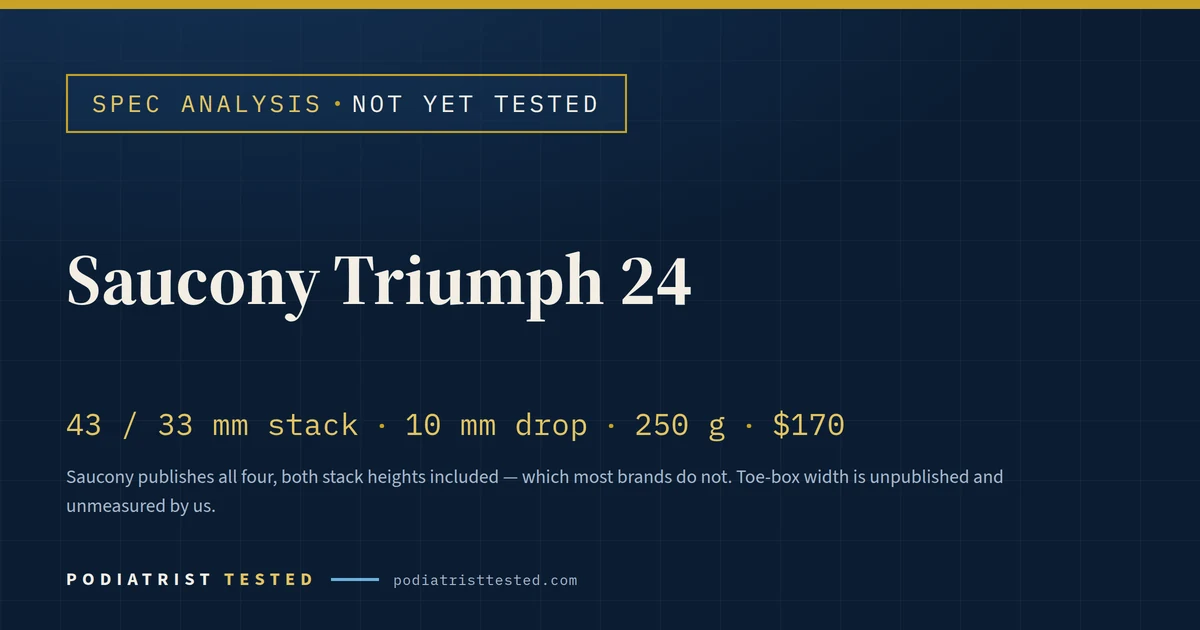
Saucony Triumph 24: A Podiatrist’s Specification Analysis
We earn a commission if you buy through links on this page, including Amazon links paid by brand partners through Levanta, at no cost to you. As an Amazon Associate I earn from qualifying purchases. How we make money
Spec analysis — not yet tested
Nothing on this page has been measured by us. We have not bought, weighed, cut or worn the Triumph 24. Every figure in the table below is Saucony’s own published number, labelled as such in the Source column; the laboratory figures in the text are RunRepeat’s. There is no score, no Orthotic Volume Rating and no Podiatrist Tested Seal here, and there will not be one until the shoe is on the bench. When it is tested, this page is replaced by the full review.
Saucony publishes more about the Triumph 24 than most brands publish about anything: not just the drop, but both stack heights that make it up. That is unusual and it is worth saying out loud, because it means a reader can do more real thinking about this shoe before buying it than they can about most of its competitors.
The Triumph is Saucony’s flagship neutral cushioned trainer, and the 24 replaces the midsole foam — PWRRUN+ gives way to a new foam Saucony calls incrediLUX. As with any foam change, nothing that was true about the 23 underfoot can be assumed to carry over.

On this page
What Saucony says the Triumph 24 is
Saucony positions the Triumph 24 as its premium high-mileage cushioned trainer — “more cushion, more miles” — in the neutral category, with no stability or motion-control structure. The company’s case for the 24 rests on incrediLUX, which it describes as lighter and more cushioned than the foam it replaces. Unlike most brands, Saucony publishes the full stack: 43 mm at the heel, 33 mm at the forefoot.
| Specification | Figure | Source |
|---|---|---|
| Model year / version | Triumph 24 | Saucony (published) |
| MSRP | $170.00 | Saucony (published) |
| Heel stack height | 43 mm | Saucony (published) |
| Forefoot stack height | 33 mm | Saucony (published) |
| Heel-to-toe offset | 10 mm | Saucony (published) |
| Weight | 8.8 oz (250 g), manufacturer sample | Saucony (published) |
| Midsole foam | incrediLUX (new for the 24) | Saucony (published) |
| Category | Neutral — no stability structure | Saucony (published) |
| Widths | Regular and Wide; a separate GTX waterproof version exists | Saucony (published) |
| Upper | Breathable comfort mesh | Saucony (published) |
| Toe-box width | Not published by Saucony | — |
| Removable insole | Not stated by Saucony | — |
| Torsional rigidity | Requires measurement | Podiatrist Tested — pending |
| Heel-counter stiffness | Requires measurement | Podiatrist Tested — pending |
| Orthotic Volume Rating | Requires measurement | Podiatrist Tested — pending |
Where a row reads “requires measurement”, our own figure comes off our bench or it does not appear. We do not reprint other reviewers’ measurements as though they were ours, and we do not estimate.
What the spec sheet suggests — and what only a test can answer
43 mm of heel stack with a 10 mm offset is a specific combination, and it is the most informative thing here. A 10 mm offset is on the higher side of the current market, which has drifted towards 4 to 6 mm. Higher offset takes tension off the Achilles and calf complex through late stance and puts marginally more demand on the forefoot. For a patient being managed for insertional Achilles tendinopathy or a mid-portion Achilles problem, a higher-offset shoe is often what a clinician is reaching for — and this is one of the few in its class that still is. The trade runs the other way for forefoot problems.
43 mm at the heel is a lot of foam, and height has a cost that cushioning conversations usually skip. The further the foot sits from the ground, the longer the lever acting on the ankle when the foot lands off-centre. For a patient with a history of lateral ankle sprains, chronic instability, or a proprioceptive deficit from neuropathy, a very tall shoe is not automatically the safe choice just because it is soft. Whether that matters in this particular shoe depends on how wide the base is and how the midsole is shaped at the heel — Saucony publishes neither, and we measure both. An independent lab has measured the base at 101.6 mm across the heel and 126.5 mm across the forefoot, the sixth- and second-widest of the 35 shoes we review that it has measured.
The new foam is the open question. Saucony’s claim for incrediLUX is that it is lighter and more cushioned than PWRRUN+. That is a claim about a material, and materials behave differently at 0, 100 and 300 miles. It is not testable by reading a spec sheet.
What Saucony does not tell you: how much orthotic fits inside it, how stiff the heel counter is, how much the shoe twists, how wide the toe box actually measures, and how the platform is shaped underfoot. Those are five of the most clinically useful facts about any shoe, and an independent lab has since measured three of them.
RunRepeat’s lab, whose review was published after this page was written (read 28 September 2026), graded the heel counter 4 out of 5 and measured the toe box at 71.4 mm at the big toe, below the 72.8 mm median of the 34 shoes we review that it has measured there. The shoe twisted more easily than all but three of the 24 shoes we review that the lab has twisted: 12.0 Nm, against a median of 14.5. The same pair measured 41.6 mm at the heel and 33.6 mm at the forefoot, an 8.0 mm drop rather than Saucony’s 10, and weighed 258 g. The new foam read 37.5 Asker C, a little firmer than the median of the 33 shoes the lab has measured this way, and returned 72.0% of the energy at the heel, the most of the 35 shoes we review that it has measured, while matching the New Balance Fresh Foam X More v6 for the most heel shock absorption, 152 SA.
On the published figures, worth a look if…
- You want a higher-offset cushioned trainer — 10 mm is increasingly hard to find.
- You are being managed for an Achilles problem and have been advised towards more heel-to-toe drop, not less.
- You want maximum cushioning for high mileage and are not chasing ground feel.
- Regular or Wide covers your foot.
Wait for the test if…
- You have chronic ankle instability or a proprioceptive deficit, where a 43 mm platform is a real consideration.
- You wear an orthotic and need to know the shoe has the volume for it — unmeasured here.
- Your problem is forefoot pain, where a higher offset loads the area you are trying to unload.
- You need more than a Wide, or you need a stability shoe. This is neutral by design and Saucony says so plainly.
What changed from the Triumph 23
The midsole foam. The 23 used PWRRUN+; the 24 uses incrediLUX, which Saucony describes as lighter and more cushioned. Saucony has not published a side-by-side of the two generations’ stack heights or offsets, so we cannot tell you whether the geometry moved with the foam — and geometry is what determines how a shoe loads a painful foot. If the 23 worked for you, treat the 24 as a new shoe and refit it rather than reordering blind.
Where to buy
Disclosure: the links below are paid links. If you buy through them, Podiatrist Tested earns a commission from Amazon at no extra cost to you. We have not been paid to write about this shoe, we were not given it, and a commission has never decided what appears on this site. We do not take money from footwear brands, and we never will.
Amazon listings are colourway-specific. The links below point at one common colourway of each — Fossil/Gunmetal for men, Spa/Silver for women. For the Wide version or the GTX, use the selectors on the product page rather than assuming one listing carries every option.
Price checked 9 September 2026. Saucony’s published MSRP is $170.00; Amazon pricing moves independently of that and by size and colour.
Questions people ask about the Triumph 24
Is the Saucony Triumph 24 good for plantar fasciitis?
We have not tested it, so we will not tell you it is. What we can say is that the 10 mm offset is the one published figure that points in a helpful direction — a higher drop takes some tension off the plantar fascia and Achilles complex compared with the 4 to 6 mm shoes that now dominate this category. That is one factor among four that matter, and the other three — heel-counter stiffness, midfoot support and orthotic capacity — we have not measured; an independent lab graded the heel counter 4 out of 5 and found the shoe twists more easily than all but three of the 24 shoes we review that it has twisted. A high heel stack alone is not treatment.
What is the difference between the Triumph 24 and the Triumph 23?
The midsole foam. PWRRUN+ has been replaced by incrediLUX, which Saucony describes as lighter and more cushioned. Saucony has not published a comparison of the two generations’ stack heights or offsets, so whether the shoe’s shape changed alongside the material is not something we can confirm from published data.
How tall is the Triumph 24?
Saucony publishes 43 mm at the heel and 33 mm at the forefoot, a 10 mm offset. That is genuinely useful and genuinely uncommon — most brands publish the offset and leave the stack heights out, which tells you the difference between the two ends of the shoe but not how far off the ground you are standing. Saucony publishing both is a point in its favour as a company, separate from whether the shoe is any good.
Does the Triumph 24 come in wide?
Yes — Saucony lists a Regular and a Wide, plus a separate GTX waterproof version. There is no extra-wide. If you need more than a Wide, this is not your shoe and no amount of cushioning changes that. A width code also describes one measurement across the forefoot, not the volume above your toes, which is what accommodates a bunion or a hammertoe.
What happens next
This page exists so there is an honest, clearly-labelled entry for the Triumph 24 rather than a guess dressed up as a review. When the shoe is bought and goes on the bench it gets weighed, cut where necessary, measured with calipers for stack height, offset, toe-box width and depth, scored for torsional rigidity and heel-counter stiffness, and given an Orthotic Volume Rating — and Saucony’s published stack figures get checked against ours. Only then does it carry a score, and only after logged wear-testing can it be considered for the Podiatrist Tested Seal.
Page type: spec analysis · Acquisition: not yet purchased · Last verified: 9 September 2026 · By Dr. Thomas Biernacki, DPM, board-certified foot and ankle surgeon, NPI 1821330051.
Where this shoe fits
Guides on this site that weigh the Saucony Triumph 24 against the problem you are actually trying to solve:
- Best Saucony shoes for plantar fasciitis — where the Saucony line sits for heel pain.
- Saucony Triumph vs Guide — neutral cushion against light stability, in one comparison.
- Best shoes for standing all day — what changes when you stand still rather than walk.
- Best shoes for Achilles tendonitis — why the drop figure matters more here than anywhere else.
Browse every shoe on file or read how we test.
Compare it with the rest: every Saucony review · everything for running · the wide fittings. Every list shows the published drop, stack, weight, widths and price side by side.
This page is a spec analysis, not a test report: the figures are the manufacturer’s or a named third party’s, each printed beside its source, and nothing here carries a score or the Seal until the shoe has been worn and measured on our bench. Quote any figure you like — keep the source attached to it, and link the page rather than the number. How to cite or link to an analysis.