
Best Shoes for Plantar Fasciitis: A Foot Surgeon’s Guide (2026)
A foot & ankle surgeon on the 4 shoe features that cut plantar fascia load, plus a 30-second in-store test. Work, running, home and dress picks.
Written and medically reviewed by Dr. Tom Biernacki, DPM, FACFAS · Last reviewed 29 September 2026
We earn a commission if you buy through links on this page, including Amazon links paid by brand partners through Levanta, at no cost to you. As an Amazon Associate I earn from qualifying purchases. How we make money
On this page
- The short answer
- Why shoes change heel pain at all
- The four features that actually matter
- The drop printed on the box is often wrong
- The 30-second test to run in the store
- What to wear, by situation
- The shoes on this site, ranked by heel drop
- What to stop wearing
- Shoes are one part of the treatment, not all of it
- What if it isn’t plantar fasciitis?
- What the research actually supports — and where it stops
- If you are going to try an insole
- Frequently asked questions
- What we are testing next
- Related guides & shoe pages
Testing status: the shoes named on this page have not yet been through our full measurement protocol. This guide covers the clinical criteria that decide whether a shoe helps or hurts plantar fasciitis, and names the categories and models that meet those criteria. Measured weights, stack heights, toe-box dimensions and Orthotic Volume Ratings will be added to each model as it is tested. We label what we know and what we do not — see How We Test.
The short answer
Model versions: the Brooks Ghost 17 named on this page has since been superseded by the Brooks Ghost 18. Nothing here has been swapped to the newer version — this page describes the model it was built on, and the newer one has its own review.
We use heel cushioning, heel-counter structure, midfoot stiffness and forefoot rocker as features to consider when shortlisting shoes. They are not a validated pass/fail test and do not guarantee relief. The 2021 best-practice guide emphasizes individualized footwear advice, including comfort and support, alongside other care. Fit, activity, symptoms and your response to the shoe matter more than a brand name or any single specification.
Where to start
Five places to start, picked from the comparison further down this page. None has been through our bench yet, so there are no scores here, only the reasons the full guide gives.
- On your feet all day: KURU ATOM 2The highest stated heel drop in our table, 10 mm, and built for standing.Women’s — check price at KURU Men’s — check price at KURU
- Stability, including 4E widths: ASICS GT-2000 15The lightest shoe in our table, with an 8 mm stated drop.Women’s — check price Men’s — check price
- The most cushion: ASICS Gel-Nimbus 28Maximum cushion that still keeps an 8 mm stated drop.Women’s — check price Men’s — check price
- Around the house: OOFOS OOahh slideFor the barefoot hours at home, which undo much of what good shoes do. One listing, men’s and women’s sizes.Check price — choose your size
- Inside the shoes you already own: PowerStep Pinnacle insoleThe insole we reach for most often: a firm shell under the arch and a deep heel cup. Pick your size on the listing.Check price — choose your size
Paid links: we earn a commission at no extra cost to you, and it never changes what is listed. Drop, weight and price for every shoe are in the full table.

Why shoes change heel pain at all
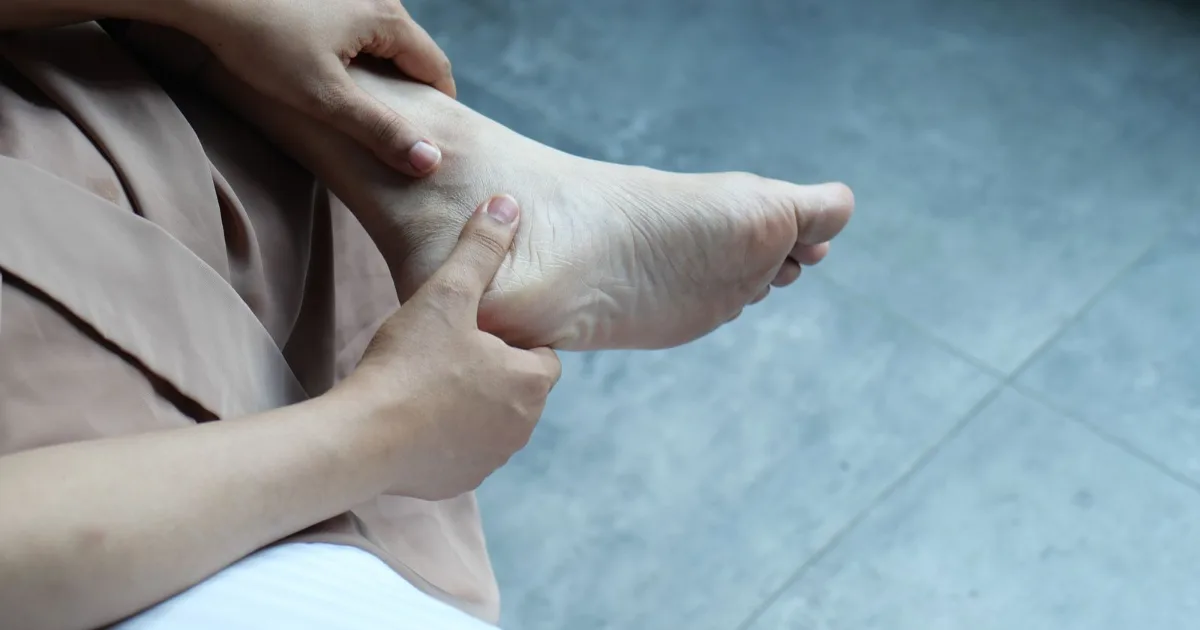
The plantar fascia is a thick band of connective tissue running from the bottom of your heel bone to the base of your toes. It works like a bowstring holding up the arch. Every time your arch flattens under load, the fascia is pulled tight at its attachment on the heel. Plantar fasciitis is what happens when that attachment is loaded past what it can repair between sessions of loading — which is why it hurts most on the first steps in the morning, after the tissue has been sitting shortened overnight.
A shoe cannot heal that tissue. What a shoe can do is reduce how much tension the fascia takes on every step, and how hard the heel is struck. That is the entire mechanism, and it is why the four features below matter and most marketing language does not.
The four features that actually matter
1. A cushioned heel with real stack under it
Heel pain is worst at heel strike. More midsole material under the heel spreads that impact over a longer time, which lowers the peak force reaching the fascial attachment. This is the single feature most people get right by accident when they buy a max-cushion shoe, and the reason those shoes get recommended so often.
A modest heel-to-toe drop helps for the same reason a heel lift helps: raising the heel relative to the forefoot slightly slackens the calf and Achilles, and a tight calf is one of the strongest drivers of plantar fascia load. This is why a zero-drop or minimalist shoe is usually the wrong choice during an active flare, even if it is a good shoe.
2. A firm heel counter
The heel counter is the cup at the back of the shoe that wraps your heel bone. If it is soft, the heel rolls inward as you load it, the arch collapses further, and the fascia stretches more. Squeeze the back of the shoe between your thumb and forefinger. It should resist you. If it folds flat, the shoe is not doing this job, and no insole you add will fix it.
3. Torsional rigidity through the midfoot
Hold the shoe at the heel and the toe and twist it in opposite directions. A shoe that wrings out like a wet towel lets your arch drop and rotate freely, which loads the fascia. A shoe that resists that twist supports the arch structurally, before any insole is involved. This one check eliminates most inexpensive flexible sneakers and nearly all flat fashion shoes.
4. A forefoot rocker
At the end of every step your big toe extends, which pulls the fascia tight across the ball of the foot — the windlass mechanism. A shoe with an upturned, rounded forefoot rolls you over that point instead of making the joint do the work, so the fascia is pulled less on every push-off. Rockered soles are the most underrated feature on this list and the reason so many patients do well in thick-soled walking shoes they expected to dislike.

The drop printed on the box is often wrong
Heel-to-toe drop is one feature to compare, not a proven ranking of shoes for plantar fasciitis. The 2021 best-practice guide includes some rearfoot-to-forefoot drop within broader advice about supportive, comfortable footwear. It does not identify a single ideal drop or show that more is always better.
Which makes the next part a problem. Independent labs cut shoes in half and measure stack heights directly. When those measurements are compared against what the manufacturer prints, the numbers often do not match — and the gap is not always small.
| Shoe | Stated drop | Lab-measured drop | Difference |
|---|---|---|---|
| HOKA Transport 2 | 5 mm | 11.2 mm | +6.2 mm |
| HOKA Bondi 9 | 5 mm | 9.1 mm | +4.1 mm |
| Brooks Ghost 17 | 10 mm | 10.4 mm | +0.4 mm |
Lab figures: RunRepeat. Stated figures: the manufacturers. None of these were measured by us — see how we test.
Read the first row again. Someone with heel pain who has been told to look for a higher drop puts the HOKA Transport 2 back on the shelf, because the box says 5 mm. The shoe an independent lab measured is an 11 mm-drop shoe. On this specification, the label is off by more than the whole distance between a “low-drop” and a “high-drop” shoe.
The Bondi 9 has the same problem in the same direction — sold as 5 mm, measured at 9.1 mm. And then there is the Brooks Ghost 17, where every published figure lands within half a millimetre of the lab measurement. That is what an honest spec sheet looks like, and Brooks deserves to be named for it as plainly as HOKA deserves to be named for the other thing.
What this means for you. Do not rule a shoe in or out on a printed drop figure alone, in either direction. Where an independent measurement exists we cite it on the shoe’s page. Where one does not, the manufacturer’s number is all any of us have — including me — and it should be read as a claim rather than a measurement.
The 30-second test to run in the store
You do not need our measurements to screen a shoe. These are the same three physical checks we run on every pair before it goes into testing, and you can do all three at a shoe wall in half a minute.
- The twist. Grip heel and toe, twist opposite ways. It should resist. If it twists easily, put it back.
- The heel squeeze. Pinch the heel counter. It should push back, not collapse.
- The bend. Bend the shoe. It should hinge at the ball of the foot, where your toes actually bend — not fold in half through the arch.
A shoe that passes all three is a reasonable candidate whatever the name on it. A shoe that fails any of them is not, regardless of the price or who endorsed it.
What to wear, by situation
Most people do not need one shoe. They need three: something for the hours they are on their feet, something for exercise, and something for the house — because the barefoot hours at home undo a great deal of what the good shoes accomplish.
| Situation | What the shoe has to do | Models that meet the criteria | Status |
|---|---|---|---|
| Walking & standing all day | Maximum heel cushioning, pronounced rocker, firm counter, wide sizes available | Hoka Bondi 9, Hoka Gaviota, Brooks Glycerin, New Balance Fresh Foam 1080 | Not yet tested |
| Running | Cushioning plus stability if you overpronate; enough drop to unload the calf | Brooks Adrenaline GTS, ASICS Gel-Kayano (stability); Brooks Ghost, ASICS Gel-Nimbus (neutral) | Not yet tested |
| Around the house | Contoured footbed and a real heel cup — the single most neglected category | Oofos OOahh / OOriginal, Vionic house slippers, Birkenstock Arizona (cork footbed) | Not yet tested |
| Work & dress | Rigid shank, structured heel, removable insole so an orthotic fits | Vionic dress lines, Ecco, Cole Haan with orthotic-friendly last, Kuru | Not yet tested |
| Slip-resistant / nursing | All of the above plus an oil-and-water-rated outsole and easy cleaning | Hoka Bondi SR, Brooks Ghost, Kuru work lines | Not yet tested |
Walking and standing all day
This is where most heel pain is actually generated — nurses, teachers, retail and hospitality staff, anyone on a hard floor for a shift. The priority here is heel stack and rocker, in that order. Hoka built its reputation on exactly this combination, which is why the Bondi appears on nearly every podiatry list including ours. HOKA publishes the men’s Bondi 9 at 10.5 oz with a 5 mm drop and a 43 mm heel stack. An independent lab that cut the shoe open measured the drop at 9.1 mm and the forefoot stack nearly 6 mm below the published figure — a discrepancy that matters here more than almost anywhere else, and one we explain in full below.
Two cautions. First, a very thick sole raises you further off the ground, and if you have unstable ankles that trade-off is real — a wider platform helps, but be honest about your own balance. Second, max-cushion shoes lose their cushioning long before the tread wears out. If you are on your feet full time, plan on replacing them every six to eight months, not when they look worn.
Running
The choice here comes down to whether your arch collapses inward under load. If it does, a stability shoe — Brooks Adrenaline GTS, ASICS Gel-Kayano — resists that motion and takes tension off the fascia. If your foot is already rigid and high-arched, adding stability will make you more uncomfortable, not less, and a cushioned neutral shoe like the Brooks Ghost or ASICS Gel-Nimbus is the better answer.
The honest advice about running with plantar fasciitis is that footwear is a smaller lever than volume. If you have pain that is worsening week over week, changing shoes while keeping mileage the same rarely works. Reduce load first, then optimise the shoe.
Around the house
This is the section most guides skip and the one that changes outcomes fastest. If you wear supportive shoes for nine hours and then spend four hours barefoot on kitchen tile, you have spent a third of your standing time doing the exact thing that irritates the tissue. Patients who improve quickly are usually the ones who stopped going barefoot indoors.
You do not need a shoe for this — you need a contoured footbed with a heel cup. Recovery sandals such as Oofos, a cork-footbed sandal like the Birkenstock Arizona, or a structured house slipper all work. What does not work is a flat backless slide, which requires your toes to grip to keep it on and loads the fascia with every step.
Work and dress shoes
The constraint here is volume. A dress shoe that looks correct usually has a shallow interior, and the moment you add an orthotic or a supportive insole your foot is pushed up and out of the shoe. The thing to check before you buy is whether the factory insole lifts out. If it does, you can replace that volume with support. If it is glued down, the shoe is a poor candidate no matter how good it feels empty.
This question — will a real orthotic actually fit inside this shoe — is the one we get asked daily in clinic and the one nobody publishes an answer to. It is why every review on this site carries an Orthotic Volume Rating.
The shoes on this site, ranked by heel drop
These are the models we have published spec pages for, sorted by stated heel drop for comparison, not by proven effectiveness for plantar fasciitis. Weights are the manufacturers’ published men’s figures; the measurement size is not always stated. Every model below is currently a specification analysis and has not been through our bench protocol.
| Shoe | Stated drop | Stated weight | MSRP | Check price |
|---|---|---|---|---|
| KURU ATOM 2 Highest drop here; built for standing | 10 mm | 371 g | $169 | Men’s Women’s at KURU |
| ASICS GT-2000 15 Lightest here; stability, 4E available | 8 mm | 252 g | $150 | Men’s Women’s |
| HOKA Arahi 8 Stability plus a rocker at push-off | 8 mm | 278 g | $150 | Men’s Women’s |
| ASICS GEL-NIMBUS 28 Max cushion that keeps an 8 mm drop | 8 mm | 281 g | $170 | Men’s Women’s |
| New Balance 860v15 Most supportive; heaviest running shoe here | 8 mm | 331 g | $149.99 | Men’s Women’s |
| HOKA Gaviota 6 Max support, but a lower heel | 6 mm | 291 g | $180 | Men’s Women’s |
| New Balance 880v15 Neutral, four widths, soft low heel | 6 mm | 299 g | $149.99 | Men’s Women’s |
| Saucony Guide 19 Good sidewall stability, lower drop | 6 mm | Not published | $150 | Men’s Women’s |
Amazon affiliate links — we earn a commission at no extra cost to you. Commission rates differ between products, and we do not rank by commission rate. The three shoes at the bottom of this table are the ones this page recommends against for heel pain specifically, and two of them pay us more than the shoe at the top. How we stay independent →
Compared head-to-head: New Balance 860v15 vs 880v15 — New Balance’s stability trainer against its neutral one — same brand, same size run, different job, and the measured figures side by side.
Compared head-to-head: HOKA Arahi 8 vs Saucony Guide 19 — two stability shoes that get there by opposite means — a firmer medial foam wrap on one, sidewalls and no medial post at all on the other.
Reading this table. Higher drop is generally the more comfortable starting point for an acutely painful plantar fascia. The bottom three are good shoes — they are simply asking your fascia to work harder than the ones above them, and if heel pain is your main complaint that is a reason to start higher up the table.
What to stop wearing
- Flat, flexible flats and canvas sneakers. No heel cushioning, no counter, no torsional rigidity. They fail all three in-store checks.
- Backless slides and flip-flops for all-day wear. Your toes have to grip to hold them on, which loads the fascia continuously.
- Shoes past their service life. Midsole foam compresses long before the outsole looks worn. Old shoes are a common and invisible cause of a relapse.
- Zero-drop and minimalist shoes during a flare. They increase the demand on the calf and Achilles at the exact moment you want less of it. They are not bad shoes; the timing is wrong.
- Going barefoot on hard floors at home. Not a shoe, but the most common single reason a well-shod patient is not improving.
Shoes are one part of the treatment, not all of it
Footwear reduces the load. It does not address why the tissue became sensitive, and on its own it is rarely enough. The measures with the strongest support are unglamorous: calf and plantar fascia stretching done consistently rather than occasionally, temporarily reducing the activity that provokes it, and arch support in the form of an over-the-counter insole or a custom orthosis. Most cases settle with conservative care given enough time, though that time is often measured in months rather than weeks — which is a genuinely frustrating thing to be told and worth knowing in advance.
See a foot and ankle specialist if the pain is not improving after several weeks of consistent conservative treatment, if it is severe enough to change how you walk, if it followed a specific injury, or if you have numbness, tingling or swelling — those point to other diagnoses that get treated differently.
Getting it looked at. Heel pain has several causes and they are not all plantar fasciitis — a nerve entrapment, a stress fracture and a fat-pad problem all hurt in roughly the same place and none of them respond to the same shoe. If it has not settled in six weeks, get it examined. In Michigan, Dr. Biernacki practises at Balance Foot & Ankle; anywhere else, see a podiatrist (DPM). This page is footwear guidance, not a diagnosis.
What if it isn’t plantar fasciitis?
Plantar fasciitis has a pattern. The first few steps out of bed are the worst of the day, it eases after five or ten minutes of walking, it comes back after you have been sitting, and the sore spot is small and specific — the inside front edge of the heel bone, where the fascia attaches. If your pain does not do that, the shoe is not the first thing to change.
Below are the conditions that most often arrive wearing a plantar fasciitis label. Two of them get worse in the shoe this page recommends, which is why it is worth ruling them out before you spend money.
| If it is actually… | The sign that separates it | What that changes about the shoe |
|---|---|---|
| A calcaneal stress fracture | Squeezing the back of the heel from both sides at once reproduces the pain. It builds the longer you are on your feet rather than being worst first thing, and it usually follows a jump in mileage, a new job on your feet, or a change of surface. | No shoe treats a stress fracture, and cushioning is actively unhelpful here because it lets you keep loading a bone that needs to stop being loaded. Imaging first. What to wear while one heals → |
| A nerve entrapment Baxter’s nerve, or tarsal tunnel | Burning, tingling or numbness rather than a sharp local ache, sometimes spreading into the arch or the toes, and often present at rest or in bed. A fascia is quiet when you are off your feet; a nerve is not. | The one case where more arch support reliably makes things worse — a firm arch bar presses on the nerve rather than unloading anything. Shoes for Baxter’s nerve entrapment → · Shoes for tarsal tunnel syndrome → |
| A plantar fibroma | You can feel a firm, distinct lump in the arch, and the pain sits at the lump rather than at the heel. Standing barefoot on a hard floor hurts more than the first step out of bed does. | The reverse of the advice above: the arch support that unloads a fascia presses straight down on the nodule. You want the arch left alone. Shoes for plantar fibroma → |
| Heel fat pad atrophy | A deep, bruised ache in the middle of the heel rather than at its front edge, worst barefoot on tile or hardwood and noticeably better the moment you put a cushioned shoe on. More common with age, and after repeated steroid injections. | Cushioning and a deep heel cup that keeps what is left of the pad underneath the bone. Arch support does little, because the fascia is not the problem. Shoes for heel fat pad atrophy → |
| Insertional Achilles tendinopathy | The pain is at the back of the heel where the tendon attaches, not underneath it. It is also worst with the first steps of the day, which is exactly why the two get confused. | A stiff heel counter — the feature that helps a fascia — rubs directly on the sore insertion. A softer heel collar and a small heel lift instead. Shoes for Achilles tendonitis → |
| Sesamoiditis | Pain under the big toe joint at the ball of the foot, not in the heel or the arch, and worse pushing off or going up stairs. | A stiff forefoot that stops the joint bending, not more cushioning under it. Shoes for sesamoiditis → |
Several of these overlap in the same foot — a fibroma and an irritated fascia often coexist, and so do fat pad thinning and fasciitis in an older heel. But if nothing has changed after a month of consistent wear in a shoe with all four features above, the thing to question is the working diagnosis, not the shoe.
What the research actually supports — and where it stops
Here is something most shoe guides will not tell you: there are no randomised trials comparing running shoes head to head for plantar fasciitis. The four features at the top of this page follow from what is known about how the fascia is loaded — they are mechanical reasoning, and good reasoning, but nobody has run the trial that proves one shoe beats another for this diagnosis. Anyone who tells you a specific model is “clinically proven” for plantar fasciitis is overstating what exists.
What has been trialled, repeatedly, is the insole. Two systematic reviews published in the British Journal of Sports Medicine in 2018 pooled essentially the same literature and came out with different emphases, which is itself worth knowing.
- Whittaker and colleagues pooled 19 trials and 1,660 participants. They found moderate-quality evidence that foot orthoses reduce pain in the medium term — roughly 7 to 12 weeks — against a sham insole, with a standardised mean difference of −0.27 (95% CI −0.48 to −0.06). Function did not improve. At under 6 weeks and beyond 13 weeks the evidence was very low quality and showed no benefit. Their own conclusion notes it is uncertain whether an effect that size is a clinically important change.
- Rasenberg and colleagues pooled 20 trials of eight different orthosis types and were blunter: no difference between prefabricated orthoses and sham for short-term pain (mean difference 0.26, 95% CI −0.09 to 0.60), and no superiority over sham or other conservative treatment overall.
The finding they agree on is the one that saves you money. Custom-moulded orthoses were no better than prefabricated ones — in Whittaker at any time point, and in Rasenberg for short-term pain. Two independent teams, the same year, the same answer. If someone quotes you several hundred dollars for custom devices on the basis that they work better than a good over-the-counter insole for straightforward heel pain, the published evidence does not support that. Custom devices earn their cost for a specific foot shape or a specific modification, which is a different argument — our insoles guide goes through when that applies.
So the honest hierarchy is: expect a modest effect from an insole somewhere around the two-to-three month mark rather than a fix; buy prefabricated first; and put more of your effort into the things with better evidence behind them — calf and plantar fascia stretching, and managing how much load you are putting through the heel — than into the purchase. The shoe matters because it changes load on every step, but it is a contributor, not a treatment.
One caveat on reading either review: both pool trials that used quite different devices, populations and follow-up windows, which is part of why they disagree in emphasis. Neither is the last word, and neither tested footwear.
Where footwear sits in the treatment order
The closest thing to an agreed plan for this diagnosis is the best-practice guide published in the British Journal of Sports Medicine in 2021 by Morrissey and colleagues, which screened 362 trials, admitted 51 of them covering 4,351 participants, and then combined that with expert clinical reasoning and a survey of patients. It is the document to read if you want to know what to do first rather than what to buy first.
- Stretching and taping lead. For first-step morning pain in the short term, stretching carried a standardised mean difference of 1.21 (0.78–1.63) and taping 0.47 (0.05–0.88). These are the cheap, self-administered things, and they are the ones with the largest short-term effects.
- Custom orthoses are second-line, not first. SMD 0.41 (0.07–0.74) short term and 0.55 (0.09–1.02) medium term — real, useful, and smaller than stretching. The guide places them as a stepped-care escalation rather than an opening move.
- Focused shockwave outranks orthoses over the long term. SMD 1.67 (0.88–2.45). If you have been in insoles for months without progress, that is the conversation to have, not a different insole.
- Footwear appears in the guide as clinical reasoning, not as trial evidence. That is the honest position, and it is the same one this page takes: the four features above are mechanically sound and nobody has run the trial.
The authors are direct about the state of the field: only 51 of 362 screened trials were good enough to admit, so the evidence base behind even the leading treatments is thinner than the confidence with which it is usually quoted. Their patient survey turned up something worth repeating too — people commonly reported that nobody had ever explained the condition to them, or told them what to do when the first treatment stopped working. If that describes you, the sequence above is more useful than any shoe on this page.
What the comfort research adds
There is one more thing worth testing against the literature, because it governs how most people actually choose a shoe for heel pain: comfort. The broadest review of it is by Menz and Bonanno (Journal of Foot and Ankle Research, 2021, open access), which searched 101 papers on how footwear comfort is defined, measured and produced.
- What people find comfortable is fairly consistent. Across the literature, well-fitted, lightweight shoes with soft midsoles and curved rocker soles are generally perceived as most comfortable.
- Comfort itself can be measured simply. A plain visual analogue scale gives a reliable overall assessment — you do not need a laboratory to rate a shoe honestly against another one.
- What is still unclear is most of the rest of it. The review found the influence of sole flexibility, shoe microclimate and insoles less clear, and likely specific to the person, the setting and the task.
- What the review does not establish is the bit everyone assumes. It draws no conclusion that a more comfortable shoe is a safer one. Comfort is a real, measurable property; it is not evidence that the shoe suits your problem.
The authors describe the available evidence as highly fragmented, spanning a wide range of study designs, participants and assessment approaches, which makes strong clinical conclusions difficult. That cuts both ways here. It means “soft feels best” is a genuine finding about perception and not a recommendation — and a soft midsole is very often paired with the collapsed heel counter this site keeps warning about. Buy on comfort by all means, once the shoe has passed the checks above; just do not let comfort stand in for them.
Sources
- Morrissey D, Cotchett M, Said J’Bari A, Prior T, Griffiths IB, Rathleff MS, Gulle H, Vicenzino B, Barton CJ. Management of plantar heel pain: a best practice guide informed by a systematic review, expert clinical reasoning and patient values. British Journal of Sports Medicine. 2021;55(19):1106–1118. doi:10.1136/bjsports-2019-101970
- Whittaker GA, Munteanu SE, Menz HB, Tan JM, Rabusin CL, Landorf KB. Foot orthoses for plantar heel pain: a systematic review and meta-analysis. British Journal of Sports Medicine. 2018;52(5):322–328. doi:10.1136/bjsports-2016-097355
- Rasenberg N, Riel H, Rathleff MS, Bierma-Zeinstra SMA, van Middelkoop M. Efficacy of foot orthoses for the treatment of plantar heel pain: a systematic review and meta-analysis. British Journal of Sports Medicine. 2018;52(16):1040–1046. doi:10.1136/bjsports-2017-097892
- Menz HB, Bonanno DR. Footwear comfort: a systematic search and narrative synthesis of the literature. Journal of Foot and Ankle Research 2021;14:63. doi:10.1186/s13047-021-00500-9 — open access.
If you are going to try an insole
The section above sets out the honest expectation: try a prefabricated insole before a custom device, and expect a modest effect somewhere around the two-to-three month mark rather than a fix. If you want a specific one to start with, the PowerStep Pinnacle (paid link) is the one we reach for most often — a firm shell under the arch with a deep heel cup, which is the combination the evidence was built on, at about $50 against the several hundred a custom device costs.
Two practical notes. Pick your size on the listing. And lift the factory insole out of the shoe before you buy one, because a shoe with no removable liner will not take a device this thick without crowding your toes.
Hiking is its own load case, and the usual advice does not transfer to it: see hiking shoes for plantar fasciitis, where descent rather than distance is what finds the heel.
Frequently asked questions
What shoes do podiatrists recommend for plantar fasciitis?
Most podiatrists recommend a cushioned shoe with a firm heel counter, a supportive midfoot and a rocker sole. In practice that means brands such as Hoka, Brooks, ASICS, New Balance and Vionic, and recovery footwear such as Oofos or Birkenstock for indoors. The specific brand matters less than whether the shoe passes the twist, heel-squeeze and bend tests described above.
Are Brooks or Hoka better for plantar fasciitis?
Neither is universally better; they solve different problems. Hoka leads on heel cushioning and rocker geometry, which suits standing, walking and heel-strike pain. Brooks offers stronger structured stability options such as the Adrenaline GTS, which suit a foot that pronates heavily. If your pain is worst on hard floors after long hours, start with Hoka. If your arch visibly collapses inward when you stand, start with a Brooks stability model.
Should I wear shoes inside the house?
Yes, or at minimum a supportive sandal or slipper with a contoured footbed and a heel cup. Barefoot walking on tile, hardwood or laminate is one of the most common reasons heel pain fails to improve despite good footwear elsewhere. This change alone often produces noticeable improvement within a couple of weeks.
Do I need custom orthotics or will over-the-counter insoles work?
For most people a quality over-the-counter insole with a firm arch and a deep heel cup is a reasonable first step and is worth trying before spending on custom devices. Custom orthoses become the better option when the foot is at the extremes of shape — a very high rigid arch or a severely flat and flexible foot — when an over-the-counter device has genuinely failed, or when there is a deformity the shelf product cannot accommodate.
How long before new shoes make a difference?
Expect some reduction in day-to-day soreness within one to two weeks, and a longer timeline for the sharp first-step morning pain, which is usually the last symptom to resolve. If nothing at all has changed after a month of consistent wear, the footwear is not the limiting factor and the problem is somewhere else.
Can I wear sandals with plantar fasciitis?
Yes, if the sandal has a contoured footbed, a defined heel cup and a strap that holds it on without your toes gripping. Cork-footbed and recovery sandals qualify. Flat rubber flip-flops do not.
What we are testing next
Every model named on this page is in the testing queue. As each one completes the protocol, this page will be updated with its measured weight in grams, heel and forefoot stack height, drop, internal toe-box width and depth, its nine category scores, and its Orthotic Volume Rating — the 1-to-5 measure of whether a real custom orthotic fits inside it with the stock insole removed.
We publish the numbers whether or not they flatter the shoe, and no brand can buy a score or a seal. That policy is written down in full on our Editorial Policy and Independence pages.
This guide is general education, not medical advice, and it does not create a doctor-patient relationship. Heel pain has several causes that look similar and are treated differently. If your pain is severe, worsening, or not improving with conservative care, see a foot and ankle specialist for a diagnosis.
Model-by-model verdicts
If you have already narrowed it down to one pair, we have assessed these individually against the evidence rather than the marketing:
- Brooks Ghost Max 4 — the rocker, and the APMA seal it does not hold
- Brooks Ghost 17 — 10 mm drop, holds the seal, and has been superseded
- ASICS Gel-Nimbus 28 — does more cushioning actually help?
- ASICS Gel-Kayano 32 — why the support evidence was downgraded in 2023
Browse the full list: 14 assessed for plantar fasciitis. Each page shows the published drop, stack, weight, widths and price side by side. Not sure which of them is you? Answer four questions and we will narrow it to two or three.
Correction — 29 September 2026: We removed guarantees that four shoe features or a particular heel drop will relieve plantar fasciitis. The guide now distinguishes comparison criteria from proven clinical effectiveness. These edits do not represent new product testing.
Reviews for Plantar Fasciitis
Individual shoe pages state their evidence tier, published measurements and who should skip them.
Dansko XP 2.0
Spec AnalysisOccupational clog with a removable dual-density footbed and slip-resistant outsole — not yet tested.
Orthofeet Coral
Spec AnalysisExtra depth, published quarter-inch removable insole, widths A to 4E depending on colour, 15.7 mm drop — not yet tested.
Skechers GO WALK Arch Fit 2.0
Spec AnalysisRemovable Arch Fit insole, hands-free entry, APMA Seal on some styles — not yet tested.
Our funding and evidence policy
We earn affiliate commissions from qualifying purchases. Our policy is to assess published evidence and fit needs rather than rank products by commission rate. Current reviews are specification analyses; see our method for their limits.