
Shoe Width Chart: What 2E and 4E Actually Mean (2026)
D, 2E and 4E for men and women: how many millimetres a width step actually adds, and which brands widen the shoe rather than just the upper.
Written and medically reviewed by Dr. Tom Biernacki, DPM, FACFAS · Last reviewed 16 October 2026
On this page
- The short answer
- Shoe width chart by size, for men and women
- 2E vs 4E: the difference in millimetres
- The width letters, by brand and sex
- What a width letter actually buys you
- The published numbers, where they exist
- Width is not the same as toe box shape
- How to measure your own foot width
- When you need width, and when you need something else
- What the research actually supports — and where it stops
- Frequently asked questions
- What we are testing next
- Related guides & shoe pages
Testing status: the width letters and measurements on this page are the brands’ own published figures, attributed where they come from. We have not yet measured internal shoe widths ourselves; when we do, the measured numbers will be added here and to each shoe review — see How We Test.
The short answer
A width letter is not a measurement. It is a brand’s label for a fit, and the brands do not agree on what it means or how much extra room it buys you. D is standard for men and wide for women; B is narrow for men and standard for women; 2E is wide for men and extra-wide for women; 4E is extra-wide for men and, at most brands, does not exist for women at all. The same letter is therefore two different shoes depending on whose foot it is meant for. And a wide letter does not promise a wide toe box: the New Balance 990v6 is sold up to 6E, yet the pair the lab measured has the narrowest toe box at the big toe of the 34 on our toe box width chart, 67.3 mm.
The more useful thing to know is what changes inside the shoe when you go up a width, and here the brands are refreshingly honest once you read the fine print. Brooks states that its narrow, medium and wide versions of a model are built on the same footbed — only the upper changes — and that only the extra-wide gets a genuinely wider platform. ASICS says the difference between its widths is “usually only a couple of millimetres”. New Balance is the one major brand that publishes actual figures, and its own chart puts about 3–4 mm between one width and the next. So if your forefoot needs a centimetre more room, moving from D to 2E in the same model will not get you there. You need a different last, not a different letter — which is the subject of our wide toe box guide.
Shoe width chart by size, men’s and women’s
These are New Balance’s own published figures, and the only full width chart from a major brand given as measurements rather than letters. Each figure is the width of foot, across the ball, that a shoe of that size and width letter is built to fit. New Balance publishes centimetres; they are shown here in millimetres, so 10.6 cm reads as 106 mm.
To use it, measure your foot standing, at its widest point (how to do that is further down this page), find your length in the first column, and read across to the width your measurement sits closest to. Other brands publish letters only, and their letters do not line up exactly with New Balance’s; the brand table below shows where they differ.
Men’s: foot width in millimetres
| US men’s size | B (narrow) | D (standard) | 2E (wide) | 4E (extra wide) |
|---|---|---|---|---|
| 6 | 93 | 97 | 101 | 104 |
| 6.5 | 95 | 98 | 102 | 105 |
| 7 | 96 | 99 | 103 | 106 |
| 7.5 | 97 | 100 | 104 | 107 |
| 8 | 98 | 101 | 105 | 108 |
| 8.5 | 99 | 102 | 106 | 109 |
| 9 | 100 | 104 | 107 | 110 |
| 9.5 | 101 | 105 | 108 | 111 |
| 10 | 102 | 106 | 109 | 113 |
| 10.5 | 103 | 107 | 110 | 114 |
| 11 | 104 | 108 | 111 | 115 |
| 11.5 | 105 | 109 | 113 | 116 |
| 12 | 106 | 110 | 114 | 117 |
| 12.5 | 107 | 111 | 115 | 118 |
| 13 | 108 | 112 | 116 | 119 |
| 13.5 | 109 | 113 | 117 | 120 |
| 14 | 110 | 114 | 118 | 121 |
| 15 | 113 | 116 | 120 | 123 |
| 16 | 115 | 118 | 122 | 125 |
Women’s: foot width in millimetres
| US women’s size | 2A (narrow) | B (standard) | D (wide) | 2E (extra wide) |
|---|---|---|---|---|
| 5 | 78 | 81 | 85 | 88 |
| 5.5 | 79 | 83 | 86 | 89 |
| 6 | 80 | 84 | 87 | 90 |
| 6.5 | 81 | 85 | 88 | 92 |
| 7 | 82 | 86 | 89 | 93 |
| 7.5 | 83 | 87 | 90 | 94 |
| 8 | 84 | 88 | 92 | 95 |
| 8.5 | 85 | 89 | 93 | 96 |
| 9 | 86 | 90 | 94 | 97 |
| 9.5 | 87 | 91 | 95 | 98 |
| 10 | 88 | 92 | 96 | 99 |
| 10.5 | 89 | 93 | 97 | 100 |
| 11 | 90 | 94 | 98 | 101 |
| 11.5 | 92 | 95 | 99 | 102 |
| 12 | 93 | 96 | 100 | 103 |
| 12.5 | 94 | 97 | 101 | 104 |
| 13 | 95 | 98 | 102 | 105 |
Source: the New Balance size and width guide, checked 3 October 2026. New Balance lists men’s sizes in half sizes to 13.5, then 14, 15 and 16. To convert to inches, divide by 25.4: 106 mm is 4.17 in.
Shoe width chart by size, for men and women
A width letter is not a fixed measurement: it grows with the length of the shoe. A men’s 2E fits a foot 105 mm (4.13 in) across at size 8 and 116 mm (4.57 in) across at size 13. The two tables below are New Balance’s own foot measurements for every US size it charts, the only brand chart we have found that publishes width as a measurement rather than a letter. Measure the widest part of your foot, find your length, and read across.
Measure both feet standing, at the end of the day, across the widest part of the forefoot, and use the larger number; the step-by-step is further down this page. If you land between two columns, take the wider one. Feet swell through the day, and a shoe that is snug at breakfast pinches by evening, worst of all over a bunion.

| US men’s size | B — narrow | D — standard | 2E — wide | 4E — extra-wide |
|---|---|---|---|---|
| 6 | 93 mm · 3.66 in | 97 mm · 3.82 in | 101 mm · 3.98 in | 104 mm · 4.09 in |
| 6.5 | 95 mm · 3.74 in | 98 mm · 3.86 in | 102 mm · 4.02 in | 105 mm · 4.13 in |
| 7 | 96 mm · 3.78 in | 99 mm · 3.90 in | 103 mm · 4.06 in | 106 mm · 4.17 in |
| 7.5 | 97 mm · 3.82 in | 100 mm · 3.94 in | 104 mm · 4.09 in | 107 mm · 4.21 in |
| 8 | 98 mm · 3.86 in | 101 mm · 3.98 in | 105 mm · 4.13 in | 108 mm · 4.25 in |
| 8.5 | 99 mm · 3.90 in | 102 mm · 4.02 in | 106 mm · 4.17 in | 109 mm · 4.29 in |
| 9 | 100 mm · 3.94 in | 104 mm · 4.09 in | 107 mm · 4.21 in | 110 mm · 4.33 in |
| 9.5 | 101 mm · 3.98 in | 105 mm · 4.13 in | 108 mm · 4.25 in | 111 mm · 4.37 in |
| 10 | 102 mm · 4.02 in | 106 mm · 4.17 in | 109 mm · 4.29 in | 113 mm · 4.45 in |
| 10.5 | 103 mm · 4.06 in | 107 mm · 4.21 in | 110 mm · 4.33 in | 114 mm · 4.49 in |
| 11 | 104 mm · 4.09 in | 108 mm · 4.25 in | 111 mm · 4.37 in | 115 mm · 4.53 in |
| 11.5 | 105 mm · 4.13 in | 109 mm · 4.29 in | 113 mm · 4.45 in | 116 mm · 4.57 in |
| 12 | 106 mm · 4.17 in | 110 mm · 4.33 in | 114 mm · 4.49 in | 117 mm · 4.61 in |
| 12.5 | 107 mm · 4.21 in | 111 mm · 4.37 in | 115 mm · 4.53 in | 118 mm · 4.65 in |
| 13 | 108 mm · 4.25 in | 112 mm · 4.41 in | 116 mm · 4.57 in | 119 mm · 4.69 in |
| 13.5 | 109 mm · 4.29 in | 113 mm · 4.45 in | 117 mm · 4.61 in | 120 mm · 4.72 in |
| 14 | 110 mm · 4.33 in | 114 mm · 4.49 in | 118 mm · 4.65 in | 121 mm · 4.76 in |
| 14.5 | 111 mm · 4.37 in | 115 mm · 4.53 in | 119 mm · 4.69 in | 122 mm · 4.80 in |
| 15 | 113 mm · 4.45 in | 116 mm · 4.57 in | 120 mm · 4.72 in | 123 mm · 4.84 in |
| 15.5 | 114 mm · 4.49 in | 117 mm · 4.61 in | 121 mm · 4.76 in | 124 mm · 4.88 in |
| 16 | 115 mm · 4.53 in | 118 mm · 4.65 in | 122 mm · 4.80 in | 125 mm · 4.92 in |
Foot width at the widest part of the foot, from New Balance’s Men’s Size & Width Tool (US men’s running sizes), read 2 October 2026. New Balance gives centimetres; the millimetres and inches are our conversion. Its chart stops at 4E, though it sells 6E in a few models.
Women’s fittings use the same letters one step narrower: a women’s B is the standard width and a women’s D is a wide.
| US women’s size | 2A — narrow | B — standard | D — wide | 2E — extra-wide |
|---|---|---|---|---|
| 5 | 78 mm · 3.07 in | 81 mm · 3.19 in | 85 mm · 3.35 in | 88 mm · 3.46 in |
| 5.5 | 79 mm · 3.11 in | 83 mm · 3.27 in | 86 mm · 3.39 in | 89 mm · 3.50 in |
| 6 | 80 mm · 3.15 in | 84 mm · 3.31 in | 87 mm · 3.43 in | 90 mm · 3.54 in |
| 6.5 | 81 mm · 3.19 in | 85 mm · 3.35 in | 88 mm · 3.46 in | 92 mm · 3.62 in |
| 7 | 82 mm · 3.23 in | 86 mm · 3.39 in | 89 mm · 3.50 in | 93 mm · 3.66 in |
| 7.5 | 83 mm · 3.27 in | 87 mm · 3.43 in | 90 mm · 3.54 in | 94 mm · 3.70 in |
| 8 | 84 mm · 3.31 in | 88 mm · 3.46 in | 92 mm · 3.62 in | 95 mm · 3.74 in |
| 8.5 | 85 mm · 3.35 in | 89 mm · 3.50 in | 93 mm · 3.66 in | 96 mm · 3.78 in |
| 9 | 86 mm · 3.39 in | 90 mm · 3.54 in | 94 mm · 3.70 in | 97 mm · 3.82 in |
| 9.5 | 87 mm · 3.43 in | 91 mm · 3.58 in | 95 mm · 3.74 in | 98 mm · 3.86 in |
| 10 | 88 mm · 3.46 in | 92 mm · 3.62 in | 96 mm · 3.78 in | 99 mm · 3.90 in |
| 10.5 | 89 mm · 3.50 in | 93 mm · 3.66 in | 97 mm · 3.82 in | 100 mm · 3.94 in |
| 11 | 90 mm · 3.54 in | 94 mm · 3.70 in | 98 mm · 3.86 in | 101 mm · 3.98 in |
| 11.5 | 92 mm · 3.62 in | 95 mm · 3.74 in | 99 mm · 3.90 in | 102 mm · 4.02 in |
| 12 | 93 mm · 3.66 in | 96 mm · 3.78 in | 100 mm · 3.94 in | 103 mm · 4.06 in |
| 12.5 | 94 mm · 3.70 in | 97 mm · 3.82 in | 101 mm · 3.98 in | 104 mm · 4.09 in |
| 13 | 95 mm · 3.74 in | 98 mm · 3.86 in | 102 mm · 4.02 in | 105 mm · 4.13 in |
From New Balance’s Women’s Size & Width Tool, read 2 October 2026, with the same conversion.
Is a 4.5-inch foot wide? It depends on its length. 4.5 inches is 114 mm: on New Balance’s chart that is just past a 4E at men’s size 10 (113 mm), a 2E at size 12 and a standard D at size 14. For a woman it is wider than the 2E at every size New Balance charts, which is the point at which a men’s shoe in the matching length is worth trying.
2E vs 4E: the difference in millimetres
4E is the next width up from 2E. For men, 2E is wide and 4E is extra wide; for women, 2E is already extra wide, and a women’s 4E is made mainly by therapeutic brands such as Propet, Dr. Comfort, Apex and Orthofeet. On New Balance’s published chart — the only major brand chart given in millimetres — a men’s 10 in 2E is built for a foot 109 mm across the ball and a 4E for 113 mm, so 4E adds about 4 mm over 2E and about 7 mm over a standard D.
| Compare | 2E | 4E |
|---|---|---|
| Men’s sizing | Wide | Extra wide |
| Women’s sizing | Extra wide | Mainly therapeutic brands |
| Foot width it fits, men’s 10 (New Balance) | 109 mm | 113 mm |
| Extra room over a standard D (106 mm) | About 3 mm | About 7 mm |
Where the extra room goes matters as much as how much there is. Brooks builds its wide (2E) on the same footbed as its standard width and changes only the upper; its extra-wide (4E) is the first width with a wider platform. So if what you feel is bone against the side of the shoe rather than fabric across the top of the forefoot, moving from D to 2E in a Brooks may not solve it, while the 4E — or a brand that widens the last at every letter, as New Balance does — will.
The width letters, by brand and sex
Read across the row for your sex. The letters run narrow to wide left to right.
| Brand | Men: narrow | Men: standard | Men: wide | Men: extra-wide | Women: narrow | Women: standard | Women: wide | Women: extra-wide |
|---|---|---|---|---|---|---|---|---|
| New Balance | 2A / B | D | 2E | 4E and 6E | 4A / 2A | B | D | 2E |
| Brooks | B | D | 2E | 4E | 2A | B | D | 2E |
| ASICS | B | D | 2E | 4E | 2A | B | D | 2E |
| HOKA | — | D | 2E | X-Wide (4E at retailers; limited models) | — | B | D | X-Wide (2E at retailers; limited models) |
| Saucony | — | D | 2E | Extra Wide (some models) | — | B | D | Extra Wide (some models) |
| Propet, Dr. Comfort, Apex, Orthofeet | — | D | 2E | 4E, 6E | — | B | D | 2E, 4E |
| Altra, Topo | — | one width, foot-shaped last | — | — | — | one width, foot-shaped last | — | — |
Designations are as published by each brand; availability varies by model, and a brand offering 4E on paper may offer it on only two shoes. HOKA prints no letters on its product pages at all, so its X-Wide letters are the ones retailers list; what HOKA says its Wide and X-Wide add is covered on its own page. The last row is the point most people miss: Altra and Topo do not sell widths because their standard last is already shaped like a foot rather than a wedge.

What a width letter actually buys you
This is where the letter system stops being useful and starts being misleading, and it matters clinically, because most people buying a wide shoe are buying it for a bunion, a neuroma or a forefoot that swells.
- Brooks states plainly that narrow, medium and wide shoes in the same model are built on the same footbed; the difference is how much upper material there is. Only the extra-wide gets both a wider footbed and more upper. In other words a Brooks 2E is a roomier upper on the same platform, and the 4E is the one that changes the shoe underneath you.
- ASICS says the difference between narrow, standard, wide and extra wide is “usually only a couple of millimetres”, concentrated in the forefoot, and proportional to shoe size.
- New Balance publishes a width chart in millimetres. At a men’s 10 it lists 102 mm for narrow (B), 106 mm for medium (D), 109 mm for wide (2E) and 113 mm for extra-wide (4E); at a women’s 8, 84 mm (2A), 88 mm (B), 92 mm (D) and 95 mm (2E). That is roughly 3–4 mm per step.
- Therapeutic brands — Propet, Dr. Comfort, Apex, Orthofeet — carry 4E and 6E as a matter of course and build the extra width into the last, because their customers have feet that need it. They also publish the least data of anyone about anything else.
Add those up and a realistic expectation is: one width letter buys you 3–4 mm at the ball of the foot, and sometimes only upper volume rather than platform. Two letters — D to 4E — buys you closer to 7 mm. If the bump on the side of your foot needs more than that, no letter is going to help.
The published numbers, where they exist
Only New Balance publishes width in millimetres, so this is the one brand where a foot measurement can be matched to a letter with any confidence. Figures are New Balance’s own published width chart.
| Width (men) | Foot width at men’s 10 | Width (women) | Foot width at women’s 8 |
|---|---|---|---|
| B — narrow | 102 mm | 2A — narrow | 84 mm |
| D — standard | 106 mm | B — standard | 88 mm |
| 2E — wide | 109 mm | D — wide | 92 mm |
| 4E — extra-wide | 113 mm | 2E — extra-wide | 95 mm |
These are foot widths the shoe is built to accommodate at one size, not measurements of the shoe. Every other major brand publishes letters only.
Which widths each reviewed shoe actually comes in
Every shoe reviewed on this site, with the widths its maker publishes. They are reproduced exactly as published rather than converted to a single scale, because — as the table above shows — a letter does not mean the same thing at every brand, and a conversion would be our inference rather than the manufacturer’s statement. Where a brand publishes nothing, the source column says so.
| Shoe | Widths, as published | Source |
|---|---|---|
| Altra Paradigm 8 | M/W: Regular, Wide (2E) | Manufacturer |
| Altra Torin 8 | Regular; a wide (2E) option is listed at retail | Altra (published) for Regular; Running Warehouse listing for the 2E |
| Altra Torin 9 | M/W: Regular, Wide (2E) | Manufacturer |
| ASICS GEL-CUMULUS 28 | M/W: Standard, 2E, 4E | Manufacturer |
| ASICS Gel-Kayano 32 | Medium, Wide, X-Wide (men) | Manufacturer |
| ASICS GEL-NIMBUS 28 | M: D/2E/4E · W: 2A/B/D | Manufacturer |
| ASICS GT-2000 15 | M: D/2E/4E · W: 2A/B/D | Manufacturer |
| Brooks Addiction Walker 2 | M: B/D/2E/4E · W: 2A/B/D/2E | Manufacturer |
| Brooks Adrenaline GTS 24 | Narrow, Medium, Wide, X-Wide | Manufacturer |
| Brooks Adrenaline GTS 25 | Narrow, Normal, Wide, X-Wide | Brooks (published); same list as this review’s spec table |
| Brooks Beast GTS 26 (Ariel GTS 26) | M: D/2E/4E · W: B/D/2E | Manufacturer |
| Brooks Ghost 17 | Narrow, Medium, Wide, X-Wide | Manufacturer |
| Brooks Ghost 18 | Narrow, Normal, Wide, X-Wide | Manufacturer |
| Brooks Ghost Max 4 | M: D/2E/4E · W: B/D/2E | Manufacturer |
| Brooks Glycerin 23 | M: D/2E | Running Warehouse listing, men’s; Brooks publishes no width list for this model |
| Dansko XP 2.0 | Regular and Wide by style | Manufacturer |
| HOKA Arahi 8 | M/W: Regular, Wide, X-Wide | Manufacturer |
| HOKA Bondi 9 | M/W: Regular, Wide, X-Wide | Manufacturer |
| HOKA Bondi SR | Regular, Wide | Manufacturer |
| HOKA Clifton 10 | Regular, Wide, X-Wide | Manufacturer |
| HOKA Clifton 11 | Regular, Wide, X-Wide | HOKA |
| HOKA Gaviota 6 | M/W: Regular, Wide, X-Wide | Manufacturer |
| HOKA Mach 7 | Regular and Wide | HOKA (published); same list as this review’s spec table |
| HOKA Transport 2 | Medium, Wide | Manufacturer |
| KURU ATOM 2 | M: D/2E/4E · W: B/D/2E | Manufacturer |
| New Balance 928v3 | Multiple widths offered; New Balance does not publish a single list | Manufacturer |
| New Balance Fresh Foam X 1080v15 | M: D/2E/4E · W: B/D/2E | New Balance (published); same list as this review’s spec table |
| New Balance Fresh Foam X 1540v4 | M: D/EE/4E/6E | Manufacturer |
| New Balance Fresh Foam X 860v15 | M: B/D/2E/4E · W: 2A/B/D/2E | Manufacturer |
| New Balance Fresh Foam X 880v15 | M: B/D/2E/4E · W: 2A/B/D/2E | Manufacturer |
| New Balance Fresh Foam X More v6 | M: D/2E/4E · W: B/D/2E | Manufacturer |
| New Balance Made in USA 990v6 | M: B/D/2E/4E/6E | New Balance (published); same list as this review’s own text |
| On Cloudmonster 3 | M: D/2E · W: D | Manufacturer |
| On Cloudrunner 2 | Not published by On; one width (D) listed at retail | On publishes none; Running Warehouse listing, men’s D only |
| OOFOS OOahh Slide | One width only, whole sizes | Manufacturer |
| Orthofeet Coral | W: A/B/D/2E | Manufacturer |
| Saucony Guide 19 | M/W: Regular, Wide, Extra Wide | Manufacturer |
| Saucony Ride 19 | M: D/2E · W: B/D | Manufacturer |
| Saucony Triumph 24 | Regular and Wide | Saucony (published); same list as this review’s spec table |
| Skechers Aero Burst | Medium only in the lace-up (style 246210); Medium and Wide in the Slip-ins build (style 246215) | Manufacturer |
| Skechers GO WALK Arch Fit 2.0 | Standard and Wide by style; X-Wide offered on some styles | Manufacturer |
| Skechers Hands Free Slip-ins | Not published at point of sale | Manufacturer |
| Vionic Walk Max | D, E (men’s 7-14) | Vionic |
43 shoes. Widths are recorded per model at the time of review; makers change width availability between versions, so check the listing before you buy.
Width is not the same as toe box shape
We now have the measurement that makes this concrete. Our toe box width chart lists 34 shoes measured at the big toe, in millimetres, by a lab that cuts them in half — and the result is uncomfortable for width letters: the 23 shoes sold in a 4E or X-Wide fitting average less room at the big toe than the 11 that are not. The letter is doing its job across the ball of the foot. It is simply not the dimension a bunion, a bunionette or a clawed toe is pressing against.
The commonest mistake in this whole subject. Width is how far apart the sides of the shoe are at the ball of the foot. Shape is where the widest point sits and whether the toe box tapers toward the big toe. A wide shoe with a tapered toe box still pushes the big toe sideways; it just does it with more room around the joint. For a bunion or a hammertoe, the shape is usually the more important of the two, which is why patients often do better in a standard-width Altra or Topo than in a 4E of a conventionally shaped trainer.
Practical version: if the pressure is on the side of your foot, you need width. If the pressure is on the ends or tops of your toes, you need shape and depth. Our wide toe box guide covers shape, and our bunion guide and Morton’s neuroma guide cover which combination each condition needs.
How to measure your own foot width
- Do it at the end of the day, standing, with the sock you normally wear. Feet spread under load and swell across the day; a seated morning measurement will send you a size too narrow.
- Stand on a sheet of paper with your weight evenly on both feet and trace around one foot, keeping the pencil upright.
- Measure straight across the widest part of the tracing — the ball of the foot, from the base of the big toe to the base of the little toe.
- Do the other foot too. A 3–5 mm difference between feet is ordinary; fit the larger one.
- Compare against the New Balance table above, adjusting for your size — every size up adds roughly 2 mm to each width band. If your measurement lands between two letters, take the wider one.
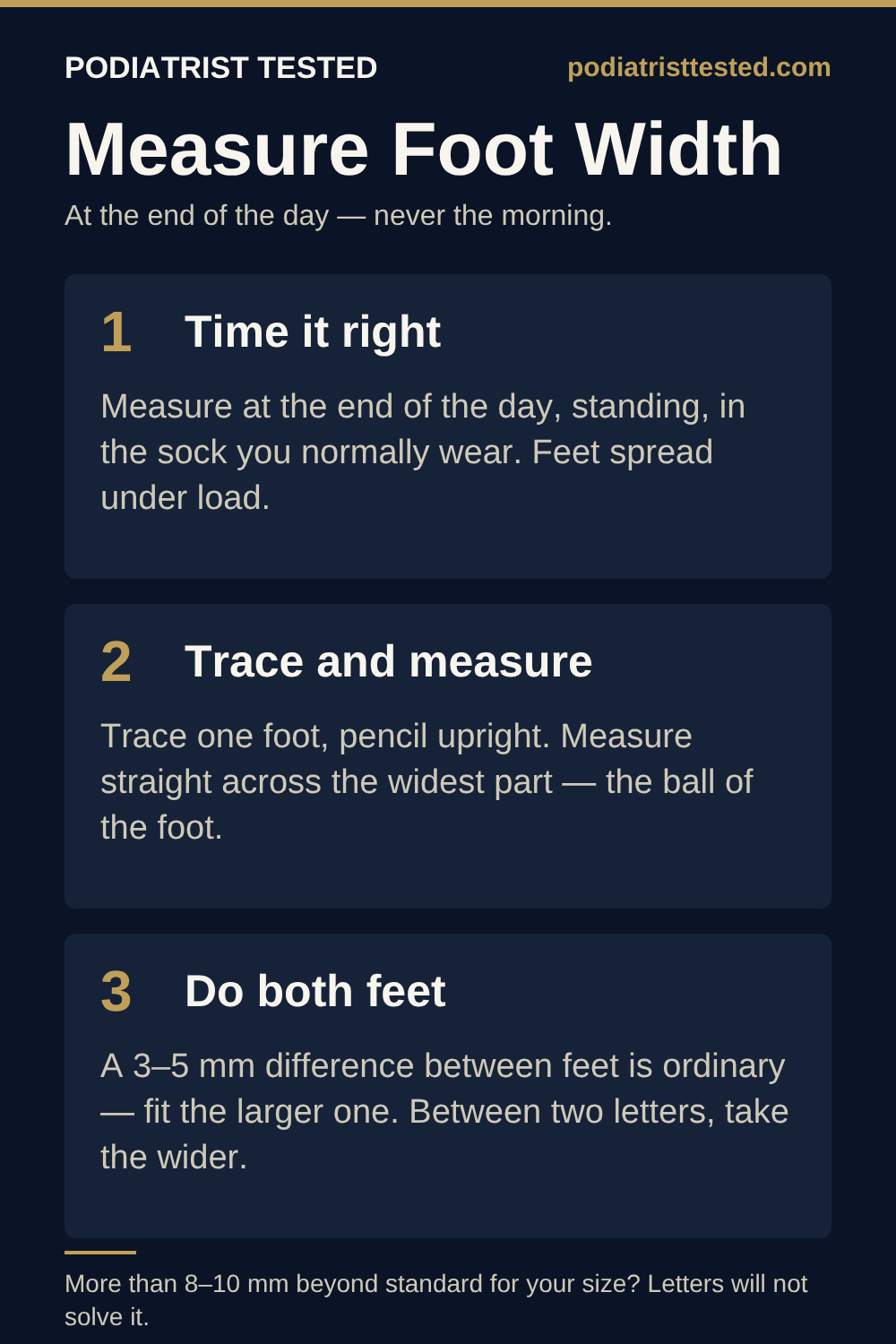
If your measured width is more than about 8–10 mm beyond the standard for your size, letters will not solve it and you are looking for a foot-shaped last or a therapeutic shoe.
When you need width, and when you need something else
| Situation | What to buy |
|---|---|
| Pressure on the side of the foot at the big-toe joint (bunion) | Width and shape: a foot-shaped last first, a wide letter second. See our bunion guide. |
| Burning between the third and fourth toes (neuroma) | Width at the ball of the foot plus a cushioned stack; avoid thin soles. See our neuroma guide. |
| Toes rubbing on the top of the shoe (hammertoes) | Depth, not width. A deeper toe box or a therapeutic shoe; extra width alone does nothing. |
| Feet that swell across the day or with heat | A width up, plus adjustable closures — laces or straps that open right down to the toes. |
| Diabetes, neuropathy, or a history of ulcers | A therapeutic last with 4E/6E availability and seamless linings; not a standard trainer in a wide letter. See our diabetic shoe guide. |
| A rigid, deformed or collapsed foot (Charcot) | Custom or therapeutic footwear with a moulded insert. See our Charcot guide. |
| Room needed for a custom orthotic | Volume, not width. A removable factory insole and enough depth — check the Orthotic Volume Rating in each review. |
What the research actually supports — and where it stops
Everything above this heading is fitting practice — the allowances shoe fitters, podiatrists and this chart have used for decades. This is the part with published evidence behind it, and the part that is still tradition.
In 2026 a Foot in Diabetes UK review in the Journal of Foot and Ankle Research asked a question nobody had put this bluntly before: are footwear fit guidelines science, or are they tradition? Petra Jones and seven co-authors searched the peer-reviewed literature for studies that actually tested the fit rules — how much length beyond the longest toe, how much width, how much depth — in people with diabetes, and graded what they found. The title they gave it is Science or Tradition?, and the answer is uncomfortable for anyone publishing a fit chart, including us.
- Getting the size wrong is clearly harmful. Across four studies, wearing the wrong shoe size raised the odds of a diabetic foot ulcer by between 1.7 and 10.4 times — the one part of fitting with solid evidence behind it, graded low to moderate certainty.
- The specific allowances are not well evidenced. The recommended length, width and depth figures — the numbers this chart and every other chart prints — came out at very low to low certainty. They are reasonable, widely agreed, and thinly tested.
- Four things have never been studied at all. The review found no studies on toe-box shape, heel width, heel height or alternatives to laces. Not weak evidence — an empty set.
- So the rule that survives is the simple one. Get the size right and get it measured; treat the millimetre-level allowances as sensible convention rather than proven thresholds.
The authors are direct about the limits. They searched English-language sources only and used broad terms that may have missed papers. Three of the four studies linking size to ulceration carried a high risk of bias. Most importantly for anyone reading this chart: every study in the review was in people with diabetes, a group whose feet lose protective sensation and whose stakes are much higher than average. Their findings about ulcer risk do not transfer to a general reader, and we are not claiming they do — what does transfer is the honest picture of how much evidence sits under the fit rules themselves.
We would rather print that than pretend the chart is something it is not. A width chart is a useful, consistent starting point for a measurement most people have never had taken. It is not a clinical threshold, and the research does not support treating it as one.
- Jones PJ, Vlachopoulos C, Branthwaite H, Gohil K, Cassidy R, Morriss-Roberts C, Pankhurst C, Hill A. Science or Tradition? Strength of Evidence for Footwear Fit Guidelines From Peer-Reviewed Studies of People With Diabetes — A Foot in Diabetes UK Systematic Review. Journal of Foot and Ankle Research 2026;19(3):e70189. doi:10.1002/jfa2.70189
Frequently asked questions
What does 2E mean in shoe width?
For men, 2E is wide — one step above the D standard. For women, 2E is extra-wide, two steps above the B standard. It is the same letter describing two different shoes, which is why women who need room are often better served buying a men’s D or 2E in the same model, a size and a half down.
Is 2E wide or extra wide?
Both, depending on whose shoe it is. On a men’s shoe, 2E is wide: one step above the standard D. On a women’s shoe, 2E is extra wide: two steps above the standard B. If the box or listing does not say men’s or women’s, check the brand’s size chart before you assume.
What does D mean in shoe size?
D is a width, not a size. On a men’s shoe, D is the standard (medium) width, so most men’s shoes are a D whether or not the box says so. On a women’s shoe, D is wide. Many brands print M for medium instead of a letter: on a men’s shoe M means D, and on a women’s shoe it means B.
What does B mean in shoe width?
B is the standard (medium) width for women. On a men’s shoe, B is narrow, two steps below the standard D. So a women’s 8 B is an ordinary women’s shoe, and a men’s 10 B is a narrow one.
What does 4E mean in shoes?
4E, sometimes written EEEE, means extra wide. In men’s sizing it is the next width up from 2E: on New Balance’s chart it fits a foot about 4 mm wider than a 2E and about 7 mm wider than a standard D at the same length. In women’s sizing, 4E is uncommon outside therapeutic brands.
How much wider is 4E than 2E?
About 3–4 mm at the ball of the foot on New Balance’s published chart, and unstated elsewhere. Going from a standard D to a 4E buys roughly 7 mm in total. That is real, but it is far less than most people expect from a label that says “extra wide”.
What is the difference between 4E and 6E?
6E is the next fitting up from 4E and the widest most catalogues carry. It is sold mainly by New Balance, on a handful of models, and by therapeutic brands such as Propet, Dr. Comfort and Apex. New Balance’s published chart, the only one that gives millimetres, stops at 4E, but its steps are 3 to 4 mm each, so treat 6E as one more step of the same size. Like every width letter, it adds girth across the ball of the foot and the instep, not room at the toes.
Is a wide shoe actually wider, or just looser?
Depends on the brand and the letter. Brooks says its wide shoes use the same footbed as the standard with more upper material, and only the extra-wide widens the platform. ASICS describes a couple of millimetres. New Balance publishes millimetres and does widen the last. If the pressure you feel is bone against the side of the shoe rather than fabric across the top, you want a brand that widens the platform.
Do Altras and Topos come in wide?
Mostly no, and they do not need to for the same reason. Both build a foot-shaped last as standard, with the widest point over the toes rather than behind them, so a standard Altra is often roomier at the toes than a 2E of a conventional trainer while being no wider at the midfoot. Some Altra models do offer a wide, but the shape is doing most of the work. Our zero drop guide covers the family.
What does wide fit mean in basketball shoes?
Usually very little. Most basketball shoes are sold in a single width, because they are built narrow and locked down on purpose for cutting and jumping, and a “wide” version, where one exists, is often a single model in a few colours. If you need genuine width on court, our guide to basketball shoes for wide feet covers the few that are actually made that way.
Should women buy men’s shoes for extra width?
It is a reasonable option when a woman’s foot is genuinely wide and the model tops out at 2E: buy the men’s version about one and a half sizes down. The trade-off is a slightly higher-volume heel and midfoot, which can slip. Lace it through the top eyelet with a heel lock before deciding it does not fit.
How do I know if my shoes are too narrow?
Look at the shoe, not the foot. ASICS’ own advice is the right test: visible stretching or bulging of the upper along the outside of the forefoot means the shoe is too narrow. Add to that a callus along the outer edge of the foot, numbness in the toes after twenty minutes, and a sock that shows pressure marks across the ball.
What we are testing next
Internal width is on the bench list: measured across the inside of the forefoot at a fixed landmark, with the sockliner in and out, at men’s 10 and women’s 8, for the standard and wide versions of the same model. That is the measurement that answers whether a 2E is really wider, and no brand publishes it. Those figures will appear here and in each review as they are taken.
Using this chart. Reproduce it wherever you like — an article, a newsletter, a lecture slide, a forum post — provided the image is unaltered and you credit Podiatrist Tested with a link to this page. No permission needed, no fee, and you are welcome to host the file yourself.
Credit line to copy: Chart: Podiatrist Tested — podiatristtested.com/shoe-width-chart/
The figures themselves are the brands’, and facts belong to nobody — we claim nothing over the numbers, only over the chart. If you want a different crop, a print-resolution file, or the underlying table as a spreadsheet, ask us and we will send it.
Related guides & shoe pages
- Wide feet vs narrow feet — how to work out which you are before you pick a letter
- Wide toe box shoes — the difference between a wide shoe and a wide toe box
- Best shoes for wide feet
- Best shoes for bunions
- Best shoes for Morton’s neuroma
- Best shoes for diabetics
- Heel-to-toe drop chart — stated vs measured
- How we test — and what the Orthotic Volume Rating measures
- Best running shoes for wide feet — the letters applied to eight running models, widest first.
- Shoe weight chart — every shoe here by published weight
- Best Basketball Shoes for Wide Feet — why basketball is the sport where the width letter barely exists.
Browse the full list: 39 in a wide fitting · 27 in an extra-wide fitting · 14 in a narrow fitting. Each page shows the published drop, stack, weight, widths and price side by side. Not sure which of them is you? Answer four questions and we will narrow it to two or three.
Every figure on this page, and the rest of them. The shoe spec database holds the published numbers for every shoe on this site in one table — heel and forefoot stack, drop, weight, toe-box width, list price and the widths each is sold in — with the name of whoever published every one of them.
The width data here is the reason this site exists, and it is more use to you than to us sitting on one page. Quote any figure on it — in an article, a forum answer, a product page or a paper — on one condition: keep the source line attached to the number, because several of the figures are a manufacturer’s claim rather than an independent measurement and the difference is the point. A link back to this page is the cleanest way to do that. If you want to reproduce a chart itself rather than link to it, ask us first; we usually say yes. The full wording we suggest.
Recently reviewed
Individual shoe pages state their evidence tier, published measurements and who should skip them.
Saucony Endorphin Speed 5
Spec AnalysisLight plated neutral trainer. Saucony publishes both stack heights and they match its 8 mm drop — not yet tested.
HOKA Mach 6
Spec AnalysisLower, firmer neutral HOKA. HOKA publishes a 5 mm drop and neither stack height — not yet tested.
ASICS Novablast 5
Spec AnalysisBouncy high-stack neutral. ASICS publishes an 8 mm drop and neither stack height — not yet tested.
Our funding and evidence policy
We earn affiliate commissions from qualifying purchases. Our policy is to assess published evidence and fit needs rather than rank products by commission rate. Current reviews are specification analyses; see our method for their limits.