
Shoe, insole & orthotic guides by a foot & ankle surgeon Clinical insight. Clear specs. Independent advice.
I'm Dr. Tom Biernacki, a board-certified foot and ankle surgeon in Michigan. This site is where I put what I tell patients about shoes and insoles. I'm upfront about the evidence: a shoe is only called tested after it has been weighed, measured and worn here. Until then, you get my clinical reading of the published specs and independent lab numbers, labeled "Spec analysis."
Shoe and insole guides from Tom Biernacki, DPM, FACFAS, a double board-certified foot and ankle surgeon, sorted by the foot problem you actually have. Current testing status: Shoe pages are spec analyses; no completed wear-test scorecards or seal awards have been published yet. View the testing register.
Clarification (8 October 2026): Clarified the current use of published specifications and outside sources. The illustrated testing protocol and scoring scheme are proposed; no completed product testing or documented clinician review is reported.

- Weight, gAttributed published weight; sample size varies
- Toe-box sourcesOutside sample measurements, where available
- Orthotic fitProposed pairing rubric; no rating recordsFit rubric
Start here
Shoe guides by foot problem
A buying guide for common foot problems, attributed to Tom Biernacki, DPM, FACFAS. The current pages compare published shoe features and source-based fitting context. They do not contain original product measurements, documented wear tests or recorded patient outcomes.
Three questions
Which guide do you need?
Your answers suggest related reading. The finder does not diagnose symptoms or prescribe a shoe; suitability depends on the actual fit and any individual care plan.
More by problem: sesamoiditis, plantar fibroma, stress fractures, Charcot foot, Sever’s disease, Parkinson’s, sciatica and metatarsalgia. If it is plantar fasciitis specifically, there are guides to soccer cleats for plantar fasciitis and Saucony shoes for plantar fasciitis.
Less common diagnoses, each with its own guide: turf toe, Lisfranc injuries, midfoot arthritis, tarsal tunnel syndrome, cuboid syndrome, sinus tarsi syndrome, an accessory navicular, tarsal coalition, Freiberg’s disease, a plantar plate tear, Morton’s toe, heel fat pad atrophy, Baxter’s nerve entrapment, Haglund’s deformity and psoriatic arthritis. Coming out of treatment: the first shoes after a walking boot, and shoes after an Achilles tendon rupture.
Shoe reviews by brand: HOKA, Brooks, New Balance, ASICS, Saucony, On, Altra, Skechers, KURU, Vionic, Dansko, Orthofeet and OOFOS.
Reference tables
Shoe charts: heel drop, width and orthotic fit
Reference pages compare attributed manufacturer specifications, outside laboratory samples and a proposed qualitative orthotic-fit rubric. They identify different kinds of information; none should be read as this publication’s own completed shoe measurements.
Also worth having open: what 34 of these shoes weigh, and where each figure comes from, independent lab toe-box widths, model by model, and the anatomy of a shoe — the vocabulary the rest of the site uses.
Published-source guides
Newest shoe guides and comparisons
The latest guides compare published product information and source-based fitting context. Read each page’s limits and compare the actual shoe or device for fit.
Swipe to see more →Published-source comparisons
Shoe specification analyses
Current shoe pages are specification analyses based on attributed manufacturer information and, where stated, outside laboratory data. They carry no score or seal. Any future physical test must identify the actual pair, method and recorded observations before being presented as a test report.
Swipe to see more →-
spec
Saucony Endorphin Speed 5 — Spec Analysis (Not Yet Tested)
Light plated neutral trainer. Saucony publishes both stack heights and they match its 8 mm drop — not yet tested.
Read the full page →: Saucony Endorphin Speed 5 — Spec Analysis (Not Yet Tested) -
spec
HOKA Mach 6 — Spec Analysis (Not Yet Tested)
Lower, firmer neutral HOKA. HOKA publishes a 5 mm drop and neither stack height — not yet tested.
Read the full page →: HOKA Mach 6 — Spec Analysis (Not Yet Tested) -
spec
ASICS Novablast 5 — Spec Analysis (Not Yet Tested)
Bouncy high-stack neutral. ASICS publishes an 8 mm drop and neither stack height — not yet tested.
Read the full page →: ASICS Novablast 5 — Spec Analysis (Not Yet Tested) -
spec

HOKA Clifton 11: A Podiatrist’s Spec Analysis (Not Yet Tested)
HOKA’s product page carries a podiatric seal claim the APMA database does not support for this version, and a women’s stack height that contradicts HOKA’s own drop. Not tested by us.
Read the full page →: HOKA Clifton 11: A Podiatrist’s Spec Analysis (Not Yet Tested) -
spec
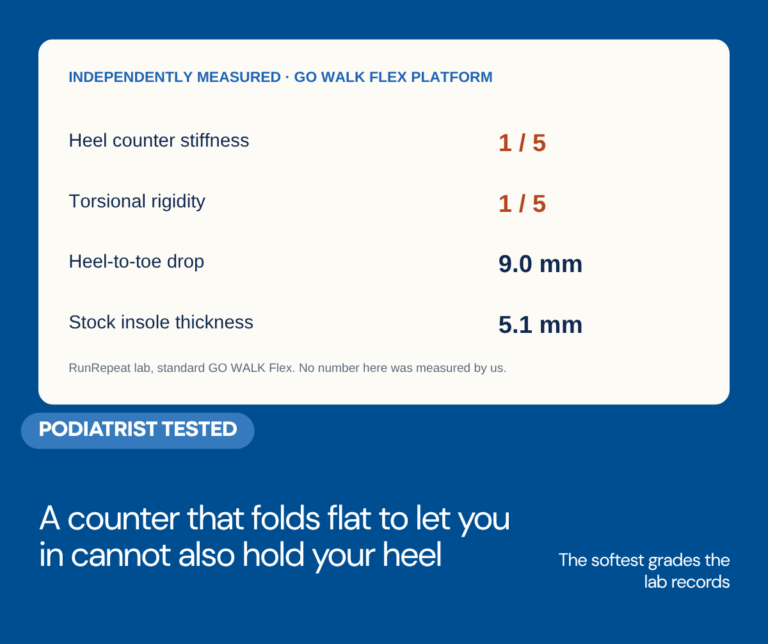
Skechers Hands Free Slip-ins — Spec Analysis (Not Yet Tested)
Untested. A heel panel engineered to stay open cannot also be a rigid heel counter, and Skechers publishes no stiffness figure for it — nor a drop, a weight or a width.
Read the full page →: Skechers Hands Free Slip-ins — Spec Analysis (Not Yet Tested) -
spec
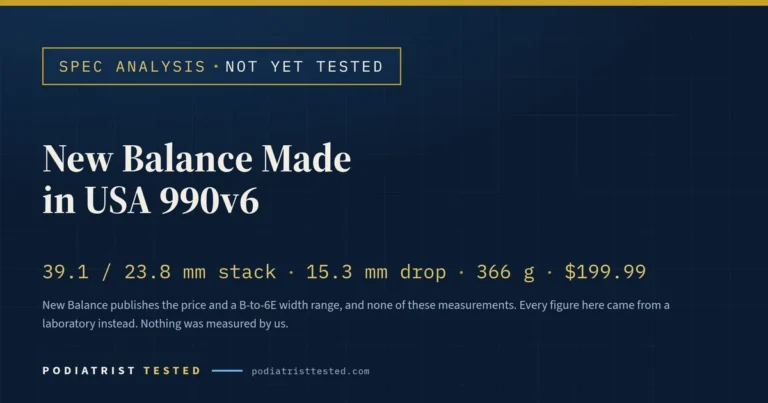
New Balance Made in USA 990v6 — Spec Analysis (Not Yet Tested)
New Balance publishes no weight, drop or stack height for the 990v6, but it does publish B through 6E widths — and that range is why it still matters. Not tested by us.
Read the full page →: New Balance Made in USA 990v6 — Spec Analysis (Not Yet Tested)
Comparison updates
Get updates to the published shoe comparisons
Current shoe pages are specification analyses. Subscribe for material updates to the comparisons and their sources. Future test reports will be identified only if documented physical testing is completed.
- Attributed shoe specifications and clearly labeled outside measurements
- Source corrections, fit limitations and updates to the comparisons
- Who should skip the shoe, which is the part most sites leave out
No sequence, no sponsors, one-click unsubscribe. Your address is never sold, shared, or given to a brand.
Proposed testing and scoring protocol
This is an illustrative layout for a proposed protocol. No original product measurements, wear-test notes or completed scorecards are available. Published specifications and outside measurements require their source labels; they should not be presented as our own measurements.
| Measurement | Unit | Source |
|---|---|---|
| Weight at men's 10 | g | PLANNED |
| Heel / forefoot stack | mm / mm | PLANNED |
| Drop | mm | PLANNED |
| Internal toe-box width & depth | mm | PLANNED |
| Orthotic Volume Rating | 1–5 | FIT ASSESSMENT |
| Miles · surfaces · duration | logged | PLANNED |
| Anything from the box | — | MANUFACTURER |
Proposed fit cautions — an illustrative place for product-specific limits; no completed test or suitability verdict is shown.
Planned measurements
If original measurement work is performed, identify the exact model, size, width and configuration, with the method and results recorded. Current figures remain attributed manufacturer specifications or outside measurements.
Planned wear observations
Any future wear report should record the actual activities, surfaces, duration and observations. No such product wear records exist for the current pages.
Planned mechanical checks
The proposed protocol describes twist, heel-counter and stance checks. No original results are available, and these checks alone do not establish treatment effectiveness or safety for an individual foot.
Fit limits and cautions
Describe product limitations and who may need a different fit or assessment. Current cautions should identify the published evidence behind them rather than imply a tested clinical outcome.
Proposed scoring
The earlier illustration contains nine criteria and weights that remain unvalidated. No product score has been completed, and these weights are not an adopted scoring standard. A formula alone does not establish repeatability or clinical benefit.
The seal that cannot be bought.
No shoe has received this publication’s seal. The stated policy describes eligibility for a future award after documented physical testing; the illustration is not an issued certification.
The submission policy describes the proposed route for future testing. No completed test or award is reported here. The planned badge terms are at seal usage, and the APMA comparison describes the different standards. Our funding and evidence policy →
Choosing insoles that fit your shoes
An insole or orthotic needs enough room inside its shoe. The proposed, unvalidated fit rubric would consider heel seating and available room with the stock insole removed. No completed physical shoe-and-device pairing assessments are documented here.
Insole guides: insoles for plantar fasciitis, flat feet, standing all day, work boots and supination. Head to head: Currex vs PowerStep, PowerStep Pinnacle vs ProTech vs SlimTech and PowerStep vs the Good Feet Store. Also: carbon fiber insoles, metatarsal pads and toe spacers.
Proposed Orthotic Volume Rating
The illustrated 1–5 rubric is a proposed, unvalidated way to describe a specific orthotic-and-shoe pairing with the stock insole removed. No completed physical ratings or pairing records are documented here.
Footwear education and published-source comparisons
Tom Biernacki’s professional background is described in the author profile. Current shoe content compares published sources; no clinic outcome dataset or documented product wear tests are available to support individual product claims.


Common questions
How Podiatrist Tested works
What the current evidence includes, what remains a proposed protocol, and how the publication is funded.
Who is responsible for Podiatrist Tested?
The publication identifies Tom Biernacki, DPM, FACFAS as its author, with his professional background on the author page. Current shoe pages are published-source specification analyses. No original product measurements, wear notes or clinician-review records are available; no completed score or seal is claimed.
Do brands pay for a score, a ranking or the seal?
The stated policy prohibits buying a score or seal. Current shoe pages are specification analyses and no completed award is reported. Any future testing arrangement must be disclosed with its evidence. Read the independence policy.
What does a spec analysis mean on a shoe page?
A spec analysis compares published product information and any clearly attributed outside measurements. It is not an original test report and carries no score or seal. A future physical test must be documented and identified separately.
How is a Podiatrist Tested score calculated?
The earlier criteria and weights are unvalidated; no adopted product-scoring standard or completed score is reported. The method page explains the evidence needed before a future score is published. A formula alone does not establish repeatability or clinical benefit.
What is the Orthotic Volume Rating?
The proposed Orthotic Volume Rating is a qualitative 1–5 assessment of an individual shoe-and-device pairing. No original rating records are available. It is not a physical volume measurement or a guarantee that every device will fit.
How does this site make money?
Podiatrist Tested earns affiliate commissions from qualifying purchases, at no extra cost to the reader. The stated policy requires editorial judgments to be independent of those commissions. Current specification comparisons carry no completed test score or seal. Read the editorial policy.
The method first, then the guides, then the scores.
Buying guides and shoe specification analyses are live. They compile published information and fitting context; no original product measurements, recorded wear sessions, patient-outcome data or clinician-review records are available. The testing method is a proposed protocol for future work.
Tested, or labelled untested
Shoes we have not physically tested will always be labelled “Spec analysis — not yet tested”, carry no score and no seal, and be kept apart from tested reviews. No exceptions, no brand can change that.
How this site makes money. Podiatrist Tested earns affiliate commissions from qualifying purchases, at no extra cost to the reader. Its stated policy requires editorial judgments to be independent of those commissions. Current specification comparisons carry no completed test score or seal. Read the editorial policy →
Podiatrist Tested is an independent publication of Foot & Ankle Web Services LLC. It is not affiliated with, endorsed by, or accredited by the American Podiatric Medical Association or any other professional body. Nothing here is medical advice or creates a doctor–patient relationship.