
Good Feet Store vs PowerStep: Is Good Feet Worth It? (2026)
Published-source comparison. Written by Tom Biernacki, DPM, FACFAS. No original product wear tests, dispensing records, patient-outcome series or documented clinician review support this comparison. Seller descriptions and prices can explain construction and cost; they do not establish clinical equivalence or superiority.
Written and medically reviewed by Dr. Tom Biernacki, DPM, FACFAS · Last reviewed 8 October 2026
We earn a commission if you buy through links on this page, including Amazon links paid by brand partners through Levanta, at no cost to you. As an Amazon Associate I earn from qualifying purchases. How we make money
On this page
- Quick Answer
- Good Feet Store pros and cons at a glance
- Is the Good Feet Store worth it?
- The Real Cost Difference
- Can you pay for either one with an HSA or FSA?
- Side-by-Side: PowerStep Pinnacle vs Good Feet Store
- What to ask before you buy any arch-support system
- What the evidence actually shows about arch supports and custom orthoses
- Which insole brands are worth the money, and what each is actually good at
- Frequently Asked Questions
Any stack heights, drops, weights, heel-cup depths or other dimensions quoted on this page are manufacturer-published figures reproduced from the original guide, not Podiatrist Tested measurements.
Podiatrist Tested is reader-supported. Links to Amazon are affiliate links; commissions never influence a recommendation or a score. Read the independence policy.
Quick Answer
This comparison does not establish that PowerStep delivers a fixed percentage of the clinical effect of Good Feet, or that either system replaces an individually prescribed device. Compare seller-described construction, fit, price and purchase terms. A retail comparison does not diagnose a condition or select treatment; our Charcot foot guide gives context on one specific concern.
I will never recommend a product I wouldn’t use on my own family. Good Feet Store is NOT an affiliate relationship; it is discussed for educational comparison only. I have no referral or commercial agreement with Good Feet or any of its franchisees.
Doctor’s Top PickPowerStep Pinnacle Semi-Rigid Orthotic
PowerStep Pinnacle Semi-Rigid Orthotic
PowerStep describes Pinnacle as a full-length insert with a contoured support shell, heel cradle and layered cushioning. Its Pinnacle Maxx listing specifies a firmer shell and an angled heel post. These are manufacturer descriptions, not our measurements or clinical outcomes. Check the exact size, available shoe volume and fit; this page has no records supporting the earlier personal dispensing or custom-equivalence claims.
Good Feet Store pros and cons at a glance
Whether the Good Feet Store is worth it comes down to what the price buys. This is the short version of the comparison on this page; the reasoning behind each point follows below.
| Pros | Cons |
|---|---|
| Rigid arch support helps a meaningful subset of flat-footed patients feel better immediately | About $1,200–$1,800 for a three-pair system at Good Feet’s own $399–$599 a pair, roughly 20–50× the cost of a podiatrist-designed off-the-shelf orthotic |
| A 90-day full-refund window and a limited lifetime warranty against cracking, per Good Feet’s own FAQ | Fitters are not licensed medical providers: no diagnosis, no imaging, and no follow-up if the inserts aren’t working at week six |
| A clean retail experience with staff trained to explain the concept | No peer-reviewed outcome data showing it beats pre-molded orthotics such as PowerStep |
| — | Not covered by insurance, though HSA and FSA cards are accepted |
Is it worth it? Price and the number of supports do not establish which purchase will improve your symptoms. Good Feet describes a three-support system; PowerStep sells individual insert models. Obtain an itemized quote and compare fit and written terms. This page presents no head-to-head outcome trial showing that the cheaper option performs the same, or that the costlier option performs better.
Is the Good Feet Store worth it?
For most people with ordinary heel or arch pain, no. Not because the arch supports are bad, but because the same job is done by a $55 insole, and the problems a $55 insole cannot fix need a diagnosis rather than a dearer insole. Here is the price ladder, from each seller’s own published figures.
| Option | Price | Where the figure comes from |
|---|---|---|
| PowerStep Pinnacle | $54.95 | PowerStep.com, September 2026 |
| PowerStep Pinnacle Maxx (2° heel post) | $57.95 | PowerStep.com, September 2026 |
| Good Feet arch supports, one pair | $399 to $599 | Good Feet’s own FAQ, September 2026 |
| Good Feet three-pair system | About $1,200 to $1,800 | Good Feet’s per-pair price, times three, before accessories |
| Custom orthotics from a podiatrist | Varies by practice | Often partly covered by insurance when medically necessary |
Good Feet does offer a 90-day return window with a full refund and no restocking fee, accepts HSA and FSA cards, and backs its supports with a limited lifetime warranty against manufacturing defects such as cracking. Those are real protections, and if you do buy, use the return window: if the pain is not clearly better by week eight, take them back. Its FAQ also says plainly that the store is not a medical provider, which is the point of the rest of this page.
The Real Cost Difference
For a separate comparison, see Dr. Scholl’s vs PowerStep. Check exact model names and current seller listings rather than assume that similar prices establish similar construction or treatment results.
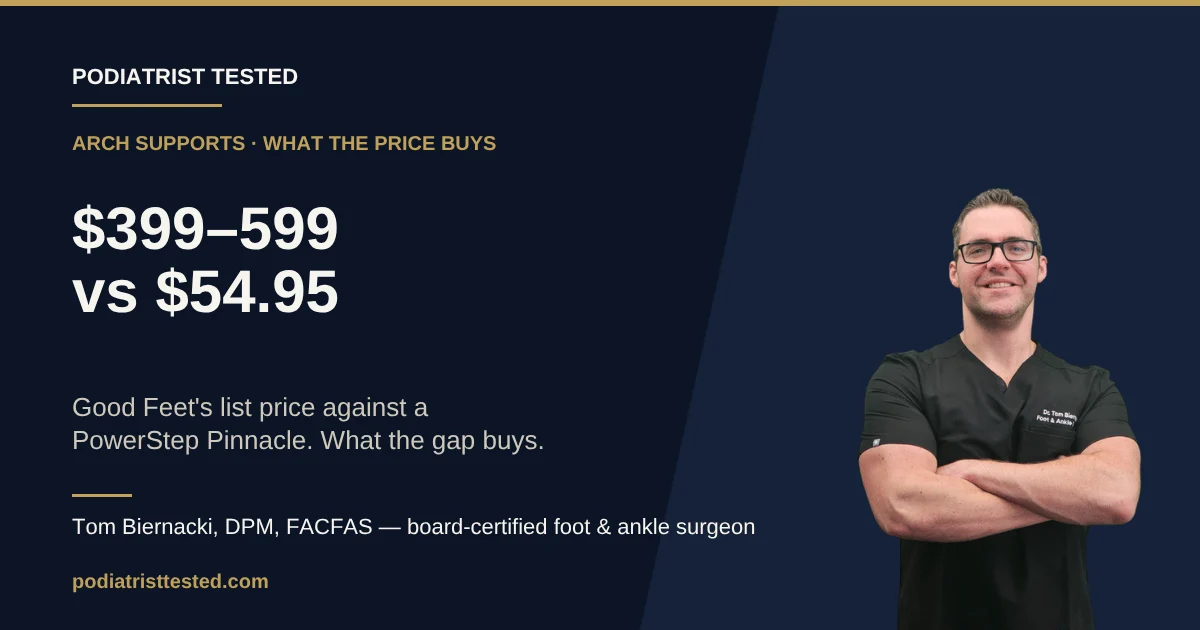
Price comparison checked 8 October 2026: PowerStep lists Pinnacle at $54.95 per pair. Good Feet lists $399–$599 per pair; three pairs at that published range would total $1,197–$1,797 before any taxes, accessories or store-specific quote. These are dated seller figures, not a treatment comparison. Confirm the exact package and current checkout price.
Dated seller prices and package details
PowerStep Pinnacle (one pair): The manufacturer listing checked 8 October 2026 was $54.95. Confirm the current price, exact model, size and seller-specific terms. This page has no daily-wear test establishing a 12–18-month lifespan.
Good Feet: The seller publishes $399–$599 per pair. Three pairs at that range total $1,197–$1,797 before extras; obtain an itemized store quote. Warranty wording is a purchase term, not proof of clinical effectiveness or a measured useful life.
A one-pair price and a three-pair package are different purchases. Compare item count, total price, fit, included services and written terms. This page has no head-to-head trial establishing that the products are clinically equivalent, and no records showing how financing affected customers’ treatment decisions.
PowerStep Pinnacle Semi-Rigid Orthotic
PowerStep Pinnacle Semi-Rigid Orthotic
The linked Pinnacle and Pinnacle Maxx listings describe different insert models. Read the exact listing for construction, sizing and instructions. This page has not independently established their development history, comparative dispensing frequency or a condition-specific first-line role.
Features and fit to compare
- Read the exact model’s manufacturer description rather than infer performance from a brand name.
- Compare the support shape and available space in the intended shoe.
- Check sizing, trimming instructions and whether the existing insole must be removed.
- Try the fit without assuming firmness predicts a clinical result.
- Check the current seller price and purchase terms.
- This page has no original wear or durability measurements.
- The earlier universal lifespan and replacement-cost claims are not established here.
- Retail availability can change; use the exact linked listing.
Trade-Offs
- A retail insert is not automatically interchangeable with an individually prescribed device.
- This page has not validated a universal break-in period.
- Check the exact size and trimming instructions against your shoe.
- Discomfort does not establish that you should continue wearing an insert until a deadline.
- A body-weight or foot-shape label alone does not select treatment.
Evidence limit: No dispensing records or patient-outcome series support the earlier clinic narrative, success percentage, recovery timetable or insurance-savings calculation. A named product is not a validated six-week treatment protocol. An assessment and any plan coverage must be established for the individual.
Individual suitability: This page has not validated a diagnosis, age or measurement checklist that determines whether Pinnacle is appropriate. If a clinician has prescribed a device, ask about its purpose and acceptable alternatives rather than substitute from a retail comparison.
Educational Comparison · No Affiliate LinkThe Good Feet Store Three-Insole System
Good Feet describes a three-support system. This is a seller-described configuration, not evidence that the system trains a foot or treats a condition. Obtain the exact package and itemized quote; the dated published per-pair price is shown above.
Purchase terms to check
- Read the current written guarantee; eligibility, follow-up and timing conditions apply.
- A comfortable retail demonstration does not establish a treatment outcome.
- Confirm what fitting, follow-up and warranty services the exact purchase includes.
Questions before purchasing
- Good Feet says its stores do not diagnose or prescribe; clarify the fitter’s role.
- Compare total package price and included services; cost does not establish clinical equivalence.
- Ask for evidence concerning the exact product rather than a broad product category.
- Ask which retail follow-up is included and distinguish it from clinical care.
- If financing is offered, obtain the total price and written terms.
- Read the full guarantee before purchase rather than assume an unconditional refund.
- Persistent or worsening symptoms need assessment; a retail demonstration cannot identify their cause.
Evidence limit: The earlier patient-group percentages and clinic stories are not supported by records available for this page. They cannot establish Good Feet’s success rate, failure rate or comparative value. Ask what evidence supports the specific product and distinguish a retail service from a clinical assessment.
Individual suitability: A retail fitting does not select a diagnosis or an insurance pathway. This page has not established that one brand is unsuitable for everyone with a particular condition, or that a fixed symptom duration determines when imaging is needed.
Product categories and quotes to compare
These categories organize purchase questions; they are not a measured market survey, a universal price ladder or a ranking of clinical effectiveness. Compare the exact product, quantity, fitting process and services in each quote.
Gel and foam inserts: Check the exact materials, shape, fit and seller listing. This page has not measured category-wide compression life or established that every such insert is ineffective for every condition.
Prefabricated inserts: Compare exact models and current prices, not a fixed price band or an assumed treatment success rate. Our insoles for plantar fasciitis and insoles for flat feet guides provide further context.
Heat-mouldable or semi-custom products: Ask the seller what is adjusted, how the exact product is fitted and what follow-up is included. A category label does not establish a price range or clinical superiority.
Retail support systems: Ask which supports and services are included in the package. A multi-pair quote should be compared with its item count and written terms, rather than with the price of one insert alone.
Individually prescribed orthoses: Ask the prescribing clinician what design is needed, how the device will be made or adjusted and what follow-up and itemized charges apply. This page does not establish a universal self-pay range.
A custom-device quote and a retail package may contain different items and services. Compare the actual quotes and any confirmed coverage. This page does not establish that a prescribed device always costs less or produces a better result.
Can you pay for either one with an HSA or FSA?
Before using an HSA or FSA, confirm the exact item and required documentation with the account administrator. This page does not determine tax eligibility or establish that every retail package can be paid with account funds.
Ask the administrator which receipt details, prescription or other documentation are required for your exact purchase, and obtain an itemized quote. Requirements should be confirmed before purchase rather than inferred from the price or store label.
Insurance coverage is specific to the plan, item and applicable requirements. This page does not establish a universal exclusion for retail inserts or a universal definition of a covered custom device. Ask the plan administrator and prescribing clinician about the exact device.
Compare the full out-of-pocket amount only after the account or plan administrator confirms eligibility and documentation. A seller’s financing offer, price or product description is not that confirmation.
Side-by-Side: PowerStep Pinnacle vs Good Feet Store
| Factor | PowerStep Pinnacle | Good Feet Store 3-Insole System |
|---|---|---|
| Typical price | $54.95 manufacturer listing checked 8 October 2026; confirm checkout | $399–$599 per pair; three pairs $1,197–$1,797 before extras; obtain a quote |
| Designed by | Read the exact manufacturer listing; history not independently verified here | Read the exact seller description; design provenance not independently verified here |
| Fit by | Preset sizing; check exact product and instructions | Retail fitting; confirm the exact service |
| Arch support type | Use the exact Pinnacle or Maxx description; models differ | Seller-described support system; compare the exact supports |
| Heel control | Check fit; no original heel-control test here | Check fit; no original heel-control test here |
| Clinical evidence | No head-to-head equivalence established by this page | No head-to-head equivalence established by this page |
| Diabetic-appropriate | Not established by this retail comparison; seek an individual assessment | Not established by this retail comparison; seek an individual assessment |
| Medicare / PPO coverage | Confirm exact plan, device and requirements | Confirm exact plan, device and requirements |
| Return policy | Seller-specific; read the terms for the exact listing | Conditional guarantee for eligible supports; see the full policy and FAQ below |
| Follow-up / escalation path | Confirm what the purchase or separate care includes | Confirm included retail follow-up; it does not replace clinical care |
| Lifespan | No original durability testing available | Warranty terms are not a measured useful life |
| In our clinic | No dispensing records supplied for this page | No patient-outcome records supplied for this page |
| Where to buy | Exact linked seller listing; availability can change | Exact seller store or listing; availability can change |
Questions to clarify before buying
Start here
Question 1: What exactly is included? Confirm the product model, size, item count, fit, total price and written terms. This page does not establish a symptom-duration rule for starting a named treatment.
Question 2: Is an individual assessment needed? A retail comparison cannot assess skin, circulation, sensation or the cause of pain. If you have a prescribed device or health concerns, ask the clinician who manages them about footwear or insert changes. This page makes no appointment-availability promise.
Question 3: What follow-up and coverage have been confirmed? Distinguish the seller’s fitting service from clinical care and confirm any plan coverage directly. This page has not validated a treatment deadline, an automatic custom-orthotic escalation or an insurance-savings percentage.
When symptoms need individual assessment
- Do not infer the cause of persistent or worsening pain from an insole comparison.
- A new visible change in the foot should be assessed rather than explained by a retail demonstration.
- New or worsening numbness, tingling or burning needs an individual assessment.
- A tender point alone does not identify a fracture; this page cannot decide whether imaging is needed.
- A sudden loss of function should not be managed solely by trying another insert.
- Skin changes, redness, warmth or swelling need advice from a qualified clinician, especially when sensation or circulation is reduced.
- This page does not establish an eight-week threshold before seeking help.
- Questions after surgery should be directed to the clinician managing recovery rather than a retail selection rule.
What to ask before you buy any arch-support system
These questions are not aimed at one retailer. They are the ones worth asking anywhere that fits and sells arch supports at a price high enough to think about, including a podiatry office. If the answers come easily and in writing, that is a good sign in itself.
What is the return window, and is it in writing? Ask whether used or altered products qualify, which conditions apply and how a return is initiated. This page has not established a universal wear period needed to evaluate an insert.
Is the price for one pair or for a set? Multi-pair systems are sold as a package for a reason, and the per-pair figure is rarely what is quoted. Ask whether you can buy a single pair first and add later, and what that changes about the price.
Does the price include follow-up adjustments, and for how long? Ask what changes the seller can make, what is included and what costs extra. This page has no records establishing a universal two-week adjustment need.
What happens to the scan or pressure reading? A foot scan can inform a device or it can decorate a quote. Ask which shapes the recommendation, what specifically in your reading points to the device being suggested, and whether you can have a copy.
Who is fitting them, and what is their training? A reasonable question asked politely, and the answer tells you whether you are getting a clinical assessment or a retail one.
Is any part of this financed? If a payment plan is offered, the interest rate is part of the price. Get the total figure, not the monthly one.
None of this means an expensive device is the wrong choice. It means you should be able to say exactly what you are getting for the difference, and if nobody can tell you that in plain terms, the answer to the original question is usually no.
What the evidence actually shows about arch supports and custom orthoses
This comparison currently provides seller descriptions and purchase terms, not an original clinical study. A claim about an entire class of orthoses cannot establish the relative outcomes of these two exact products.
Product outcomes: No original patient series or cited product-specific head-to-head trial is presented here. The earlier broad assertion of consistent pain reduction does not establish an outcome for a buyer of either system.
Equivalence: This page does not establish that Pinnacle and Good Feet produce the same result, or that either substitutes for every prescribed device. Comparisons involving other orthoses or selected patient groups cannot be transferred automatically to these products.
Mechanism: Seller language about support, alignment or pressure does not establish a measured clinical mechanism. This page has no original pressure or biomechanical tests, and comfort during fitting is not proof that a condition is being treated.
Other symptoms: This comparison has not reviewed condition-specific evidence for knee or back pain. It cannot promise an indirect benefit or determine whether a foot insert is appropriate for those symptoms.
Mobility: This page has no measured walking-distance, balance or daily-function outcomes for either system. A claim about mobility should identify the exact product, population and outcome rather than be inferred from arch support alone.
Evidence questions: Ask the seller which published studies concern the exact system being offered. This page has not completed a systematic literature search, so it cannot establish that no peer-reviewed retailer study exists. A missing citation here proves neither effectiveness nor ineffectiveness.
None of the above is a substitute for an examination. It is the background you should have before deciding how much to spend, and it is general information rather than advice about your own foot.
Which insole brands are worth the money, and what each is actually good at
Compare exact models using current specifications, fit and purchase terms. The following links are additional comparisons, not tested rankings or evidence that a brand is clinically best for a particular activity.
PowerStep: Its models differ; use the exact listing rather than assume one design has the widest condition coverage or lowest useful price. See Pinnacle vs Maxx vs Pulse for a separate comparison.
Superfeet: Check the exact model’s construction and fit. This page has not validated a brand-wide firmness ranking or a two-week adaptation response.
CURREX: Check the exact model and intended use. This page has not established a brand-wide best-for-sport or unsuitable-for-standing rule. See CURREX vs PowerStep for a separate comparison.
Sole: Verify whether the exact model is mouldable and follow its instructions. This page has not measured the size or clinical value of any resulting shape change.
Tread Labs: Check the exact shell, top cover, sizing and replacement terms. This page has no durability or cost-recovery study supporting a brand-wide value ranking.
Spenco: Check the actual insert’s thickness, construction and shoe-space requirements. This comparison has no tests establishing a brand-wide advantage for hard floors.
Dr. Scholl’s: Compare the exact model rather than infer its structure or user satisfaction from the brand. See Dr. Scholl’s vs PowerStep for a separate comparison.
Value depends on the exact item, fit, services and terms you need. This page has not established that higher prices reliably buy durability or clinical improvement, or that the cheapest matching shell is the best treatment.
Frequently Asked Questions
Is Good Feet Store a scam?
This comparison does not establish fraud or product-specific clinical inferiority. Good Feet describes a retail fitting service, and its own FAQ says the stores do not diagnose, prescribe or handle insurance claims. Ask for the exact package, total price, fitter role and written purchase terms; a demonstration or price alone does not establish a diagnosis or treatment result.
My doctor said I need custom orthotics. Is PowerStep a substitute?
This page cannot decide whether a retail insert can replace an individually prescribed orthosis. Ask the prescribing clinician about the purpose, required design and acceptable alternatives. The comparison has not validated a condition checklist or numerical threshold for substituting PowerStep or Good Feet.
Are PowerStep Pinnacles covered by insurance?
Check the exact item and your own plan before buying. This guide does not establish a universal retail-price exclusion, reimbursement percentage or lower net cost for a custom device. Good Feet says its stores do not process insurance claims and directs coverage questions to the plan administrator; that statement does not determine your plan’s benefits.
I already bought the Good Feet system. Can I get my money back?
Check the written terms for your purchase. Good Feet’s published guarantee, checked 8 October 2026, applies to eligible warranty-backed arch supports and requires its fitting/wearing process, a 60-day adjustment period and at least one in-person follow-up. It permits an original-store return from day 60 through day 90 with proof of purchase, refunded to the original payment method without a restocking fee. A refit or exchange resets the window; other product categories are excluded. Read the current full policy and contact the store about your purchase.
Why does my arch feel so good when I first try a Good Feet insole?
A comfortable demonstration is useful fit feedback, but it does not establish a diagnosis, long-term benefit or whether a condition is improving. This page has no patient-outcome data showing that an immediate arch sensation predicts relief or masks a particular disease. Persistent or worsening symptoms need assessment rather than a diagnosis inferred from the demo.
Can I try PowerStep and Good Feet at the same time?
Use an insert only as directed and in a shoe with adequate space. If a clinician prescribed a device, discuss substitutions or combining devices with that clinician. This page has not validated the earlier three-week crossover schedule, pain-score rule or six-week imaging deadline.
What if I have flat feet and both insoles feel uncomfortable?
Discomfort with two inserts does not identify its cause. Check fit and shoe space, and seek help if pain persists or increases. This comparison cannot diagnose a tendon problem, coalition or rigid flatfoot from intolerance of an insole, or determine whether imaging is needed.
What about Superfeet or other retail orthotics?
Compare each exact model’s shape, dimensions, shoe-space requirements and current listing. This page does not establish which brand is clinically superior, a body-weight rule for choosing a firmer insert, or a fixed price ceiling for every option.
Can kids use PowerStep Pinnacle?
Adult-product comparisons do not establish a child’s orthotic needs. Check the exact product’s labelled sizing and discuss a prescribed device or persistent symptoms with the child’s clinician. This page has not validated the earlier age-based substitution rules or a categorical judgment about one retailer’s suitability for every child.
What’s the difference between PowerStep Pinnacle and a custom orthotic I’d get from you?
PowerStep Pinnacle is sold in preset sizes; an individually prescribed orthosis can have a different design or fitting process. That distinction does not establish a patient success percentage or automatic insurance eligibility. This comparison has no dispensing or outcome records supporting the earlier 70/30 split, and cannot decide which device an individual needs.
Will I need imaging or surgery?
This comparison cannot determine whether you need imaging, a prescribed device or surgery. Those decisions depend on an assessment and the problem identified, not a retail price comparison or a fixed trial period. Seek help for persistent or worsening symptoms rather than use this page as a treatment decision rule.
Clarification (8 October 2026): Removed unsupported treatment-equivalence percentages, personal dispensing and patient stories, retail substitution rules and coverage guarantees. Added dated primary-seller prices and the conditions of Good Feet’s published refund policy. No original product or patient-outcome testing is claimed.
Recently reviewed
Individual shoe pages state their evidence tier, published measurements and who should skip them.
Saucony Endorphin Speed 5
Spec AnalysisLight plated neutral trainer. Saucony publishes both stack heights and they match its 8 mm drop — not yet tested.
HOKA Mach 6
Spec AnalysisLower, firmer neutral HOKA. HOKA publishes a 5 mm drop and neither stack height — not yet tested.
ASICS Novablast 5
Spec AnalysisBouncy high-stack neutral. ASICS publishes an 8 mm drop and neither stack height — not yet tested.
Our funding and evidence policy
We earn affiliate commissions from qualifying purchases. Our policy is to assess published evidence and fit needs rather than rank products by commission rate. Current reviews are specification analyses; see our method for their limits.