
Best Shoes for Bunions: A Foot Surgeon’s Guide (2026)
Compare toe-box shape, width and depth for bunions, with practical fit checks and evidence on footwear, pads and nonsurgical care.
Written and medically reviewed by Dr. Tom Biernacki, DPM, FACFAS · Last reviewed 14 October 2026
We earn a commission if you buy through links on this page, including Amazon links paid by brand partners through Levanta, at no cost to you. As an Amazon Associate I earn from qualifying purchases. How we make money
On this page
- The short answer
- The roomiest toe boxes we hold measurements for
- What a bunion actually is
- The five things that decide whether a shoe works
- The paper test — do this before you buy anything
- What to wear, by situation
- Dress shoes and flats with a bunion
- The shoes worth shortlisting, and who should skip each
- The shoes we have spec pages for, and their published widths
- If you have a bunion and plantar fasciitis at the same time
- Bunion sleeves, spacers and splints: what they actually do
- What to stop wearing
- After bunion surgery: what to wear, phase by phase
- When footwear is no longer the answer
- What the research actually supports — and where it stops
- About toe spacers
- Frequently asked questions
- What we are testing next
- Related guides & shoe pages
Testing status: this shortlist is based on published specifications, construction and fit considerations. The models below have not completed our measurement protocol, and their inclusion does not establish a treatment benefit for bunions. Internal toe-box width and depth are among the figures our protocol is designed to measure — see How We Test.
The short answer
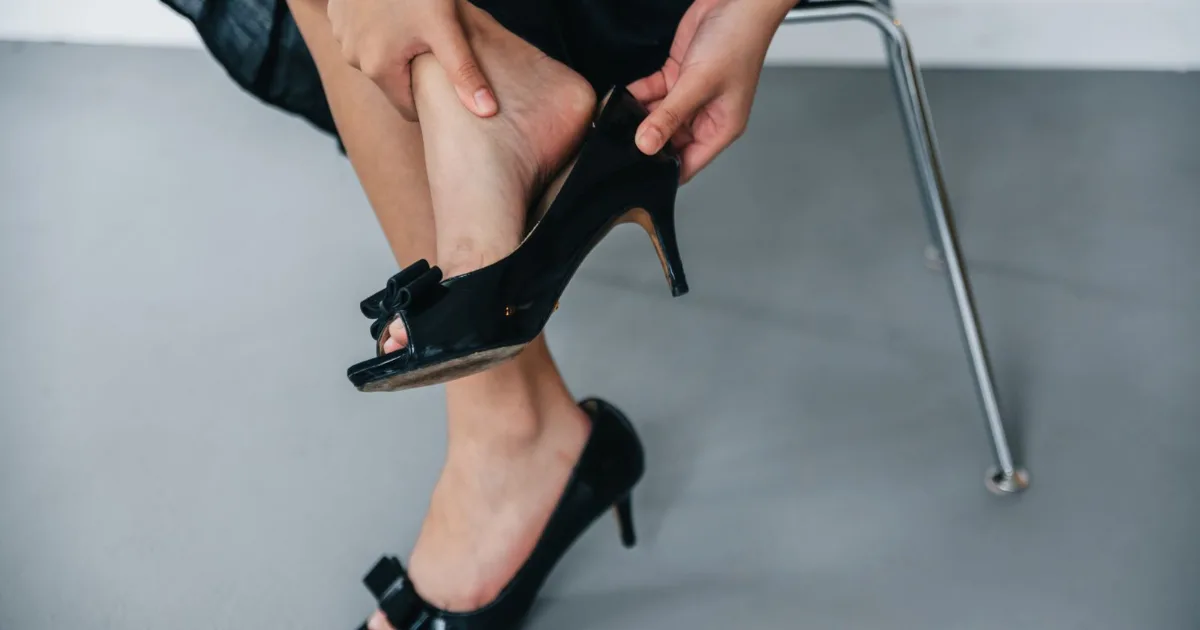
The right shoe for a bunion has a toe box shaped like a foot rather than a triangle, is wide and deep enough that nothing presses on the bump, has a soft seam-free upper over the joint, keeps the heel low, and still supports the arch. Shape matters more than width alone: a wide shoe that still narrows to a point at the front will not help. No shoe corrects a bunion, but the wrong shoe reliably makes one hurt.
Where to start
Five places to start, drawn from the shortlist further down this page. None has been through our bench yet, so there are no scores here, and no shoe corrects a bunion.
- Every shoe presses on the bump: Altra TorinThe widest genuinely foot-shaped forefoot, so the big toe can sit straight. It is zero-drop, so with heel pain start with the Topo instead.Women’s — check price Men’s — check price
- A bunion and heel pain: Topo Athletic PhantomA forefoot as roomy as Altra’s, on a modest heel-to-toe drop.Women’s — check price Men’s — check price
- A big toe joint that has stiffened: Brooks Ghost MaxA pronounced rocker that rolls you over the joint. Take the wide: the standard toe box measures on the narrow side.Women’s — check price Men’s — check price
- Cushioning as much as room: HOKA Bondi, wide fittingA genuinely wide fitting with the deepest cushioning and a strong rocker.Women’s — check price Men’s — check price
- Warm weather and around the house: Birkenstock Arizona, soft footbedAdjustable straps you can position to miss the joint entirely.Soft footbed — check price (women’s and men’s)
Paid links: we earn a commission at no extra cost to you, and it never changes what is listed. Who should skip each shoe is in the full shortlist.
The roomiest toe boxes we hold measurements for
A bunion asks for room in two places. The bump is the joint at the ball of the foot, on the widest line of the shoe. The big toe drifting towards the second toe sits further forward, where most shoes taper. No brand publishes either width, so we collected the only independent measurements there are, from a lab that cuts shoes in half, for the 34 shoes on our toe box width chart.
The two tell different stories. At the big toe the 34 shoes span 16.3 mm, and the Altras give a drifting toe about 15 mm more room than the narrowest shoe. At the widest point, where the joint sits, they span only 5.2 mm, and one width step adds 3–4 mm. For the bump, the fitting matters more than the model; for the drifting toe, the model matters more than the fitting.
| Shoe | At the big toe | At the widest point | Fittings sold | Bunion note |
|---|---|---|---|---|
| Altra Torin 8 | 83.6 mm | 95.3 mm | Regular; 2E at retail | The most toe room on file. Zero drop; assess comfort if you also have heel or Achilles symptoms. |
| Altra Paradigm 8 | 82.3 mm | 95.8 mm | Regular, Wide (2E) | The same foot-shaped room, with guidance for a foot that rolls in. Zero drop too. |
| Altra Torin 9 | 82.2 mm | 97.7 mm | Regular, Wide (2E) | Roomy at the toes, and the widest of all 34 at the joint. Zero drop. |
| HOKA Gaviota 6 | 76.7 mm | 97.2 mm | Regular, Wide, X-Wide | The widest at the big toe of any shoe here with a heel-to-toe drop, near the top at the joint, and sold in X-Wide. |
| New Balance 860v15 | 75.1 mm | 93.6 mm | Men B to 4E; women 2A to 2E | Room for the toes, narrow at the joint in a standard width: buy the 2E or 4E. |
| New Balance 990v6 | 67.3 mm | 94.1 mm | Men 2A to 6E | The trap: sold in six fittings, yet the narrowest toe box on our chart. |
Toe-box figures: RunRepeat lab, internal width at the big toe (28.3 mm from the tip) and at the widest point, one standard-width pair of each, read September 2026. Fittings as each brand lists them. The widest-point ranking of all 34 is on our tailor’s bunion page.
What a bunion actually is
A bunion — hallux valgus — is not a growth on the side of the foot. It is a change in the alignment of a joint. The first metatarsal drifts away from the second toward the inside of the foot, while the big toe angles back toward the smaller toes. The bump you can see is the head of that first metatarsal now sitting where there is nothing but skin over it.
A bunion involves altered alignment at the big-toe joint. Roomier footwear can reduce rubbing and pressure, but shoes are not an established way to permanently correct the deformity. Some studies of splints, exercises or orthoses report modest changes in alignment; the evidence is uncertain, and symptom relief is more likely than reliable correction. Footwear advice should focus on a comfortable fit rather than promise that controlling pronation will stop the drift.
Genetics and foot type are the primary drivers; footwear is an aggravator rather than the sole cause. But the aggravating part is the part you control.
If your bump is on the outside of your foot, this is not the page you want. A prominence at the base of the little toe is a bunionette, or tailor’s bunion — the same mechanism at the fifth metatarsal head instead of the first. It needs room in the opposite corner of the shoe, and that guide ranks which shoes actually provide it, using RunRepeat’s published lab toe-box widths.
The five things that decide whether a shoe works
1. Toe box shape, not just width
This is the one that matters most and the one shoe sizing hides. A conventional shoe last tapers to a point roughly aligned with the second toe, while a human foot is widest across the ball and the big toe points more or less straight ahead. If your second toe is longer than your big toe, the taper bites sooner still, and the fitting rule needs one adjustment. Buying a wide version of a tapered last gives you a wider triangle, not a foot-shaped one, and the bump still sits against the seam.
What you want is an anatomical or asymmetric toe box, where the widest point of the shoe sits where the widest point of your foot sits and the big toe is allowed to lie straight. That same shape argument is why a square-toe flat can work where a tapered one cannot, if a dress code rules out a trainer — though a flat is still a flat, which is the caveat our Vivaia assessment spells out. Brands built on this principle include Altra, Topo Athletic, Lems and Birkenstock; several mainstream brands offer specific lasts that achieve it. If you have ever taken off a shoe and found a red mark exactly over the bump, the shape was wrong, whatever the width letter said.
2. Depth as well as width
A bunion frequently comes with a second toe that has drifted upward or begun to claw. Width alone does not solve that — the toe needs vertical room, or the top of the shoe rubs a callus into the knuckle. Extra-depth shoes exist precisely for this, and they are also the only ones that will still fit once an orthotic is added.
3. A soft, seam-free upper over the joint
Run your finger over the inside of the shoe where the bump will sit. A stitched seam, a plastic overlay or a stiff logo panel at that point will irritate the skin over the joint however roomy the shoe is. Soft knit and stretch uppers are forgiving; leather softens and moulds over time; synthetic overlays never do.
4. A low heel
Raising the heel shifts body weight forward onto the forefoot, which is exactly the load that provokes a bunion and drives it. Keep everyday heel height low. If you wear heels occasionally, keep them under about two inches, choose a chunky heel over a stiletto for stability, and pair the day with flat supportive shoes either side of it.
5. Real arch support
Arch support or an orthotic may help some people manage discomfort or redistribute pressure. It is worth assessing when a roomy shoe alone is not comfortable. That does not establish that every bunion needs pronation control, or that arch support prevents the deformity progressing. Toe-box shape, upper pressure and comfort still matter.
The paper test — do this before you buy anything
The single most useful thing you can do costs nothing and takes two minutes.
- Stand on a sheet of paper with your full weight on it and trace around your foot, holding the pencil upright.
- Take the insole out of the shoe you are considering and set it on top of the tracing.
- Look at the forefoot. If your outline spills over the edge of the insole anywhere — and with a bunion it will usually spill on the inside — the shoe is too narrow for your foot at the place that matters.
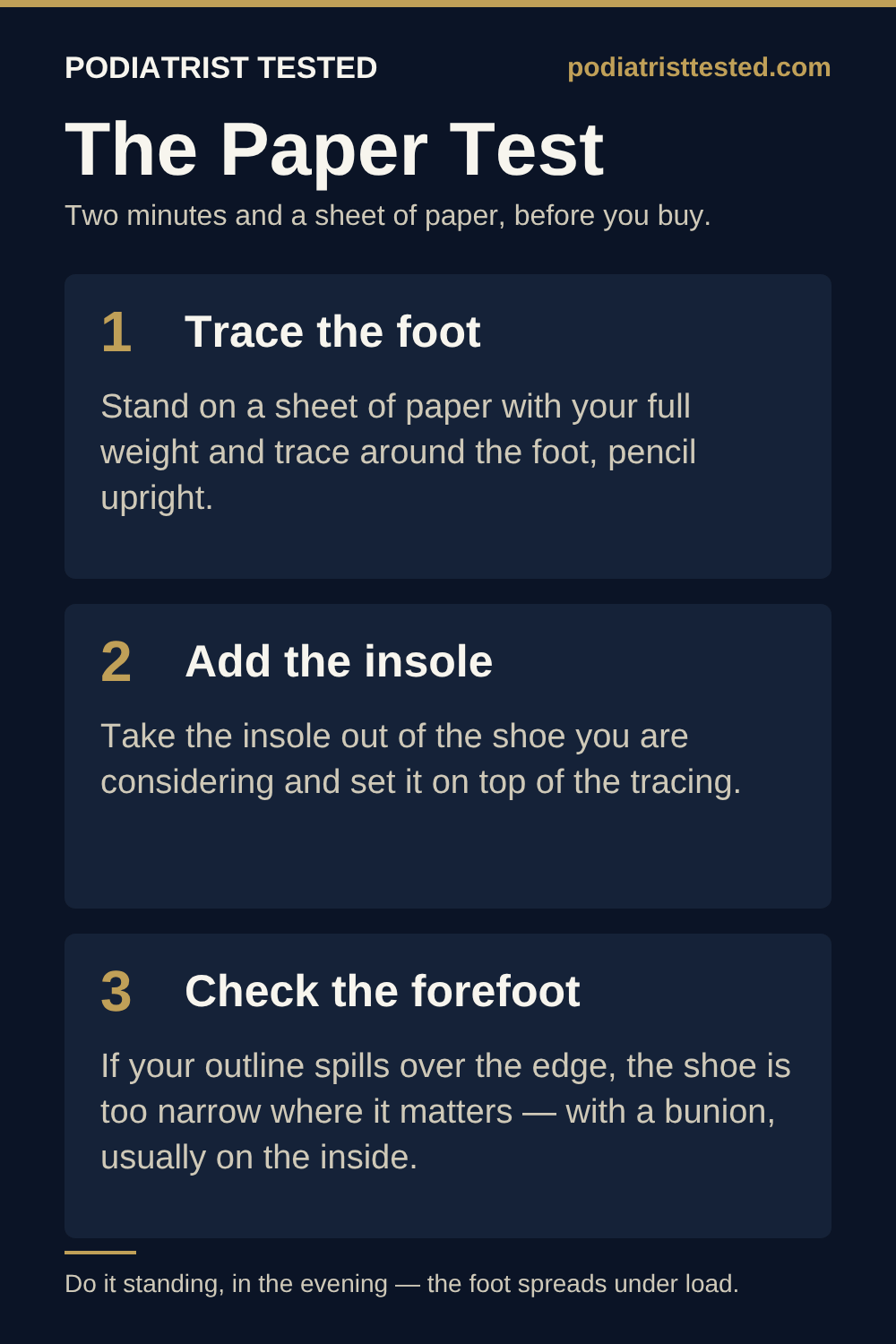
Do it standing, not sitting; the foot spreads under load. Do it in the evening. If the insole does not lift out of the shoe at all, that tells you something too: you will not be able to add an orthotic to it later.
What to wear, by situation
| Situation | What the shoe has to do | Models that meet the criteria | Status |
|---|---|---|---|
| Walking & everyday | Anatomical toe box, soft upper, low heel, arch support | Altra Torin, Topo Athletic Phantom, Hoka Bondi wide, New Balance 1080 wide | Not yet tested |
| Running | Foot-shaped forefoot plus enough stability for the pronation driving it | Altra Provision, Topo Ultrafly, HOKA Gaviota 6, ASICS Gel-Kayano wide | Not yet tested |
| Work & dress | Wide, deep last with no overlay across the joint; removable insole | Sole Bliss, Vionic dress lines, Ecco Soft, Orthofeet dress | Not yet tested |
| Sandals & warm weather | Adjustable straps that avoid the bump; contoured footbed | Birkenstock Arizona soft footbed, Vionic adjustable, Naot | Not yet tested |
| Around the house | Contoured footbed and heel cup; nothing pressing on the joint | Oofos OOahh, Birkenstock house lines, Vionic slippers | Not yet tested |
Dress shoes and flats with a bunion
This is the situation patients ask about most and the one with the fewest good answers. A ballet flat is, for a bunion, close to the worst shoe ever drawn: the toe box tapers to a point somewhere over the joint, the last is shallow, the sole is thin enough to transmit every hard floor, and because nothing fastens across the instep the foot slides forward with each step and drives the toes further into the taper. The word “flat” misleads too — plenty of them sit the heel several millimetres above the forefoot and have no heel counter worth the name.
The fix is not a different brand of the same shape. It is four specific features, and a dress shoe that has them will look slightly blunter at the toe than fashion currently dictates. That bluntness is the price, and it is also the entire point.
What to look for in a dress shoe or flat
- Something that fastens. A strap, a lace, or an elastic gore across the instep. This is the feature that matters most and the one slip-on flats do not have. If the foot cannot slide forward, the toes are not being driven into the front of the shoe all day.
- A round or square toe, not a point or an almond. Look at the shoe from directly above while it is empty. The widest part of the toe box should sit over the widest part of your foot — the joint line — not in front of it.
- Depth as well as width over the joint. A bunion is a bump that stands up as well as out. A wide but shallow last still presses on the top of the joint, which is where the skin thickens and where the lining eventually wears through.
- A removable insole. It buys you the depth to add your own support, and it is the single feature that turns a tolerable dress shoe into a usable one.
The paper test described above works on a dress shoe exactly as it does on a trainer, and it is worth doing at the end of the day rather than first thing. Feet spread as the day goes on, and a flat that fits at nine in the morning can be a millimetre short by six.
The brands that build dress lines on a deliberately wider and deeper last are the ones named in the work-dress row of the table above: Sole Bliss, Vionic’s dress range, Orthofeet’s dress range and Ecco’s softer lasts. None has been through our measurement protocol, so treat them as places to start trying rather than as recommendations. Internal toe-box width and depth are the two figures that would settle it, and no manufacturer publishes either.
One caveat about heel height, since it decides more than the brand does. A heel of two inches or more shifts load onto the forefoot and onto the first joint specifically — the joint you are trying to protect. If a dress code requires a heel, the version that does least is a block or a wedge under about an inch and a half, with a fastening across the instep. The height matters, but so does whether your foot is sliding forward into the taper the whole time you are wearing it.
The shoes worth shortlisting, and who should skip each
A bunion narrows your options in one specific way: the shoe has to clear the joint without pressing on it, and it has to do that at the end of the day as well as the start. The models below are the ones that most reliably manage it. Each entry names the foot it does not suit, because a wide toe box is not automatically the right answer for every bunion. Nothing here has been under our own caliper, so none of it carries a score or a seal.
Altra Torin — the widest genuinely foot-shaped forefoot
Altra builds on a last shaped like a foot rather than a tapered oval, and for a bunion that is the whole point: the big toe is allowed to sit straight instead of being pushed toward the second. If your complaint is that every shoe presses on the bump, this is the category that solves it most directly, and the Torin is the cushioned everyday version of it.
Reconsider it if: the change to a zero-drop platform increases your heel or Achilles symptoms. Zero drop describes heel-to-forefoot height difference, not toe-box width or cushioning. The Torin is cushioned, and heel pain does not automatically rule out every zero-drop shoe. Try changes gradually and use a comfortable option that fits your care plan. Read the heel-pain guide if both conditions apply to you.
Topo Athletic Phantom — a foot-shaped toe box without the zero drop
Topo occupies the gap that catches most people out: an anatomical forefoot as roomy as Altra’s, but built on a modest heel-to-toe drop so the calf and fascia are not asked to lengthen. For the very common patient who has a bunion and heel pain, this is usually the better starting point of the two, and it is the recommendation I make most often when someone has tried zero-drop and found their heel got worse. Our Topo vs Altra comparison has the lab figures: the toe boxes measure the same, and the drop is the difference.
Skip it if: you need real motion control for a heavily overpronating foot — the line is neutral to lightly structured, and a flat foot driving the bunion will not get the correction it needs here.
Brooks Ghost Max — a rocker for a joint that has stiffened
Bunions and a stiffening big toe joint travel together more often than people expect, and once the joint is stiff, width alone stops being enough — bending it hurts regardless of how much room the shoe gives. The Ghost Max answers with a pronounced rocker that rolls you over the joint instead of through it. Its standard toe box is not the roomy part: a lab measured the Ghost Max 4 at 71.3 mm at the big toe and 93.4 mm at the widest point, both below the middle of the 34 shoes we hold figures for, so buy it in a wide fitting. If your pain is at push-off rather than from the shoe rubbing, this is the mechanism you want. Our specification analysis of the standard Ghost covers the platform it is derived from.
Skip it if: your bump is prominent and sensitive to any contact — the upper is more structured than Altra’s or Topo’s, and a hard overlay landing on the joint will undo the benefit of everything else.
Hoka Bondi, wide fitting — when cushioning matters as much as room
Worth naming because the wide fitting is genuinely wide rather than a slightly relaxed standard, and because it brings the deepest cushioning and a strong rocker with it. For an older foot with a bunion, a thinning heel fat pad and a lot of standing to do, that combination handles three problems at once. Check the specification analysis for the measured toe-box figures, which are more useful here than the marketing.
Skip it if: your balance is unreliable — the stack height is tall. And do not buy the standard fitting hoping it will stretch; a bunion needs the wide last, not a broken-in narrow one.
Birkenstock Arizona, soft footbed — for warm weather and around the house
The adjustable straps are the feature that matters: you can position them to avoid landing across the joint entirely, which almost no closed shoe allows. The contoured cork footbed also gives the arch something to rest on, which matters because the flat-footed mechanics that drive many bunions do not switch off indoors. The barefoot hours at home undo a lot of what good shoes achieve, and this is the cheapest fix for that.
Skip it if: you have neuropathy or diabetes with any loss of sensation — an open sandal with a firm footbed and no toe protection is a poor idea on a foot that cannot feel a rub developing. Also skip the firm footbed version if the joint is tender; take the soft one.
Vionic dress lines — when a dress code is the constraint
The hardest category for a bunion, because dress shoes achieve their shape by tapering exactly where you need room. Vionic’s dress and dress-casual lines are built on a wider, deeper last with a contoured footbed already in the shoe, which makes them one of the few genuinely wearable options that still reads as smart. Look specifically for models without a stitched overlay crossing the joint.
Skip it if: you already wear a prescribed custom orthotic — the built-in footbed and your own device will fight each other. In that case you want a dress shoe with a flat removable insole and depth to spare instead.
The shoes we have spec pages for, and their published widths
Read this before the table. For a bunion the numbers that decide everything are the internal widths of the toe box, and we have not measured them ourselves yet — they are the first figures our bench produces. No manufacturer publishes them either; the lab figures near the top of this page are the only independent ones. What brands do publish is the range of widths a model comes in. Treat the table as a shortlist to go and try on, not as a recommendation.
| Shoe | Published widths | Skip it if… | Check price |
|---|---|---|---|
| New Balance 880v15 The widest width range here | Men B / D / 2E / 4E · Women 2A / B / D / 2E | You need a foot-shaped toe box rather than a wider one. Width letters widen the whole shoe; they do not change the taper at the front. | Men’s Women’s |
| ASICS GT-2000 15 Stability with a 4E option | Up to 4E | You run in custom orthotics, or you have rigid flat feet or a posterior tibial tendon problem — its own review says so. | Men’s Women’s |
| HOKA Bondi 9 Max cushion; wide and extra wide offered | Regular, Wide, X-Wide | You picked it for HOKA’s stated 5 mm drop. The lab that cut one open measured 9.1 mm. | Check price (men’s) |
| Brooks Ghost 17 Neutral daily shoe, wide offered | Regular, wide, extra wide | Your forefoot needs room. The same lab measures its toe box at 69.6 mm against the Bondi 9’s 72.5 mm — the narrowest front end in this table. | Check price (men’s) |
| KURU ATOM 2 Built for standing; roomy forefoot claimed by the brand | Men D / 2E / 4E · Women B / D / 2E | You need room at the toes. KURU calls the forefoot roomy; a lab measured 70.7 mm at the big toe, below the middle of the 34 shoes we hold figures for, and the shallowest toe box of them all. | Men’s Women’s at KURU |
Amazon affiliate links — we earn a commission at no extra cost to you. Commission rates differ between products, and we do not rank by commission rate. None of these has been measured or worn by us; every one is a spec analysis until it goes on the bench.
If you have a bunion and plantar fasciitis at the same time
These two problems want opposite things from a shoe, which is why advice written for each one separately tends to make the other worse. The conflict is worth naming plainly before resolving it.
A bunion needs room around the joint: an appropriately shaped toe box and an upper that does not press on the bump. That can be combined with cushioning or support; a wide toe box does not require a zero-drop or minimalist platform. If you also have plantar heel pain, choose footwear that accommodates both symptoms. No single drop, arch-support level or midfoot stiffness is established as a universal prescription for the combination. Footwear and inserts can complement a care plan that includes stretching and appropriate activity modification.
The resolution: width and drop are not one choice
You do not need a zero-drop shoe to get room for a bunion. Width and heel-to-toe drop are independent variables, and the shoes that give you a genuinely wide last and a normal drop are mainstream neutral and stability trainers offered in 2E and 4E — not barefoot shoes. Three of the shoes with spec pages on this site sit at that intersection.
| Shoe | Published drop | Published widths | Why it suits both |
|---|---|---|---|
| Brooks Ghost 18 | 10 mm (an independent lab measured 12.2 mm) | Four widths | The highest published drop of any shoe with a spec page here, and it still comes in four widths. The closest thing to a single answer for this combination. |
| ASICS Gel-Kayano 32 (now succeeded by the Kayano 33, also 8 mm) | 8 mm | Wide and extra wide | Adds stability to the drop, which matters if the bunion is being driven by pronation rather than by shoe shape alone. |
| ASICS GT-2000 15 | 8 mm | Up to 4E | The lighter, cheaper stability option at the same drop and the widest ASICS fitting. |
The second route is a rocker. A rocker sole reduces how far the big toe joint has to bend at push-off, which helps a bunion that has begun to stiffen, and it smooths the tension spike the fascia takes at toe-off. The Brooks Ghost Max 4 is the rockered option among the shoes named on this page: a 6 mm published drop, a 4E width, and a last Brooks builds around a removable insole.
One figure worth understanding if the HOKA Bondi 9 is on your list: HOKA publishes a 5 mm drop, while RunRepeat measured 9.1 mm. Manufacturer and laboratory methods can produce different figures, so this is not proof that the specification is wrong. Nor does the larger measured drop establish a better treatment for plantar heel pain. These are published figures, not measurements taken by Podiatrist Tested.
Which one to treat first
Manage both problems according to their symptoms. Plantar heel pain may benefit from stretching, exercise and appropriate activity modification; an orthotic may be used alongside other treatment when indicated. A roomy shoe can protect the bunion from rubbing during that care. Persistent pain at either site deserves assessment, rather than waiting for heel pain to settle before seeking an opinion about the bunion.
One thing to avoid while you do it: a rigid off-the-shelf insole with a hard arch bar. It is a common self-prescription for heel pain, and in a foot where the first ray has become unstable — which is part of what a progressing bunion is — a hard bar under the arch can load the joint you are trying to protect. A contoured insole with some give under the arch and real room in the forefoot is the better starting point. Our plantar fasciitis guide works through the support question in detail.
Bunion sleeves, spacers and splints: what they actually do
These are worth using and worth having accurate expectations about. A gel sleeve or pad over the joint reduces friction and pressure from the shoe, and for many people that is the difference between a comfortable day and a sore one. A toe spacer sitting between the first and second toes can relieve the crowding and feels good, particularly at rest — our toe spacer guide covers what the trials found, who they suit and how to build up wear time.
What none of them do is realign the joint permanently. A night splint holds the toe in a straighter position while you sleep, and the toe returns to its position once you stand on it. That is not a reason to avoid them — comfort is a legitimate goal in itself — but if a product is sold on the promise of correcting the deformity without surgery, that claim is not supported.
What to stop wearing
- Pointed toes, including pointed flats. The shape is the problem, and a flat pointed shoe compresses the joint just as effectively as a heeled one.
- Heels above roughly two inches for daily wear. They load the forefoot continuously.
- Rigid overlays across the bump — logo panels, welded synthetic strips, decorative stitching.
- Shoes you are “breaking in.” A shoe that hurts over the joint now will still be the wrong shape later.
- Going a size longer to gain width. It buys forefoot room at the cost of a heel that slips and an arch in the wrong place. Buy the right width and shape instead.
After bunion surgery: what to wear, phase by phase
After bunion surgery, follow the surgeon’s instructions for weight-bearing, the boot or surgical shoe, joint motion and the move back into ordinary footwear. Osteotomies, fusions and other corrections can have different restrictions. A timeline published for one procedure, including Lapiplasty, is not a recovery schedule for every operation. The fit considerations below apply only once your surgical team clears that stage; swelling and healing can change the timing.
- In the boot. The boot adds height to one leg. Put a shoe with a similar sole height on the other foot, or a boot-leveller over it, from the first day, or your hip and back will pay for the difference.
- First weeks in a shoe. A roomy, stiff-soled, rockered trainer, a half to a full size bigger than usual if the swelling needs it, with the laces loosened over the top of the foot. Mesh, not leather, over the incision. The rocker rolls you over a joint that has not yet earned the right to bend.
- The swelling months. The foot swells at the end of the day for months. Buy for the evening foot, keep a roomier pair for bad days, and expect your usual size to feel right again only gradually.
- Back to normal shoes. Return to dress shoes, flats or heels only when the surgical team clears the footwear and activity involved. A fixed fourth-month milestone does not apply to every operation. Check that the toe box and upper accommodate any remaining swelling and do not rub the incision or joint.
What the surgery changes is the bone, not the shoe that caused the trouble. The toe box that hurt before the operation is the toe box to avoid after it.
When footwear is no longer the answer
Shoes, padding and orthoses are the first line and they resolve the symptoms for a great many people. The conversation changes when the joint hurts even in a roomy shoe or at rest, when the big toe has begun to overlap or underlap the second toe, when the second toe is being pushed into a hammertoe or developing pain under its base, when the joint is becoming stiff and arthritic, or when the deformity is limiting activities you care about. At that point a surgical opinion is reasonable — not inevitable, but reasonable. Modern bunion correction is a family of procedures chosen by the specific pattern and severity of the deformity, and the right operation depends on measurements taken from weight-bearing X-rays rather than on how the foot looks.
Getting it looked at. A podiatrist can tell you in one visit which part of the deformity is actually driving your pain, usually with weight-bearing X-rays. If you are in Michigan, Dr. Biernacki practises at Balance Foot & Ankle in Howell and Bloomfield Hills. Anywhere else, look for a podiatrist (DPM) or a foot and ankle orthopaedic surgeon. This page is footwear guidance, not a diagnosis.
What the research actually supports — and where it stops
Almost everything written about bunions and footwear, including most of this page, is mechanical reasoning rather than trial evidence. It is worth being straight about which parts have been measured and which have not.
The part that is well established is prevention: narrow, tapered footwear is a recognised modifiable risk factor for developing hallux valgus in the first place.
How well established, and against what? A 2026 systematic review in BMC Musculoskeletal Disorders pooled 23 observational studies to rank the factors associated with hallux valgus, and the footwear result is not the one most people expect. Narrow-toed shoes carried the higher odds — 2.25 (95% CI 1.64–3.07) — and high heels the lower, at 1.65 (1.27–2.15). The toe box, not the heel height, is the larger association, which is the same order of priority this page argues for on mechanical grounds. Female sex was the strongest factor in the review at 2.57, with foot pain 2.36, knee pain 2.04, osteoporosis 1.50 and flatfoot 1.19 also reaching significance. Body mass index did not. That is worth printing, because “lose some weight and the bunion will settle” is common advice with nothing in this data behind it. The authors are careful about what the review is: hallux valgus was defined three different ways across the included studies, nearly all of which were cross-sectional or case-control, so these are associations and not proof of cause; lifetime footwear history and genetics were not measured; and they grade the overall certainty low to very low.
The part that is less settled is what a roomier shoe does once the deformity is already there and already painful.
A 2025 study in the Journal of Foot and Ankle Research looked at exactly that question. The researchers took 28 women with moderate or severe painful hallux valgus (mean age 60.7), laser-scanned the shape of the symptomatic foot, hand-traced the toe box of the shoes those women actually wear, and recorded in-shoe pressure at the medial forefoot. Two findings are worth carrying into a shoe shop.
- The load was concentrated further forward than the bump. Peak pressure was significantly higher at the distal forefoot than the proximal forefoot — a mean difference of 33.0 kPa (p < 0.001), with maximum force 12.8 N higher (p = 0.001) and arriving slightly later in the step.
- A roomier toe box did not predict lower pressure. There was no significant correlation between how much wider or larger the toe box was than the foot inside it and the pressure measured at the medial forefoot — every correlation came in below 0.35, none statistically significant. The authors’ own conclusion is that changing the toe-box width and area of the footwear these women habitually wore “may not necessarily reduce medial forefoot pressures”.
That sounds like it contradicts the advice above. It does not — it sharpens it. A foot-shaped toe box reliably solves a friction problem: the seam sitting on the bump, the red mark, the callus, the skin that breaks down over the joint. That is the complaint most people actually walk in with, and shape fixes it. What this study suggests is that shape alone should not be expected to change the load travelling through the forefoot in an established bunion. Those are two different problems, and it is why one person gets complete relief from a wider shoe while the next says the shoe is comfortable but the joint still aches by the evening.
The second problem is what a metatarsal pad, an orthosis or a rocker sole is for, and it is the reason this page lists arch support and a low heel alongside toe-box shape rather than treating width as the whole answer.
What the study cannot tell you, and the authors are clear about it: 28 participants, all women, all with moderate or severe deformity, so it says nothing about a mild bunion or about men. It was cross-sectional — it measured the shoes those women already owned, not what happens when somebody moves into a genuinely foot-shaped last, which is the actual recommendation here. It measured pressure, not pain, and the two are not the same thing. And it was not a prevention study, so it does not touch the stronger evidence that narrow shoes contribute to the deformity developing.
Our reading, stated plainly so you can disagree with it: buy for shape to stop the rubbing and to avoid driving the deformity further, and treat anything that unloads the forefoot as a separate decision rather than something the shoe has already handled.
Sources
- Zhang G, Ma Y, Zhang S. Determinants and associated factors for hallux valgus: a systematic review and meta-analysis. BMC Musculoskeletal Disorders 2026;27:647. doi:10.1186/s12891-026-10054-1
- Bajraszewski KJ, Lim PQX, Buldt AK, Hurn SE, Mickle KJ, Roddy E, Wluka AE, Erbas B, et al. Footwear toe-box shape and medial forefoot pressures in women with hallux valgus. Journal of Foot and Ankle Research. 2025;18(2):e70041. PMID 40220280.
About toe spacers
A silicone spacer may reduce rubbing between toes for some people. Small studies of toe separators and related orthoses have also reported modest changes in the hallux-valgus angle, but the evidence is limited and does not establish a dependable permanent cure. Treat a spacer as an option for fit and comfort, rather than a promise that wedging the toes apart will correct the deformity.
What some people do get is comfort: less skin-on-skin rubbing between the first and second toe, and a stretch that feels good after a day in narrow shoes. At about $10 the Mind Bodhi spacers (paid link) are a cheap thing to test that against. Start with twenty minutes at home, not a full day in a shoe, and if they hurt, stop — pain here is not the device working.
Frequently asked questions
What shoes do podiatrists recommend for bunions?
Shoes with an anatomical, foot-shaped toe box, extra depth, a soft seam-free upper over the joint, a low heel and genuine arch support. Brands frequently recommended include Altra, Topo Athletic, Birkenstock, Hoka and New Balance in wide fits, and purpose-built lines such as Sole Bliss, Orthofeet and Vionic. Shape matters more than the width letter on the box.
Can the right shoes correct a bunion or make it go away?
The right shoe can relieve pressure and make walking more comfortable, but footwear is not an established way to permanently correct a bunion. Some small studies of splints, exercises or orthoses report modest alignment changes; the certainty is low. Arch support may help symptoms for some people, but it should not be presented as a proven way to stop progression.
Do wide shoes stop bunions from getting worse?
Roomy, well-shaped shoes remove a known aggravating factor, and that helps. But bunions are largely driven by inherited foot structure and mechanics, so footwear alone does not guarantee a bunion will stop progressing. Think of it as removing the accelerator rather than applying a brake.
What is a stage 4 bunion?
Ask which grading system is being used: “stage 4” is not a single universal diagnosis. Clinicians assess alignment on weight-bearing X-rays alongside pain, joint motion and neighbouring-toe problems. A severe-looking bunion does not automatically require surgery. A surgical opinion is reasonable when pain or walking limitations persist despite appropriate nonsurgical care; the decision depends on the individual assessment.
Are barefoot or zero-drop shoes good for bunions?
A roomy toe box may reduce pressure on the bunion, but check the actual fit. Zero drop is the heel-to-forefoot height difference; it does not mean there is no cushioning. For example, the Altra Torin 8 is a cushioned zero-drop shoe. Minimalist footwear is a separate construction choice. Choose an option that is comfortable for your bunion and any heel or Achilles symptoms, rather than assuming all zero-drop shoes help or harm.
Is walking barefoot better for bunions?
Not necessarily, and it is a different question from whether minimalist shoes help. Walking barefoot removes the compressive force of a narrow toe box, which is the single thing most likely to make a bunion symptomatic — so on carpet at home, barefoot is often comfortable. What barefoot walking does not do is correct the deformity, because the underlying alignment at the first metatarsal is structural. On hard floors it also removes cushioning and arch support at the same time, which is why people with a bunion plus flat feet or plantar fasciitis frequently feel worse barefoot, not better. The useful version of the idea is a shoe with a foot-shaped toe box that lets the toes sit where they would barefoot, while keeping the support underfoot.
Are Birkenstocks good for bunions?
Often, yes, with one condition: the strap has to miss the joint. An open-toed Birkenstock leaves the big toe free, the cork footbed has a real arch and a ridge for the toes to rest against, and the buckles let you ease the strap that crosses the joint. Stand in a two-strap Arizona before you buy it and check where the front strap crosses your foot; on some feet it lands right on the bump. Avoid the styles with a strap around or beside the big toe, the toe-loop Mayari and the thong-style Gizeh, which press on a big toe that is already drifting. The soft-footbed versions are kinder for the first weeks. Our guide to whether Birkenstocks are good for your feet covers the widths and the break-in.
Should I wear a bunion splint at night?
A night splint may be worth a trial if it is comfortable. Studies report variable pain and alignment outcomes, with low certainty overall; a dependable permanent correction is not established. Stop using it if it increases pressure or pain, and have persistent symptoms assessed rather than relying on the splint alone.
What we are testing next
Every model named here is in the testing queue. Internal toe-box width at the widest point and internal toe-box depth are measured on every pair we test — the two numbers that decide whether a shoe works for a bunion and the two that almost nobody publishes. We publish them whether or not they flatter the shoe, and no brand can buy a score or a seal. See our Editorial Policy and Independence pages.
This guide is general education, not medical advice, and does not create a doctor-patient relationship. Bunion severity and the right treatment are determined by examination and weight-bearing X-rays. If your joint is painful at rest, stiffening, or deforming the neighbouring toes, see a foot and ankle specialist.
Correction — 7 October 2026: We clarified the distinction between zero drop and cushioning, the uncertain evidence for nonsurgical alignment changes, procedure-specific postoperative restrictions, and the source of published laboratory measurements. These corrections do not represent new bench testing.
Browse the full list: 17 assessed for wide feet · 39 in a wide fitting. Each page shows the published drop, stack, weight, widths and price side by side. Not sure which of them is you? Answer four questions and we will narrow it to two or three.
Recently reviewed
Individual shoe pages state their evidence tier, published measurements and who should skip them.
Saucony Endorphin Speed 5
Spec AnalysisLight plated neutral trainer. Saucony publishes both stack heights and they match its 8 mm drop — not yet tested.
HOKA Mach 6
Spec AnalysisLower, firmer neutral HOKA. HOKA publishes a 5 mm drop and neither stack height — not yet tested.
ASICS Novablast 5
Spec AnalysisBouncy high-stack neutral. ASICS publishes an 8 mm drop and neither stack height — not yet tested.
Our funding and evidence policy
We earn affiliate commissions from qualifying purchases. Our policy is to assess published evidence and fit needs rather than rank products by commission rate. Current reviews are specification analyses; see our method for their limits.