
Hoka Bondi vs Arahi: Podiatrist Comparison 2026
HOKA has since released the Arahi 9. The comparison below was written against the Arahi 8, and that is the shoe the buy links point to. This page compares published specifications and independent laboratory data for the Bondi 9 and Arahi 8; it does not contain our own bench or wear results.
Written and medically reviewed by Dr. Tom Biernacki, DPM, FACFAS · Last reviewed 7 October 2026
We earn a commission if you buy through links on this page, including Amazon links paid by brand partners through Levanta, at no cost to you. As an Amazon Associate I earn from qualifying purchases. How we make money
On this page
- HOKA Bondi 9 vs Arahi 8: The Core Difference
- HOKA Bondi 9: Who It’s For
- HOKA Arahi 8: Who It’s For
- Bondi 9 vs Arahi 8: Side-by-Side
- Matching Shoe to Foot Type
- Which Shoe for Specific Foot Conditions
- Arahi 6 vs Bondi 7: what to do about the discontinued pairs
- The Most Common Mistake
- The Bottom Line
- Podiatrist’s Top Picks: Dr. Tom Biernacki’s Final Recommendations
- Frequently Asked Questions
- Bondi or Arahi — or something underneath?
- What the research actually supports — and where it stops
- Related guides & shoe pages
Correction (7 October 2026): Corrected source attribution and the explanation of model construction; removed unsupported condition-specific treatment rankings and clarified the limits of laboratory measurements. These changes do not represent new bench or wear testing.
Not yet bench-tested. This guide was written by Tom Biernacki, DPM, FACFAS from clinical experience and moved to Podiatrist Tested from the practice’s patient library. The products named here have not been measured or worn under the Podiatrist Tested standard, so no scores and no Seal appear on this page. Tested reviews replace these recommendations as they are published.
Any stack heights, drops, weights, heel-cup depths or other dimensions quoted on this page are manufacturer or retailer specifications, or credited independent laboratory measurements, as labelled below. They are not Podiatrist Tested measurements or evidence that either shoe treats a particular condition.
Podiatrist Tested is reader-supported. Links to Amazon are affiliate links; commissions never influence a recommendation or a score. Read the independence policy.
Hoka Women’s Bondi 9
Hoka Men’s Bondi 9
HOKA Arahi 8 — women’s and men’s links
Women’s Arahi 8 — check price on Amazon Men’s Arahi 8 — check price on Amazon
Quick answer from Tom Biernacki, DPM, FACFAS
Quick answer: The HOKA Bondi 9 is a highly cushioned neutral shoe; the Arahi 8 adds H-Frame stability features. Both provide cushioning, and both may suit more than one arch type. Compare fit, comfort during your intended activity and any support your clinician has prescribed. A stability shoe is not automatically a substitute for prescribed motion-control footwear. Neither arch height nor a diagnosis alone establishes that one of these models is the right choice.
Model versions: HOKA has moved this matchup on. The Arahi 8 compared here gave way to the Arahi 9, on general sale in the US since 1 October 2026; the current Clifton is the Clifton 11, and the Bondi 9 is the current maximal shoe. The older versions are often discounted while stock lasts. What RunRepeat’s lab found on the Arahi 9, and who should still buy the 8, is in our podiatrist’s review of the Arahi 9 lab data.
HOKA Bondi 9 vs Arahi 8: The Core Difference
The main design difference is neutral cushioning versus cushioning with an added stability system. It is not a choice between cushioning and control as if only one could be present. Fit, movement, activity and the reason for any symptoms also matter.
The Bondi 9 has a neutral, highly cushioned platform with a broad base and rocker geometry; RunRepeat measured 41.3 mm at the heel. The Arahi 8 uses HOKA’s H-Frame stability system with dual-density foam. HOKA describes that system as intended to combat overpronation. These construction differences do not establish that a neutral shoe harms every flat foot or that a stability frame harms every high-arched foot.
HOKA Bondi 9: Who It’s For
HOKA Bondi 9
Men’s Bondi 9 — check price on Amazon · Read our spec review
The Bondi 9 is HOKA’s highly cushioned neutral daily trainer, with supercritically foamed EVA and a Smooth MetaRocker. RunRepeat measured a 41.3 / 32.2 mm heel/forefoot stack and 146 SA of heel shock absorption. That is a laboratory shoe measurement, not a measurement of force reaching an individual patient’s heel, metatarsals or healing bone.
When to consider the Bondi 9: when you want a neutral, broad-base shoe with substantial underfoot cushioning and its rocker feels comfortable during your intended activity. People with high arches, heel or forefoot pain may wish to compare this design, but the diagnosis does not guarantee benefit. After surgery or a stress fracture, return to ordinary shoes requires clearance and an appropriate protection plan.
When to compare other options: when its weight, toe-box fit or ride does not suit you, or when you need support the shoe does not provide. “Neutral” does not mean no inherent stability, and visible pronation alone does not establish that the Bondi is unsuitable. HOKA’s description of a plush ride also should not be confused with a softness measurement: RunRepeat describes its tested foam as relatively firm.
Key takeaway: The Bondi offers more heel shock absorption than the Arahi 8 in this lab comparison. That does not prove it is the best shoe for painful feet or that it will make a foot needing additional support worse.
HOKA Arahi 8: Who It’s For
HOKA Arahi 8
Women’s Arahi 8 — check price on Amazon Men’s Arahi 8 — check price on Amazon
The Arahi 8 is HOKA’s stability daily trainer. Its H-Frame replaced the Arahi 7’s J-Frame and allows the use of softer foam than its predecessor, according to HOKA. The dual-density frame is a design intended to guide pronation; whether its pressure and fit feel comfortable is individual.
When to consider the Arahi 8: when you prefer an added stability system or your clinician recommends trying this type of support. Low arches or inward movement can be part of that assessment, but do not automatically identify the cause of shin, tendon or knee pain or prove that the Arahi treats it.
The Arahi is not automatically interchangeable with prescribed motion-control footwear. If a clinician has asked for a particular level of support, check whether this shoe meets that plan. The Brooks Addiction Walker and New Balance 1540 are other constructions to compare, rather than automatic upgrades. If you use an orthotic, assess the complete shoe-and-insert combination for depth, heel retention, contact pressure and comfort; no combination is guaranteed to avoid over-correction.
Arahi 9: independent laboratory data for the new model differ from the Arahi 8. Our Arahi 8 vs 9 comparison explains the measured geometry and stiffness changes. A lower twisting torque or a narrower toe box is a design difference, not proof of worse clinical results.
Bondi 9 vs Arahi 8: Side-by-Side
Here are the published specifications and independent lab results for these model versions. They describe the shoes, rather than ranking treatments for foot conditions:
| Specification | HOKA Bondi 9 | HOKA Arahi 8 |
|---|---|---|
| Stability category | Neutral | Mild stability (H-Frame) |
| Stack height, heel | 43 mm | 39 mm |
| Stack height, forefoot | 38 mm | 31 mm |
| Drop, as stated | 5 mm | 8 mm |
| Drop, lab-measured | 9.1 mm | 11.3 mm |
| Heel stack, lab-measured | 41.3 mm | 39.4 mm |
| Heel impact absorbed, lab | 146 SA | 138 SA |
| Force to bend the forefoot, lab | 16.5 N | 18.3 N |
| Twist stiffness, lab | older method | 19.5 Nm |
| Toe box, big toe / widest, lab | 72.5 / 94.1 mm | 73.6 / 95.3 mm |
| Weight, men’s | 297 g | 278 g |
| Widths | Regular, Wide, X-Wide | Regular, Wide, X-Wide |
| MSRP | $175 | $150 |
Bondi 9 stack, drop and weight: HOKA. Arahi 8 stack heights: Fleet Feet; its drop, weight and price: HOKA. Lab rows: RunRepeat’s Bondi 9 review and Arahi 8 review; SA is its shock-absorption metric. The figures describe the lab’s tested samples and method, not every size or width. Bondi 9 twist stiffness was assessed with an older method, so it cannot be compared numerically with the Arahi’s Nm figure. Manufacturer and lab geometry can differ by measurement method; neither is an individual treatment outcome. Neither shoe has been measured under the Podiatrist Tested protocol, so no score and no Seal appear here — see how we test.
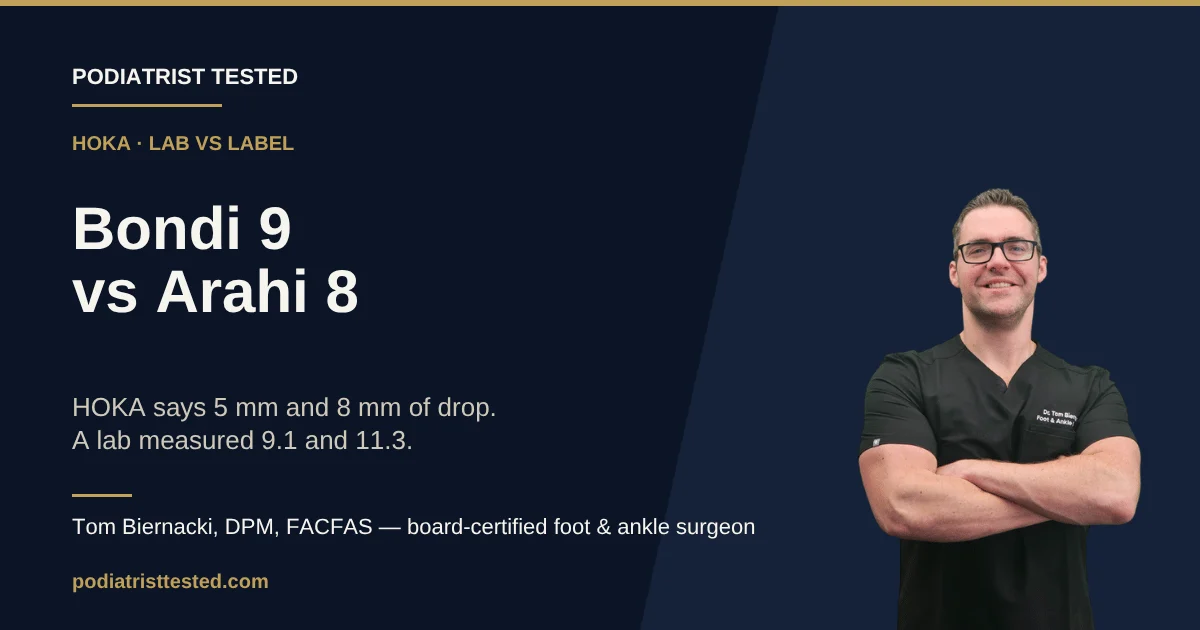
RunRepeat measured the Bondi 9 at 9.1 mm of drop and the Arahi 8 at 11.3 mm, compared with HOKA’s published 5 and 8 mm. The Arahi therefore had the higher drop under both reporting methods. It also required more force to bend at the forefoot in the lab (18.3 versus 16.5 N), while the Bondi recorded higher heel shock absorption. These figures do not establish how either shoe changes Achilles load, plantar-fascia strain or pain in an individual wearer.
For plantar fasciitis: the Bondi 9’s higher lab shock absorption and the Arahi 8’s stability system are different features to discuss or try. No head-to-head clinical trial cited here shows that arch type, heel drop or stiffness identifies which model gives better pain relief. Similarly, the Arahi 8’s greater measured twist stiffness than its successor does not prove better plantar-fasciitis outcomes; our Arahi 8 vs 9 comparison describes the design changes.
Matching Shoe to Foot Type
Arch height, flexibility and movement may inform fitting, but do not dictate a shoe by themselves. Pronation is part of normal movement; an imprint or appearance alone does not establish that it is excessive or causing symptoms.
High arch (pes cavus) / rigid foot: A cushioned neutral option such as the Bondi 9 may feel comfortable, but added support is not automatically harmful. Insole material and posting depend on the purpose of the device, pressure and fit. Our best insoles for high arches guide covers options to discuss.
Flat foot / low arch (pes planus) with flexible pronation: The Arahi 8 is an option when added stability is wanted. A low arch does not always need treatment, and neither a home-measured heel angle nor an arch touching the floor establishes which support is required. If an insert is part of the plan, best insoles for flat feet compares designs; custom devices are a separate fitting decision.
Neutral arch / moderate pronation: Either model may suit you. Compare usable toe room, heel retention, comfort during the intended activity and the complete fit with any prescribed orthotic. Heel, arch or knee pain alone is not enough to select one model.
Key takeaway: A “wet foot test” shows the contact shape of a stationary foot. It does not assess motion during gait or diagnose the cause of pain, and should not be used to prescribe Bondi versus Arahi. A randomised military study found little injury benefit from assigning shoe categories by plantar shape; that population and those shoes differ from this comparison.
Which Shoe for Specific Foot Conditions
- Plantar fasciitis: Neither model has demonstrated superior pain relief in a comparison cited here. Fit and comfort, any prescribed support and the wider treatment plan matter; arch shape alone does not select the winner.
- Metatarsalgia (ball-of-foot pain): Forefoot room, cushioning and a comfortable roll-through are features to assess. The Bondi’s rocker does not establish a fixed 15–20% reduction in metatarsal pressure; published rocker results depend on the tested geometry and wearer.
- Posterior tibial tendon pain: The Arahi offers a stability construction, but this page does not demonstrate reduced tendon loading or establish whether a shoe, orthosis or more protective device is needed.
- Achilles tendon pain: Heel drop and rocker geometry can affect mechanics, but shoe measurements do not establish that either model takes enough tension off the tendon or treats insertional pain. The cause, location and response to the complete shoe should inform the clinician’s advice.
- Knee pain: This comparison does not show that either shoe treats medial compartment pain or runner’s knee. Pronation, cushioning and knee loading cannot be reduced to an arch-type rule.
- Stress fractures (metatarsal recovery): Follow the prescribed protection and weight-bearing plan. A highly cushioned shoe or rocker is not a replacement for that plan; use ordinary footwear only when the treating clinician says it is appropriate.
Arahi 6 vs Bondi 7: what to do about the discontinued pairs
A good number of people reach this page searching Hoka Arahi 6 vs Bondi 7 rather than the current models — usually because they already own one of them, because a fitter or a podiatrist named that model to them years ago, or because a discontinued size has turned up at a discount. The first thing worth saying is that Bondi and Arahi are not two versions of the same shoe. They are two different categories, and they have been in every generation.
- The Arahi is HOKA’s stability trainer, and the Arahi 6 is no exception. Fleet Feet’s spec sheet for the Arahi 6 lists it as Category: Stability and describes HOKA’s J-Frame as a J-shaped hook of foam that wraps the heel and lines the medial side of the shoe. Listed drop 5 mm; listed weight 9.3 oz men’s / 7.6 oz women’s. On that update the J-Frame, the EVA and the Meta-Rocker all carried over unchanged from the Arahi 5 — the changes were a lighter upper and a plusher tongue.
- The Bondi is HOKA’s maximum-cushion neutral trainer, and the Bondi 7 is no exception. No J-Frame, no medial post. Solereview’s review of the Bondi 7 lists a 4 mm drop, weighed it at 323 g / 11.4 oz for a men’s US 9, records D / 2E / 4E widths, and describes the compression-moulded EVA midsole as medium-soft with a hint of firmness.
The neutral-versus-stability distinction remains relevant to Bondi 7 vs Arahi 6, but the individual models are not mechanically identical to the current versions. Foam, fit, stack, rocker and support systems can change between generations. Do not transfer the Bondi 9/Arahi 8 lab results or a pain-related recommendation to the older pairs without checking the actual shoe.
Two caveats that matter more than the model number:
- We have not had the Bondi 7 or the Arahi 6 on our own bench. The figures above are attributed manufacturer/retailer specifications and an independent reviewer’s measurements. The current HOKA Bondi 9 and HOKA Arahi 8 pages also distinguish published and third-party laboratory figures from our own testing; neither has completed our bench or wear protocol.
- Check the condition of a discontinued pair. Consider its storage, construction, compressed cushioning, upper damage and worn soles. A model’s release date alone does not determine the condition of a particular pair or how much protection it provides.
Arahi 8 belongs to the same stability family as Arahi 6, and Bondi 9 to the same neutral family as Bondi 7. They are not identical replacements, and Arahi 9 is now available. Compare the actual model’s fit and construction rather than assuming the family name settles the choice.
The Most Common Mistake
A useful fitting mistake to avoid is deciding from either an arch label or a brief soft-underfoot impression alone. Compare both shoes in the intended activity and consider any support already prescribed. Comfort matters, but a short try-on does not establish long-term pain relief or injury protection.
A shoe also needs to accommodate an orthotic if one is used. Check internal depth, heel retention and contact pressure with the actual device in place. This guide does not establish a 30–50% loss of orthotic effectiveness in a particular shoe category or show that a stability shoe is always the best platform.
⚠️ See a podiatrist before buying if:
- You’ve already tried 2+ pairs of shoes and still have foot, knee, or lower back pain
- Your podiatrist has prescribed motion-control shoes (neither HOKA is appropriate — escalate)
- You have diabetes, neuropathy, or Charcot foot (shoe selection is a medical decision)
- You’re recovering from a foot/ankle surgery or stress fracture
- Your heel valgus (inward tilt) is visually severe
The Bottom Line
The HOKA Bondi 9 offers a highly cushioned neutral design; the Arahi 8 adds H-Frame stability features. The table helps compare their construction and the tested samples. Choose with attention to fit, activity, comfort and any clinician-directed support. Persistent symptoms need assessment; neither a shoe category nor one consultation guarantees pain relief or an immediate definitive footwear answer.
Podiatrist’s Top Picks: Dr. Tom Biernacki’s Final Recommendations
APMA: Choosing Shoes for Sports
HOKA — My Picks
HOKA Clifton 11 — The everyday neutral pick when the Bondi is overkill — lighter underfoot, still well-cushioned. Read our Clifton 11 spec analysis.
Women’s Clifton 11 — check price on Amazon Men’s Clifton 11 — check price on Amazon
HOKA Arahi 8 — An H-Frame stability option to compare when you want added guidance. Its ride and contact pressure should be judged in the actual shoe; this guide has no own wear test establishing comfort or a treatment advantage.
Women’s Arahi 8 — check price on Amazon Men’s Arahi 8 — check price on Amazon
Frequently Asked Questions
What is the difference between Hoka Bondi and Hoka Arahi?
For the versions compared here, Bondi 9 is HOKA’s highly cushioned neutral model, while Arahi 8 adds an H-Frame stability system. Both provide cushioning. The appropriate choice depends on fit, activity, comfort and any prescribed support; a flat arch or history of ankle pain does not automatically select Arahi.
Are Hoka Arahi good for flat feet?
Arahi 8 is a stability option that some people with low arches may prefer. HOKA describes its H-Frame as intended to combat overpronation. Not every low arch needs added support, and the shoe has not demonstrated a universal clinical or comfort advantage for flat feet in evidence cited here.
What is the main difference between Hoka Bondi and Arahi?
Bondi 9 has a neutral, highly cushioned platform with rocker geometry; Arahi 8 adds H-Frame stability features. Neither category belongs exclusively to one arch type. These are version-specific comparisons: older Arahi models used J-Frame, and Arahi 9 is now available.
Is Hoka Bondi or Arahi better for plantar fasciitis?
No head-to-head clinical trial cited here establishes which model provides better plantar-fasciitis relief. Bondi 9 had higher heel shock absorption in RunRepeat’s lab, while Arahi 8 has an added stability system and required more force to bend at the forefoot. Those measurements are not treatment results. Fit, comfort, any recommended support and the overall care plan should guide the choice.
Bondi or Arahi — or something underneath?
Both shoes cushion, and the Arahi adds a stability system. If symptoms persist, reassess the diagnosis, activity demands and shoe-and-insert fit with your clinician rather than assuming the midsole or foot mechanics alone explain the problem.
What the research actually supports — and where it stops
Product specifications, laboratory mechanics and clinical outcomes answer different questions. Neither shoe has completed our own testing, and this comparison has no model-specific clinical trial demonstrating superiority for the conditions discussed above.
Khusal and colleagues’ 2026 scoping review examined how rocker footwear is defined and measured. It included 19 academic sources, mostly experimental studies, plus commercial descriptions. It did not compare Bondi 9 with Arahi 8 or establish injury-prevention benefits for either.
- Definitions were inconsistent. Academic studies sometimes quantified rocker geometry, but used no common definition or threshold.
- Commercial descriptions were mainly qualitative. The sampled brand materials did not consistently provide the measured geometry needed to compare research designs with retail shoes.
- Prospective running-injury evidence was absent from the included studies. Biomechanical changes are not the same as demonstrated injury prevention. Responses also differed by design and wearer.
The review searched for the explicit term “rocker,” sampled brands by one marathon’s popularity and did not formally appraise study quality. Its heterogeneous findings cannot establish that every rocker works alike or that no shoe has published geometry. Trying a shoe can inform fit and comfort, but cannot prove its pressure redistribution or injury effect.
Foot-type evidence also needs boundaries. A military trial found little injury benefit from assigning shoe categories by plantar shape. A separate trial in 372 recreational runners found fewer injuries with a motion-control design, with the clearest benefit in its pronated-foot subgroup. These findings support considering movement and context; they do not establish Bondi/Arahi treatment rules for walkers or painful feet.
- Khusal P, Frecklington M, Gardner S, Jackson A. Rocker Geometry in Running Footwear: A Scoping Review of Definitions, Commercial Descriptors and Outcome Measures. Journal of Foot and Ankle Research 2026;19(3):e70200. doi:10.1002/jfa2.70200 — open access.
- Knapik JJ et al. Injury reduction effectiveness of assigning running shoes based on plantar shape in Marine Corps basic training. American Journal of Sports Medicine 2010.
- Malisoux L et al. Injury risk in runners using standard or motion control shoes: a randomised controlled trial. British Journal of Sports Medicine 2016 — open access.
Recently reviewed
Individual shoe pages state their evidence tier, published measurements and who should skip them.
Saucony Endorphin Speed 5
Spec AnalysisLight plated neutral trainer. Saucony publishes both stack heights and they match its 8 mm drop — not yet tested.
HOKA Mach 6
Spec AnalysisLower, firmer neutral HOKA. HOKA publishes a 5 mm drop and neither stack height — not yet tested.
ASICS Novablast 5
Spec AnalysisBouncy high-stack neutral. ASICS publishes an 8 mm drop and neither stack height — not yet tested.
Our funding and evidence policy
We earn affiliate commissions from qualifying purchases. Our policy is to assess published evidence and fit needs rather than rank products by commission rate. Current reviews are specification analyses; see our method for their limits.