
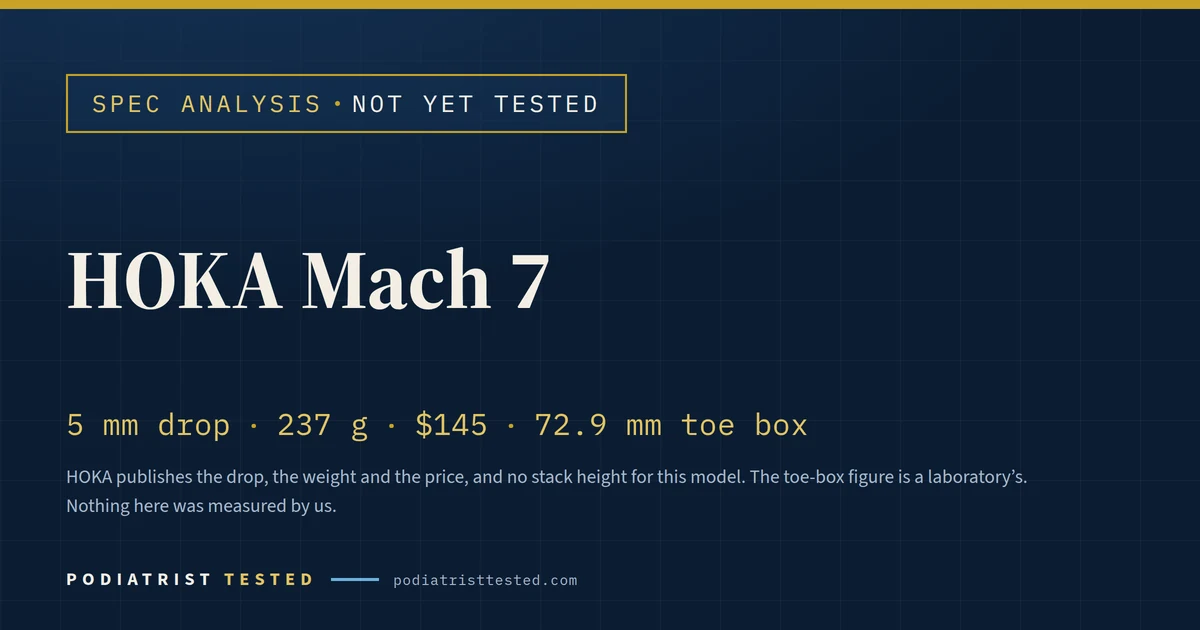
HOKA Mach 7: A Podiatrist’s Specification Analysis
Spec analysis — not yet tested
Nothing on this page has been measured by us. We have not bought, weighed, cut or worn the Mach 7. Every figure below is HOKA’s own published number, labelled as such in the Source column. There is no score, no Orthotic Volume Rating and no Podiatrist Tested Seal here, and there will not be one until the shoe is on the bench.
Patients come into clinic and say “I want HOKAs, they’re the cushioned ones.” The Mach 7 is the shoe that makes that sentence a problem. HOKA describes it as a low-profile cushion bed that keeps the foot closer to the ground, built from a firmer material for push-off. That is close to the opposite of the Bondi, and someone who buys a Mach expecting a Bondi has bought the wrong shoe for the reason they were shopping.
So the useful thing this page can do, before anything is measured, is stop that mistake.

On this page
What HOKA says the Mach 7 is
HOKA positions the Mach 7 as an everyday trainer with a bias towards speed — “your gateway to everyday speed.” On HOKA’s own two scales it sits at neutral for stability, with what the company calls a symmetrical bed of cushion and no prescriptive support features, and at responsive rather than plush for cushioning. HOKA publishes the weight and the heel-to-toe drop. It does not publish stack heights for this model; an independent lab measured 35.6 mm at the heel and 26.2 mm at the forefoot.
HOKA also publishes a fit instruction that most brands leave to reviewers: go up half a size from your usual. That is the manufacturer telling you the shoe runs short, and it is worth more than most spec-sheet lines.
| Specification | Figure | Source |
|---|---|---|
| Model year / version | Mach 7 | HOKA (published) |
| MSRP | $145.00 | HOKA (published) |
| Heel-to-toe drop | 5 mm | HOKA (published) |
| Weight | 8.37 oz (237 g), manufacturer sample | HOKA (published) |
| Stability rating | Neutral — no prescriptive support features | HOKA (published) |
| Cushioning character | Responsive; low-profile bed, firmer material | HOKA (published) |
| Sizing guidance | Go up half a size from usual | HOKA (published) |
| Widths | Regular and Wide | HOKA (published) |
| Heel stack height | 35.6 mm (HOKA publishes none) | RunRepeat lab |
| Forefoot stack height | 26.2 mm (HOKA publishes none) | RunRepeat lab |
| Toe-box width | 72.9 mm at the big toe, 92.5 mm at the widest point | RunRepeat lab |
| Removable insole | Yes, 4.4 mm thick | RunRepeat lab |
| Torsional rigidity | 13.6 Nm | RunRepeat lab |
| Heel-counter stiffness | 5 of 5 | RunRepeat lab |
| Orthotic Volume Rating | Requires measurement | Podiatrist Tested — pending |
Where a row reads “requires measurement”, that figure comes off our bench or it does not appear. We do not reprint other reviewers’ measurements as though they were ours, and we do not estimate.
What the spec sheet suggests — and what only a test can answer
HOKA lists a 5 mm drop; a lab measured almost twice that. RunRepeat cut the Mach 7 in half and measured 9.4 mm, a conventional drop close to the 8.5 mm median of the lab-measured shoes we review; the Mach 6 measured 9.6. So the usual reasoning about a 5 mm shoe, more work for the calf and Achilles and less load on the forefoot, does not describe the shoe the lab measured. For mid-portion Achilles tendinopathy the measured drop is, if anything, helpful; for insertional pain or a Haglund’s bump the heel counter may be the obstacle, because it scored 5 of 5 for stiffness and a stiff counter is what rubs there. If your problem is under the forefoot and you wanted a genuinely low drop, look elsewhere.
“Firmer” and “low-profile” are HOKA’s words, not ours, and they matter more than the brand name. A patient with fat-pad atrophy, a healing calcaneal stress reaction or painful heel spurring is shopping for compliance underfoot. HOKA is telling you plainly that this model is the firmer, closer-to-the-ground option in its range. That is useful engineering for a runner chasing turnover and the wrong answer for a heel that hurts — and it is exactly the mismatch that sends people back to clinic in a shoe that cost $145 and made things worse.
The half-size-up instruction is a length statement, not a width one. Sizing up buys length; it does not buy toe-box volume, and it can leave a foot sliding in a shoe that is now too long. For a patient with a hammertoe or a bunion, the question is how much room there is over and across the toes, which HOKA does not publish; a lab measured a tall toe box, 29.1 mm, that is narrow at the ball of the foot.
What an independent lab has since measured, none of it published by HOKA: a 35.6 mm heel, a heel counter that scored 5 of 5 for stiffness, 13.6 Nm of torsional rigidity, close to the median, and a toe box of 72.9 mm at the big toe and 92.5 mm at the widest point, the narrowest of the 34 shoes we review there. What only our own bench can answer: how much orthotic fits inside it.
On the published figures, worth a look if…
- You want a lighter, firmer, faster-feeling trainer and know that is what you are buying.
- You want a conventional drop despite the label: HOKA lists 5 mm, a lab measured 9.4 mm.
- You want a HOKA that is not a max-stack shoe.
- Regular or Wide covers your foot, and you will order half a size up as HOKA instructs.
Wait for the test — or look elsewhere — if…
- You are buying a HOKA because you want maximum cushioning. This is the firm, low one; that is HOKA’s own description.
- You have a Haglund’s bump or insertional Achilles pain: a lab scored its heel counter 5 of 5 for stiffness.
- You have heel pain from fat-pad atrophy or a stress reaction and need compliance underfoot.
- You wear an orthotic and need to know the volume is there — unmeasured, and low-profile shoes are where this most often fails.
- You need more than a Wide, or you need stability. HOKA states there are no prescriptive support features.
What changed from the Mach 6
HOKA has not published a specification comparison between the Mach 6 and the Mach 7, but a lab has since cut both in half. Underfoot they are nearly identical, both about 9.5 mm of drop against HOKA’s 5; the 7 is 2.8 mm wider at the big toe and 3.0 mm narrower at the widest point, the narrowest of the 34 shoes we review there, with a stiffer heel counter. Our Mach 6 vs Mach 7 comparison sets out who should switch. What we can say is that the Mach line and the Mach X line are different shoes with different intents — the X carries a plate — and that HOKA currently lists the Mach X 3 alongside the Mach 7. If someone recommended “the Mach” to you, check which one they meant before you order.
HOKA’s Mach 6 product pages are still live, though, so its published figures can be set beside these: a 5 mm drop, 8.20 oz for the men’s shoe and 6.70 oz for the women’s (neither with a reference size), and the same Neutral stability and Responsive cushioning ratings. Our HOKA Mach 6 spec analysis lists them line by line, with the item numbers to check if you are buying the outgoing model.
Where to buy
Disclosure: the links below are paid links. If you buy through them, Podiatrist Tested earns a commission from Amazon at no extra cost to you. We have not been paid to write about this shoe, we were not given it, and a commission has never decided what appears on this site. We do not take money from footwear brands, and we never will.
Amazon listings are colourway-specific. Both links below point at the Black/White colourway. Remember HOKA’s own instruction to order half a size up, and use the width selector on the product page if you need the Wide.
Price checked 9 September 2026. HOKA’s published MSRP is $145.00 and the shoe was discounted on HOKA’s own site at the time of checking; Amazon pricing moves independently of both.
Questions people ask about the Mach 7
Is the HOKA Mach 7 good for plantar fasciitis?
On the published figures it is not the HOKA we would point a heel-pain patient towards first, and we say that without having tested it. HOKA describes the Mach 7 as its firmer, lower-profile, closer-to-the-ground model. Its 5 mm drop did not hold up in the lab, which measured 9.4 mm, but the lab also found its foam on the firm side and its heel cushioning about average for the shoes we review, which is not what a painful plantar fascia wants first. Midfoot support and orthotic capacity are still unmeasured.
Is the Mach 7 as cushioned as the Bondi or the Clifton?
No, and HOKA does not claim it is. On HOKA’s own cushioning scale the Mach 7 sits at the responsive end rather than the plush end, and the company describes a low-profile bed with a firmer material. If the reason you want a HOKA is the cushioning the brand is famous for, the Mach is the wrong model in the range.
Does the Mach 7 run small?
HOKA says yes — its own product page instructs buyers to go up half a size from usual. That is unusually direct for a manufacturer and worth acting on. Note that sizing up adds length, not width or toe-box height, so it does not solve a forefoot that is too tight across or too shallow over the toes.
Can you fit an orthotic in the Mach 7?
HOKA does not state whether the insole is removable; a lab found a removable 4.4 mm insole. We have not measured the internal volume. Low-profile shoes are usually where orthotic fit fails, but the lab measured this toe box at 29.1 mm tall, one of the tallest we have figures for; the tighter limit is width, because at the widest point it measured the narrowest of the 34 shoes we review. Orthotic Volume Rating is a measurement we take ourselves on every shoe we test, and it is absent from this page because this shoe has not been tested.
What happens next
This page exists so there is an honest, clearly-labelled entry for the Mach 7 rather than a guess dressed up as a review. When the shoe is bought and goes on the bench it gets weighed, cut where necessary, measured with calipers for stack height, drop, toe-box width and depth, scored for torsional rigidity and heel-counter stiffness, and given an Orthotic Volume Rating — and because HOKA publishes no stack figures for this model, ours will be the first ones on this page. Only then does it carry a score, and only after logged wear-testing can it be considered for the Podiatrist Tested Seal.
Page type: spec analysis · Acquisition: not yet purchased · Last verified: 9 September 2026 · By Dr. Thomas Biernacki, DPM, board-certified foot and ankle surgeon, NPI 1821330051. Clinician review not documented.
Where this shoe fits
Guides on this site that weigh the HOKA Mach 7 against the problem you are actually trying to solve:
- Best running shoes for plantar fasciitis — what changes when the heel has to survive a run.
- Best HOKA shoes for walking — which HOKAs suit walking rather than running.
- Best shoes for Achilles tendonitis — why the drop figure matters more here than anywhere else.
- Best shoes for supination — a foot that rolls outward wants cushioning, not a post.
Browse every shoe on file or read how we test.
Compare it with the rest: every HOKA review · everything for running · the wide fittings. Every list shows the published drop, stack, weight, widths and price side by side.
This page is a spec analysis, not a test report: the figures are the manufacturer’s or a named third party’s, each printed beside its source, and nothing here carries a score or the Seal until the shoe has been worn and measured on our bench. Quote any figure you like — keep the source attached to it, and link the page rather than the number. How to cite or link to an analysis.