
Are Crocs Bad for Your Feet? A Foot Surgeon’s Answer
Testing status: no Crocs model has been through the Podiatrist Tested measurement protocol, so nothing here carries a score or a seal. What follows is the clinical assessment — what the shoe genuinely does well, what it genuinely does badly, and the one change that moves it from the second column to the first.
On this page

The strap decides almost everything
Almost every argument about whether Crocs are bad for your feet is really an argument about backless shoes, and most people wearing Crocs are wearing them backless without thinking of it that way.
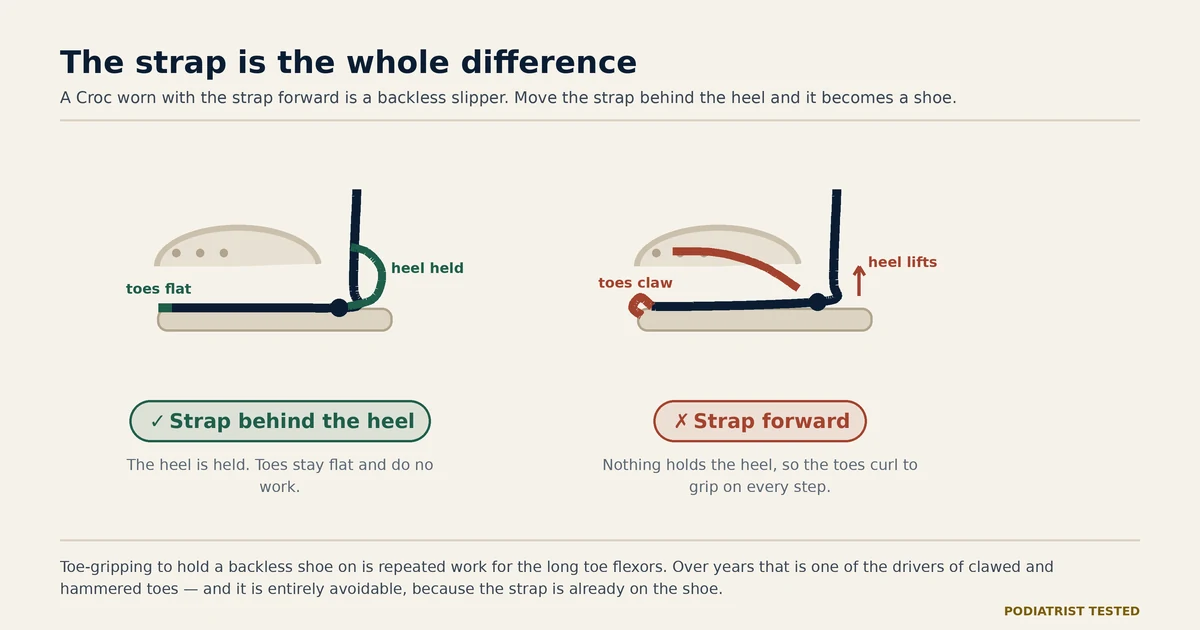
Here is the mechanism. A shoe stays on your foot because something holds the heel — laces, a counter, a strap. If nothing does, the shoe wants to drop off your foot every time you swing your leg through. Your body solves that automatically by curling the toes down to grip, using the long flexor tendons that run from the calf under the foot to the toe tips. It is not a conscious decision and most people never notice they are doing it. But it is repeated work, thousands of times a day, in a muscle group that is already usually stronger than its opposing extensors.
Over years, that imbalance is one of the recognised contributors to toes that stay bent — claw toes and hammer toes. It also loads the ball of the foot harder, because a clawing toe pulls the metatarsal head down into the ground, which is a route into metatarsalgia and callus. And it makes the shoe less stable on stairs and uneven ground, because a foot that is gripping is not a foot that is balancing.
The fix costs nothing and takes two seconds: rotate the strap back behind your heel. Now something holds the heel, the toes stop working, and the shoe behaves like a shoe. I would guess fewer than one wearer in ten does this consistently, which is why the reputation is worse than the shoe deserves.
What Crocs genuinely do well
It is worth being fair to the shoe, because a few of its properties are hard to find anywhere else at this price.
- A wide, deep, round toe box. This is the big one and it is genuinely unusual. Almost all mainstream footwear tapers to a point well before the end of the toes. A Croc does not — the front is broad and tall, and it does not press on a bunion, a hammer toe, or a swollen forefoot. For people whose problem is compression, that alone can be the difference between a comfortable day and a painful one.
- Thick, soft, shock-absorbing foam. Croslite is a closed-cell resin foam, and there is a lot of it under the heel. On hard hospital and kitchen floors, that matters.
- No seams and no pressure points. A moulded one-piece upper has nothing to rub. For a foot with fragile skin, a healing wound, or a deformity that catches on stitching, that is a real clinical advantage.
- Extremely light, and washable. Trivial-sounding, but a shoe you can hose out is the right answer for a garden, a beach, a boat or a ward.
- Easy on and off. Genuinely important for anyone who cannot reach their feet easily — after surgery, in late pregnancy, with a stiff back or hip. A shoe you can actually put on is better than a better shoe you cannot.
- Room for a swollen foot. Oedema, post-operative swelling, a foot in a dressing — the volume and the give are useful.
What they genuinely do badly
- Heel hold, when the strap is forward. Covered above. This is the main charge, and it is fair.
- Torsional stability. Hold a Croc at both ends and twist: it gives easily. A shoe that twists that readily is not controlling a foot that rolls inwards. If you overpronate or have flat feet that need holding, this shoe is not doing that job, whatever the sole thickness suggests.
- The foam is soft, and soft compresses. Cushioning and support are different properties, and Croslite delivers the first without much of the second. Under a heavier body, or after a few hundred hours, the arch shape flattens further.
- No adjustability beyond the strap. There is no lacing, so you cannot tighten the midfoot. Feet that need to be held down over the instep have no way to be held.
- The fit runs roomy, and people size up. A shoe that is too long makes the foot slide forward on every step, which puts the toes into the front and, again, makes them grip. If your heel moves inside the shoe when you walk, the shoe is too big.
- They are not built for distance. A soft, flexible, unstructured shoe is fine for the walking you do inside a building. It is not a shoe to do five miles on pavement in, and most of the injuries I see attributed to Crocs come from someone doing exactly that.
Who they suit, and who they don’t
A reasonable choice for: nurses and hospital staff on hard floors for short bursts between sitting; anyone with a wide forefoot, a bunion or hammer toes who needs the toes left alone; people recovering from forefoot surgery once the surgeon allows a normal shoe; late pregnancy and anyone who cannot bend to their feet; swollen feet; gardening, poolside, boats, showers, and the ten minutes of house shoe most people need.
A poor choice for: anyone who overpronates or has a foot that needs structural control; long walks or any running; ladders, stairs, and workplaces where a shoe coming off is a hazard; anyone with reduced sensation in the feet who needs a secure, protective shoe rather than a loose one; and anyone whose forefoot pain is already being driven by toe clawing — which is the specific case where a backless shoe makes an existing problem worse.
The special case: diabetes and neuropathy. Crocs get recommended for diabetic feet because of the depth, the seamlessness and the room, and those instincts are right. But a loose shoe that can slip, and a foam sole soft enough to let a stone press through, are exactly the wrong properties for a foot that cannot feel damage. If you have neuropathy, take footwear decisions with your own clinician rather than from a buying guide — the neuropathy guide covers what a protective shoe needs to do.
Crocs and plantar fasciitis
This comes up constantly, and the answer is genuinely split.
What helps: the thick heel foam softens heel strike, and there is more arch shape moulded into the footbed than the shoe gets credit for. Compared with going barefoot on a hard floor — which is what a lot of people with heel pain actually do at home, and one of the worst things for it — a Croc is a clear improvement. That is a low bar, but it is the comparison that matters for most people at home.
What does not help: the midfoot is soft and torsionally loose, so it does not stop the arch flattening under load, and flattening is what puts the fascia under tension. It also has no heel counter to speak of, so the heel is not held. For someone whose plantar fasciitis is driven by pronation and a collapsing arch — which is most people with it — the shoe is not addressing the mechanism.
The practical answer I give in clinic: a Croc with the strap back is a reasonable house shoe if the alternative is barefoot, and a poor choice as the shoe you walk miles in. If heel pain is your problem, the plantar fasciitis guide sets out the four features that actually change fascia tension, and the slippers guide covers the indoor hours specifically, which is where most heel-pain damage quietly happens.
About the APMA acceptance
You will see it repeated that Crocs are “podiatrist approved” because some models have carried the American Podiatric Medical Association Seal of Acceptance. That is true of certain models, and it is worth knowing what it means and what it does not.
The APMA seal tells you a manufacturer applied, paid the fee, and submitted evidence that a panel accepted. It does not tell you anyone measured that shoe against another one, or that it suits your foot, or how it performs after six months. It is a manufacturer-initiated certification, not an independent test. We wrote a full comparison of what the APMA seal certifies and what it does not, because this specific claim gets used to end conversations that should keep going.
So: “a podiatry association accepted an application about this shoe” is a much weaker statement than “this shoe is good for your feet.” It is not nothing. It is also not the answer to your question.
How to wear them without paying for it
- Strap behind the heel. Every time. The single change that matters. If you do nothing else on this page, do this.
- Size them so your heel does not move. Walk a few steps. If the heel lifts away from the footbed, they are too big — and too big is the most common fitting error with this shoe.
- Treat them as one of several pairs, not the only pair. House, garden, ward, poolside: fine. The two-mile walk into town: put on something with a heel counter.
- Replace them when the footbed has flattened. Look at the heel area from the side. When the moulded shape has packed down flat, the cushioning is spent, whatever the outsole looks like.
- Do not wear them on ladders, stairs at speed, or anywhere a shoe coming off matters. Even with the strap back, this is a loose shoe.
- If your toes ache after a day in them, that is the answer. Aching under the ball of the foot or in the toes themselves after a Croc day means the toes have been working. Strap back, or different shoe.
If Crocs are not the answer
The thing people usually want from a Croc is room at the front and no fuss getting it on. Both are available in shoes that also hold the heel. If your reason for reaching for them is a wide or painful forefoot, the wide toe box guide covers shoes measured for internal width rather than sold on a width letter. If the reason is standing on hard floors all day, the standing all day guide and the nursing guide are the relevant ones. If it is swelling or reaching your feet, look for a shoe with a wide opening and a single strap or a bungee lace rather than a backless one.
And if the appeal is simply that they are comfortable at home, that is a legitimate reason to own a pair. Just wear them with the strap back, and do not let them become the shoe you do everything in.