
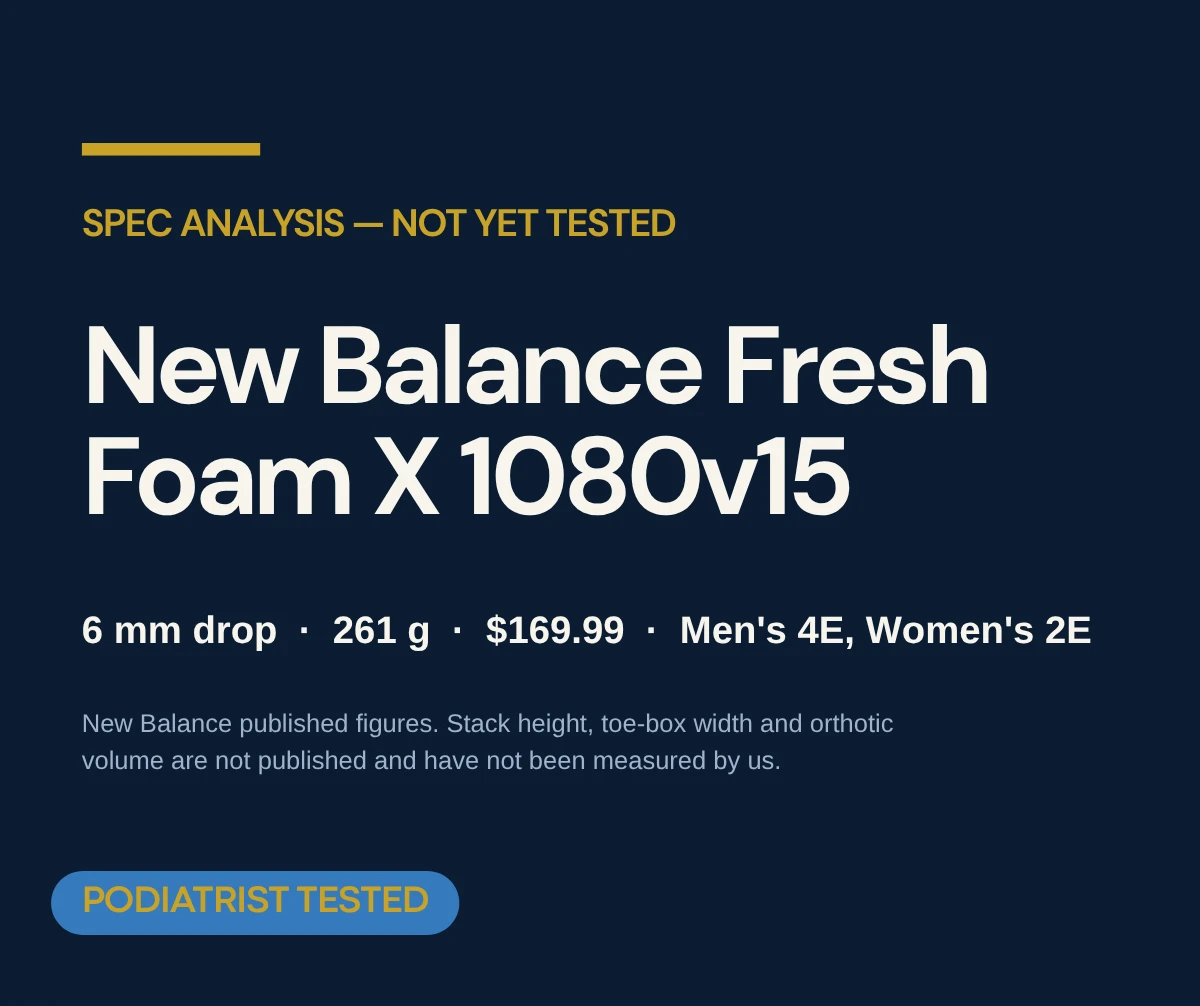
New Balance 1080v15: A Podiatrist’s Specification Analysis
We earn a commission if you buy through links on this page, including Amazon links paid by brand partners through Levanta, at no cost to you. As an Amazon Associate I earn from qualifying purchases. How we make money
Spec analysis — not yet tested
Nothing on this page has been measured by us. We have not yet bought, weighed, cut or worn the Fresh Foam X 1080v15. Every figure below is New Balance’s own published number, labelled as such in the Source column. There is no score, no Orthotic Volume Rating and no Podiatrist Tested Seal on this page, and there will not be one until the shoe is on the bench. When it is tested, this page is replaced by the full review.
The 1080 is New Balance’s flagship cushioned daily trainer, and the v15 is the biggest change the line has had in years: the Fresh Foam X midsole of recent versions has been replaced outright by a new foam New Balance calls Infinion. That matters clinically, because midsole foam is the single component that determines how a shoe loads a painful heel, and a new foam means none of what was true about the v14 underfoot can be assumed to still be true.
What follows is what New Balance publishes, what a foot and ankle surgeon can reasonably infer from those published figures, and — stated plainly — what cannot be known until the shoe is measured.

A note on the name. New Balance now calls this shoe simply the 1080v15, and its midsole is Infinion Foam — not Fresh Foam X. Earlier versions of the 1080 did carry the Fresh Foam X name, which is why you will still see it used widely, including by retailers. We have corrected it here because the spec table on this page credits its figures to New Balance, and the name New Balance actually publishes is the one that belongs in it.
On this page
What New Balance says the Fresh Foam X 1080v15 is
New Balance positions the 1080v15 as its most cushioned everyday running shoe, built for daily mileage rather than racing. The company’s stated case for the v15 rests on Infinion foam, which it describes as resisting the compression that makes an older shoe feel “worn out”, alongside what it calls a total visual makeover. New Balance publishes the drop, the weight and the width range. It does not publish heel or forefoot stack height, and we will not estimate them.
| Specification | Figure | Source |
|---|---|---|
| Model year / version | 1080v15 | New Balance (published) |
| MSRP | $169.99 | New Balance (published) |
| Heel-to-toe drop | 6 mm | New Balance (published) |
| Weight | 261 g (9.2 oz), manufacturer sample | New Balance (published) |
| Midsole foam | Infinion | New Balance (published) |
| Heel stack height | 37.0 mm (New Balance publishes none) | RunRepeat lab |
| Forefoot stack height | 30.6 mm (New Balance publishes none) | RunRepeat lab |
| Men’s widths | B (narrow), D (standard), 2E (wide), 4E (extra wide) | New Balance (published) |
| Women’s widths | B (standard), D (wide), 2E (extra wide) | New Balance (published) |
| Category | Neutral cushioned daily trainer | New Balance (published) |
| Removable insole | Yes, 4.3 mm thick | RunRepeat lab |
| Toe-box width | 73.2 mm at the big toe, 94.8 mm at the widest point | RunRepeat lab |
| Torsional rigidity | 10.3 Nm, the least rigid of the 24 shoes we review with this test | RunRepeat lab |
| Heel-counter stiffness | 4 of 5 | RunRepeat lab |
| Orthotic Volume Rating | Requires measurement | Podiatrist Tested — pending |
Where a row reads “requires measurement”, that figure comes off our bench or it does not appear. We do not reprint other reviewers’ measurements as though they were ours, and we do not estimate.
What the spec sheet suggests — and what only a test can answer
The 6 mm drop is the number worth pausing on. A great many cushioned daily trainers sit at 8 to 10 mm. Dropping to 6 mm shifts a little more demand onto the calf and Achilles through late stance and a little less onto the forefoot. For a patient with insertional Achilles tendinopathy who has been managed into a higher-drop shoe, that is a change in the wrong direction, and it is worth knowing before the shoe is bought rather than after. For someone with forefoot pain — metatarsalgia, a healing stress reaction, hallux rigidus — the same change can work in their favour. Neither statement is a prediction about this shoe specifically; it is what a 6 mm drop does mechanically, and the shoe still has to be measured before anyone says more.
The width range is the strongest thing on the spec sheet. Men’s 4E and women’s 2E in a max-cushion daily trainer is genuinely uncommon. Most shoes in this category stop at 2E for men and D for women, which is why patients with wide feet so often end up in a shoe that fits the length and crushes the forefoot. That said, a stated width code is a last measurement, not a fit guarantee: two shoes both labelled 4E can differ substantially in actual toe-box volume, and volume is what accommodates a bunion, a hammertoe or a swollen forefoot. We measure toe-box width and depth for exactly this reason, and we have not measured this one.
The new foam is the open question. New Balance’s claim for Infinion is about durability — that it resists the compression that makes an old shoe feel flat. That is a claim about how the shoe behaves at 300 miles, not at zero, and it is not testable by reading a spec sheet or by wearing a shoe for a week. It is also the claim that matters most to a patient who is being asked to pay $169.99 and replace the shoe on a schedule. We will not repeat it as fact and we will not dismiss it either; it is a manufacturer claim awaiting evidence.
What an independent lab has since measured, none of it published by New Balance: a heel counter that scored 4 of 5 for stiffness, the least resistance to twisting of the 24 shoes we review with its newer test, a toe box of 73.2 mm at the big toe and 94.8 mm at the widest point, and a 37.0 mm heel. What only our own bench can answer: how much orthotic fits inside it.
On the published figures, worth a look if…
- You need a genuinely wide cushioned trainer — 4E for men, 2E for women is rare in this category.
- You want maximum cushioning for daily walking or easy mileage rather than speed.
- A 6 mm drop suits you, or you have no drop-sensitive diagnosis either way.
- You replace shoes on mileage and want to see whether the durability claim holds.
Wait for the test if…
- You have insertional Achilles tendinopathy and have been placed in a higher-drop shoe on purpose.
- You wear a custom or prefabricated orthotic and need to know the shoe has the volume for it — unmeasured here.
- Your problem is forefoot width or a bunion, where stated width codes are a poor proxy for actual toe-box volume.
- You need a stability shoe. This is a neutral trainer, and no amount of cushioning substitutes for posting or a firm heel counter.
What changed from the 1080v14
The headline change is the midsole. Recent versions were built on Fresh Foam X; the v15 replaces it with Infinion. New Balance also describes the v15 as a full visual redesign. A lab has since measured both, and the geometry did move with the foam. The heel stayed at 37.0 mm while the forefoot lost 2.2 mm, so the drop rose from 4.2 to 6.4 mm, and the toe box measured 3.4 mm wider at the big toe. The Infinion foam was the softest of the 33 shoes we review with the lab’s hardness test, and the shoe the least resistant to twisting of the 24 on its newer torsion test. If you were fitted successfully into a v14, treat the v15 as a new shoe. Our 1080 v14 vs v15 comparison sets out who should switch.
Where to buy
Disclosure: the links below are paid links. If you buy through them, Podiatrist Tested earns a commission from Amazon at no extra cost to you. We have not been paid to write about this shoe, we were not given it, and a commission has never decided what appears on this site. We do not take money from footwear brands, and we never will.
Amazon listings are colourway-specific. The two links below point at one common colourway of each — Grey Matter/Afterglow for men, Slate Grey/Afterglow for women. If you need a different colour or a 4E width, use the width and colour selectors on the product page rather than assuming the listing carries every option.
Price checked 9 September 2026. New Balance’s published MSRP is $169.99; Amazon pricing moves independently of that and by size and colour.
Questions people ask about the Fresh Foam X 1080v15
Is the New Balance 1080v15 good for plantar fasciitis?
For heel pain in a foot that does not roll in much, the lab figures make it one of the better-cushioned options we have; for a flat, rolling foot they point elsewhere. We have not worn it, so that is a reading of the measurements, not a score. What helps plantar fasciitis is a combination of a firm heel counter, adequate midfoot support, room for an orthotic if you use one, and enough cushioning to reduce heel impact. A lab has now measured most of them on the v15: a heel counter of 4 of 5, the third-highest heel shock absorption of the 35 shoes we review, and the least resistance to twisting of the 24 with its newer test, which is the weak point for a flat, rolling foot. The 6 mm drop (6.4 measured) is mildly unhelpful in isolation, because a lower drop puts marginally more tension through the plantar fascia and Achilles complex, but drop alone does not decide it.
What is the difference between the 1080v15 and the 1080v14?
The midsole foam. The v14 used Fresh Foam X; the v15 uses a new foam New Balance calls Infinion, and the company frames the change around durability rather than softness. The v15 is also visually redesigned. Whether the shoe’s stack height, drop or shape changed alongside the foam is not something New Balance publishes clearly, which is why we treat the v15 as a new shoe rather than an update. A lab has since answered it: the drop rose from 4.2 to 6.4 mm, the toe box widened 3.4 mm at the big toe and the foam measured about 25% softer; our 1080 v14 vs v15 comparison has the figures.
Does the 1080v15 come in wide widths?
Yes, and this is its strongest published feature. New Balance lists men’s B, D, 2E and 4E, and women’s B, D and 2E. A 4E option in a maximally cushioned trainer is uncommon. Be aware that a width code describes one measurement across the forefoot, not the volume available above your toes — two shoes with the same code can fit a bunion very differently.
Will an orthotic fit in the 1080v15?
Probably, but we have not measured the internal volume. New Balance does not state whether the insole is removable; a lab that cut the shoe open found a removable 4.3 mm insole, among the thinnest we have figures for, so taking it out frees less depth than in most shoes. This is the question we get asked most often and the one manufacturers answer least often, which is why Orthotic Volume Rating is a measurement we take ourselves on every shoe we test. It is not on this page because this shoe has not been tested.
Do podiatrists recommend the New Balance Fresh Foam X 1080?
The 1080 comes up in podiatry offices more often than most neutral trainers, and the reason is usually width rather than foam. New Balance builds the v15 in B, D, 2E and 4E for men and B, D and 2E for women, which is more widths than most daily trainers offer and is what matters if a bunion, a tailor’s bunion or post-operative swelling is the thing making shoes hurt. The 6 mm drop is lower than the 8–12 mm most daily trainers use, so an Achilles that has been symptomatic is better served by phasing the shoe in over a few weeks than by switching in one. New Balance publishes the weight at 261 g (9.2 oz) but publishes no heel or forefoot stack height; an independent lab measured 37.0 mm at the heel and 30.6 mm at the forefoot. Podiatrist Tested has not worn or measured this pair, so it carries no score and no seal.
What happens next
This page exists so there is an honest, clearly-labelled entry for the 1080v15 rather than a guess dressed up as a review. When the shoe is bought and goes on the bench, it gets weighed, cut where necessary, measured with calipers for stack height, drop, toe-box width and depth, scored for torsional rigidity and heel-counter stiffness, and given an Orthotic Volume Rating. Only then does it carry a score, and only after logged wear-testing can it be considered for the Podiatrist Tested Seal.
Page type: spec analysis · Acquisition: not yet purchased · Last verified: 9 September 2026 · By Dr. Thomas Biernacki, DPM, board-certified foot and ankle surgeon, NPI 1821330051.
Where this shoe fits
Guides on this site that weigh the New Balance Fresh Foam X 1080v15 against the problem you are actually trying to solve:
- Best shoes for plantar fasciitis — what a shoe actually has to do for heel pain.
- Best New Balance shoes for women — the widest published width range on the market, model by model.
- Best shoes for standing all day — what changes when you stand still rather than walk.
- Best walking shoes — why a cushioned running shoe usually beats a walking-specific one.
- Best shoes for sesamoiditis — the shoe criteria when the pain is under the big-toe joint, and the padding protocol that goes with them.
- Best shoes for turf toe — why a rockered, high-stack shoe and a stiff plate are the two tools that matter.
- New Balance 1080 v14 vs v15 — what the switch to Infinion foam changed, in the lab.
Browse every shoe on file or read how we test.
Compare it with the rest: every New Balance review · everything for running · the extra-wide fittings · the wide fittings. Every list shows the published drop, stack, weight, widths and price side by side.
This page is a spec analysis, not a test report: the figures are the manufacturer’s or a named third party’s, each printed beside its source, and nothing here carries a score or the Seal until the shoe has been worn and measured on our bench. Quote any figure you like — keep the source attached to it, and link the page rather than the number. How to cite or link to an analysis.