
Brooks vs New Balance: Neither Publishes a Stack Height
Six shoes, three matched pairs, and not one published stack height between the two brands. New Balance goes wider and flatter; Brooks runs higher and confirms the insole lifts out.
On this page
- The short answer
- Neutral daily trainer: Ghost 18 vs Fresh Foam X 1080v15
- Stability daily trainer: Adrenaline GTS 25 vs 860v15
- Maximum support: Beast GTS 26 vs Fresh Foam X 1540v4
- Where the numbers are shaky — and they are shaky on both sides
- Which brand a foot doctor hands you
- Where to buy
- Our full analysis of each
- Common questions
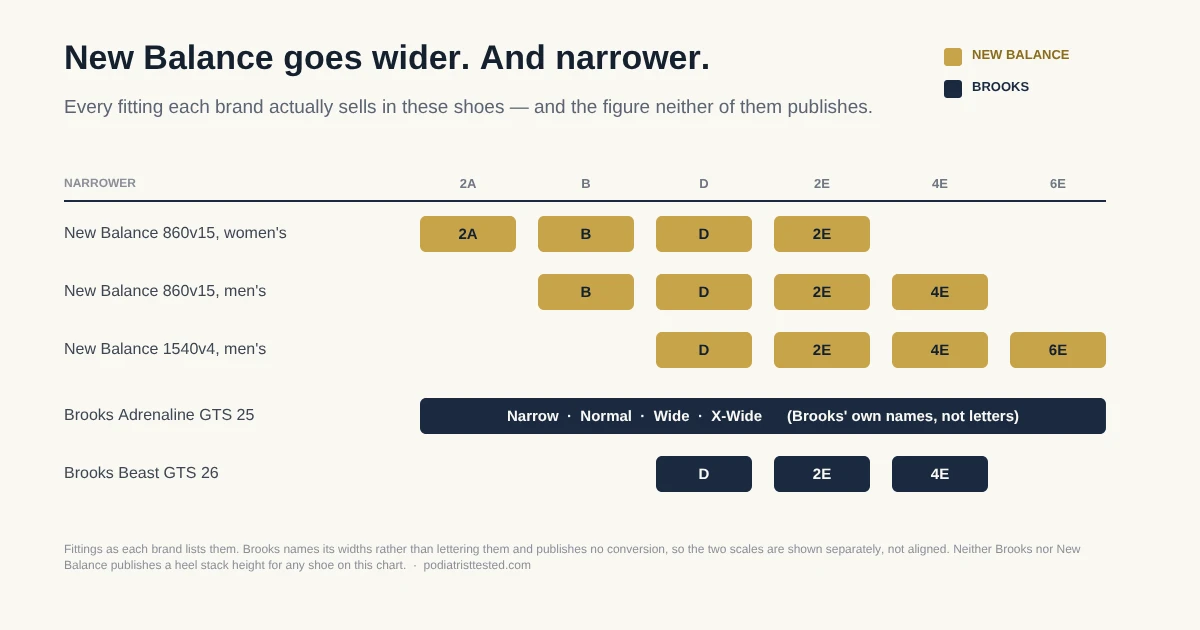
Here is the thing nobody tells you: neither brand publishes a stack height. Not for one of these six shoes. Brooks states no stack on any locale of its site; New Balance states none either, and on the 860v15 it does not even publish the drop. So the decision comes down to the two figures they do publish, and on those the brands separate cleanly. New Balance goes wider and flatter — 2A to 6E, 4 to 8 mm of drop. Brooks runs higher and tells you the insole lifts out — 10 to 12 mm of drop, and a confirmed removable footbed on every model here.
None of these shoes has been under our caliper, so none is scored and none carries our seal. Every figure below is a brand’s, a lab’s or a named retailer’s, labelled. What our testing tiers mean →
The short answer
Go New Balance if your problem is the shape of your foot. The width range is the widest in this library and it is not close: the 860v15 is sold from 2A through 4E, and the 1540v4 adds a 6E on its Made in USA colourways. If you have a bunion, a hammertoe, a genuinely wide forefoot — or a narrow heel that swims in a standard shoe — that range solves a problem no amount of foam solves.
Go Brooks if your problem is what happens under load. Brooks confirms in writing that the insole lifts out on all three of these models, which is the figure that decides whether your orthotic goes in; New Balance does not state it on any of the three. Brooks also runs the higher drop, 10 to 12 mm against New Balance’s 4 to 8 mm, which takes marginally more strain off the plantar fascia and the Achilles insertion.
Neutral daily trainer: Ghost 18 vs Fresh Foam X 1080v15
| Specification | Brooks Ghost 18 | NB 1080v15 | What it means |
|---|---|---|---|
| List price brand | $149.95 | $169.99 | $20 apart for the same job |
| Heel-to-toe drop brand | 10 mm | 6 mm | The single biggest difference on this page |
| Heel stack brand | Not published | Not published | Neither brand states it |
| Forefoot stack brand | Not published | Not published | Neither brand states it |
| Weight, men’s brand | 289 g / 10.2 oz | 261 g / 9.2 oz | 28 g lighter, neither size stated |
| Weight, women’s brand | 261 g / 9.2 oz | Not stated separately | Brooks publishes a women’s figure |
| Midsole brand | DNA LOFT v3, nitrogen-infused | Infinion | Both new-generation supercritical foams |
| Widths brand | Narrow, Normal, Wide, X-Wide | Men D, 2E, 4E; women B, D, 2E | Four each, different ends of the range |
| Removable insole brand | Yes | Not stated | Orthotic users: Brooks is the known quantity |
| Toe box at the big toe 3rd party | 70.6 mm measured | Not measured by anyone | Only one of these has been to a lab |
| Heel-counter stiffness 3rd party | 5 of 5 measured | Not measured | The Ghost’s counter is as stiff as they rate |
| Torsional rigidity 3rd party | 12.2 Nm measured | Not measured | — |
The Ghost 18 is the better-documented shoe by a distance: RunRepeat has measured its toe box, insole thickness, heel-counter stiffness, forefoot flexibility and torsional rigidity. Nobody has put a 1080v15 on a bench at all. That does not make the New Balance worse — it makes it unknowable, which is a different problem and a worse one if you are buying for a specific foot.
Stability daily trainer: Adrenaline GTS 25 vs 860v15
| Specification | Brooks Adrenaline GTS 25 | NB 860v15 | What it means |
|---|---|---|---|
| List price brand | $155 | $149.99 | Effectively the same money |
| Support system brand | GuideRails | Stability Plane in Fresh Foam X | Sidewalls versus a geometry change |
| Stated drop brand | 10 mm | Not published | A retailer says 8 mm for the 860 |
| Measured drop 3rd party | 10.2 mm lab | Not measured | Brooks’ figure checks out to 0.2 mm |
| Heel stack 3rd party | 36.1 mm lab | 43 mm retailer | Two different kinds of number, not comparable |
| Forefoot stack 3rd party | 25.9 mm lab | 35 mm retailer | Same caveat |
| Weight, men’s brand | 10.6 oz stated, 295 g measured | 331 g / 11.7 oz | The New Balance is about 36 g heavier |
| Widths, men’s brand | Narrow, Normal, Wide, X-Wide | B, D, 2E, 4E | NB adds a B for a narrow male foot |
| Widths, women’s brand | Narrow, Normal, Wide, X-Wide | 2A, B, D, 2E | 2A is the narrowest fitting in this library |
| Heel-counter stiffness 3rd party | 4 of 5 measured | Not measured | — |
| Removable insole brand | Yes | Not published | Again, only Brooks says |
| APMA Seal brand | Not stated on the product page | Accepted badge on both pages | NB claims it here; Brooks does not |
This is the closest pair on the page and the one most people are actually choosing between. The honest read: the 860v15 wins on fit range and carries the APMA badge; the Adrenaline wins on weight, on having been measured, and on confirming the insole comes out.
Maximum support: Beast GTS 26 vs Fresh Foam X 1540v4
| Specification | Brooks Beast GTS 26 | NB 1540v4 | What it means |
|---|---|---|---|
| List price brand | $170 | $199.99 | $30 apart at the top of both ranges |
| Support device brand | GuideRails holistic support | ROLLBAR post system | Sidewalls versus a rearfoot post |
| Drop brand | 12 mm | 4 mm, stated as approximate | An 8 mm gap — these are not interchangeable |
| Heel stack 3rd party | 38 mm retailer | Not published by anyone | Nobody has a figure for the 1540 |
| Weight, men’s brand | 354 g / 12.5 oz | 363 g / 12.8 oz at US 9 | Both heavy; these are support shoes |
| Widths, men’s brand | D, 2E, 4E | D, 2E, 4E, and 6E on Made in USA | 6E is the widest fitting we have logged |
| Widths, women’s brand | B, D, 2E (as the Ariel) | Not listed on the page we read | Brooks names the women’s model separately |
| Orthotics brand | “A design that can accommodate orthotic inserts” | Not stated | Brooks says it out loud |
| APMA Seal brand | Beast and Ariel both named by APMA | Not stated | Brooks claims it here; NB does not |
Where the numbers are shaky — and they are shaky on both sides
No stack heights at all, from either brand, on any of these six shoes. Brooks publishes none on any locale of its site. New Balance publishes none either. Every stack figure above came from RunRepeat’s calipers or from a retailer’s listing, and those two are not the same kind of measurement: a lab strips the insole and measures to a defined point, a retailer usually repeats whatever the brand told its buyers. The Adrenaline’s lab heel stack of 36.1 mm and the 860v15’s retailer figure of 43 mm should not be read as an 7 mm difference. They should be read as two numbers produced by different methods.
Sizes go unstated on both sides. Brooks gives a men’s and a women’s weight for the Ghost 18 and names no size for either. New Balance calls the 1080v15’s 261 g a “manufacturer sample.” The 1540v4’s only weight comes from a retailer at a US 9, which is one size below the US 10 our bench uses. None of these figures can be compared with each other without a caveat, which is precisely why we weigh shoes ourselves.
New Balance publishes a drop it calls approximate. The 1540v4’s 4 mm carries New Balance’s own note that the figure varies with development and manufacturing. That is unusually honest labelling and it should be read as a range, not a number.
Which brand a foot doctor hands you
New Balance makes more sense when
- Fit is the constraint. 2A through 4E on the 860v15, up to 6E on the 1540v4 — nothing else in this library reaches either end.
- You want a flatter shoe. 4 to 8 mm across these three against 10 to 12 mm for Brooks.
- You want the lightest neutral trainer of the six: the 1080v15 at 261 g.
- The APMA badge matters to you on a stability shoe — the 860v15 carries it, the Adrenaline does not claim it.
Brooks makes more sense when
- You wear an orthotic. Brooks confirms a removable insole on all three; New Balance states it on none.
- You want the shoe somebody has actually measured. Every Brooks model here has lab figures; none of the New Balance models does.
- Your pain is heel-dominant — plantar fasciitis, insertional Achilles — where the higher drop is the friendlier starting point.
- You want maximum support with an APMA listing: the Beast GTS 26 and Ariel GTS 26 are both named by the APMA.
Where to buy
Amazon affiliate links. We earn a commission at no extra cost to you; commissions never influence a ranking, a score or the seal. Price and availability change, so check the listing. Our independence policy.
Brooks — Ghost 18 from $149.95, Adrenaline GTS 25 from $155, Beast GTS 26 from $170. Removable insole confirmed on all three.
Brooks Ghost 18 on Amazon Adrenaline GTS 25 on AmazonNew Balance — 1080v15 from $169.99, 860v15 from $149.99, 1540v4 from $199.99. The widest fit range in this library.
NB 1080v15 on Amazon NB 860v15 on AmazonThese buttons open an Amazon search rather than one colourway, because every model here is sold in dozens of colour and width combinations and a single listing would send most readers to the wrong one. Prices are the brands’ list prices read on September 17, 2026.
Our full analysis of each
The most thoroughly lab-measured shoe in this comparison, and a 5-of-5 heel counter.
The lightest of the six at 261 g, and the one nobody has measured.
Includes the version-on-version lab table against the GTS 24.
2A to 4E, the APMA badge, and a drop New Balance does not publish.
Named by the APMA, and sold as the Ariel GTS 26 in women’s.
ROLLBAR, a 6E fitting, and a drop New Balance itself calls approximate.
Common questions
Is Brooks or New Balance better for plantar fasciitis?
We have not tested either brand for it, so we will not rank them. On published figures Brooks is the friendlier starting point — the higher drop takes marginally more strain off the fascia, and Brooks confirms the insole lifts out so an orthotic goes in. New Balance’s advantage is fit: if the shoe squeezes your forefoot you change how you load the arch, and the 2A-to-4E range fixes that where foam cannot. See our plantar fasciitis guide for the shoes we have looked at.
Which brand is wider?
New Balance, clearly. The 860v15 runs 2A, B, D and 2E in women’s and B, D, 2E and 4E in men’s; the 1540v4 adds a 6E on Made in USA colourways. Brooks offers four fittings on its running models — Narrow, Normal, Wide and X-Wide — but only D, 2E and 4E on the Beast. If you are at either extreme of the width range, New Balance is the shorter search.
Why does neither brand publish a stack height?
There is no regulation requiring it and no agreed measurement point, so a published stack invites comparison a brand cannot control. Drop is safer to publish because it is a difference between two numbers rather than either number itself. The practical effect is that you cannot compare cushioning between these six shoes from the brands’ own data at all — you are comparing foam names.
What about Brooks vs Hoka, or Brooks vs On?
Different questions with different answers. On publishes markedly less than either brand here — see our Brooks vs On Cloud comparison, where On states no stack, no drop and no weight for the Cloudmonster 3. HOKA sits in between: it states weights and drops, usually not stack heights. On published data, Brooks and New Balance are the two most forthcoming major brands in this library, and neither is generous.
Sources: Brooks’ US and UK product pages for the Ghost 18, Adrenaline GTS 25 and Beast GTS 26; New Balance’s US product pages for the 1080v15, 860v15 and 1540v4; RunRepeat’s laboratory measurements for the Brooks models; Running Warehouse and Holabird Sports for retailer stack and weight figures where the brands publish none; APMA’s Brooks listing for the Beast and Ariel. Last verified 17 September 2026.
Also on this site: Wide feet vs narrow feet — what these width letters actually mean, and how to tell which you are
Recently reviewed
Individual shoe pages state their evidence tier, published measurements and who should skip them.
HOKA Clifton 11
Spec AnalysisHOKA’s product page carries a podiatric seal claim the APMA database does not support for this version, and a women’s stack height that contradicts HOKA’s own drop. Not tested by us.
Skechers Hands Free Slip-ins
Spec AnalysisUntested. A heel panel engineered to stay open cannot also be a rigid heel counter, and Skechers publishes no stiffness figure for it — nor a drop, a weight or a width.
New Balance Made in USA 990v6
Spec AnalysisNew Balance publishes no weight, drop or stack height for the 990v6, but it does publish B through 6E widths — and that range is why it still matters. Not tested by…
Measured, worn, scored — never sponsored
No brand has ever paid for a review, a score, a ranking or the seal. Where we earn a commission the link says so, and the score does not change.