
Skechers Hands Free Slip-ins — Spec Analysis (Not Yet Tested)
We earn a commission if you buy through links on this page, including Amazon links paid by brand partners through Levanta, at no cost to you. As an Amazon Associate I earn from qualifying purchases. How we make money
Spec analysis — not yet tested
What this page is. A podiatrist’s reading of what Skechers publishes about its Hands Free Slip-ins system and the shoes that carry it. Nothing here has been measured, worn or scored by us yet. There is no score and no seal on purpose: under our standard, a number only appears once a pair has been on the bench. When these are tested, this page is replaced by the full review and the change is logged.
Slip-ins are the most clinically interesting thing Skechers has done in years, and almost nobody writes about them honestly. The reviews are either “so convenient” or “podiatrists hate Skechers.” Both miss it. There is a real group of patients for whom a shoe you can put on without bending down is not a convenience — it is the difference between wearing a proper shoe and wearing a slipper. And there is a real engineering trade-off underneath, which Skechers does not publish a single number about.
On this page
- What Skechers says Slip-ins are
- Skechers Hands Free Slip-ins specifications
- The patients this was actually built for
- The trade-off Skechers does not quantify
- What the spec sheet suggests — and what only a test can answer
- Who the Skechers Hands Free Slip-ins is probably for
- Questions people ask about Skechers Slip-ins
What Skechers says Slip-ins are
Two parts, both named on Skechers’ own technology page. The first is an exclusive molded heel panel, described as “shape-retaining,” that “keeps the heel upright and open as you step in, acting like a built-in shoehorn.” The second is the Heel Pillow™, “a soft but secure cushion at the back of the shoe that snugs against your heel, locking it comfortably in place to prevent any unwanted slipping.” The panel holds the collar open on the way in; the pillow closes on the heel once you are in.
Skechers puts the system across several of its lines — GO WALK®, Cozy Fit™, Max Cushioning®, Arch Fit® and UNO Golf SI™ — so “Slip-ins” is a mechanism, not one shoe. The example we costed below is the Slip-ins Max Cushioning Glide-Step at $110.
Skechers Hands Free Slip-ins specifications
Figures are from Skechers’ own US pages: the Hands Free Slip-ins technology page and one representative model, the Slip-ins Max Cushioning Glide-Step. “Not published” means it appears nowhere on those pages.
| Specification | Figure | Source |
|---|---|---|
| Entry system | Molded heel panel plus Heel Pillow™ | Skechers |
| Heel panel description | “Shape-retaining”, “acting like a built-in shoehorn” | Skechers |
| Heel-counter stiffness | Not published — no figure, no test, no standard | — |
| Lines carrying it | GO WALK, Cozy Fit, Max Cushioning, Arch Fit, UNO Golf SI | Skechers |
| Example model | Slip-ins Max Cushioning Glide-Step, $110 | Skechers |
| Upper | Engineered mesh | Skechers |
| Cushioning | ULTRA GO® on the Max Cushioning® platform | Skechers |
| Insole | Air-Cooled Goga Mat™. Removability not stated | Skechers |
| Outsole | “Anti-slip high-traction Goodyear® Rubber” | Skechers — no slip standard cited |
| Heel height | “2-inch heel height” (Skechers’ wording) | Skechers |
| Heel-to-toe drop | Not published | — |
| Weight | Not published | — |
| Widths | Not published on the model page | — |
| Machine washable | Yes | Skechers |
| Arch support claim | Arch Fit® only: “podiatrist-certified arch support” | Skechers |
| APMA Seal | Not claimed on the Slip-ins technology page | Skechers |
The patients this was actually built for
There is a real clinical case for step-in footwear, and it has nothing to do with convenience. A meaningful share of the people I see cannot comfortably or safely reach their own feet: after a hip or knee replacement, with a lumbar fusion or acute back pain, at a body habitus where bending forward compresses the abdomen, late in pregnancy, with rheumatoid or severe osteoarthritic hands that cannot manage a lace, or with the balance impairment that comes with peripheral neuropathy — where leaning down to tie a shoe is itself a fall risk.
What those patients have historically done is wear something backless around the house because the proper shoe is too much effort to get into. That is a worse outcome than any Slip-in. A shoe with a real sole, a real outsole and a closed upper that goes on without bending is a genuine gain in that situation, and the profession should say so plainly instead of dismissing the whole brand.
Parkinson’s disease is the case where both halves of this are largest at once. Rigidity, tremor and slowed fine movement make a lace genuinely hard, so the step-in gain is real. But the shuffling, low-clearance step that comes with the same diagnosis is also the step most likely to catch on a heel that has folded and stayed down — which turns the spring-back of the collar from a detail into the whole question. We take that further in our guide to shoes for Parkinson’s disease.
The trade-off Skechers does not quantify
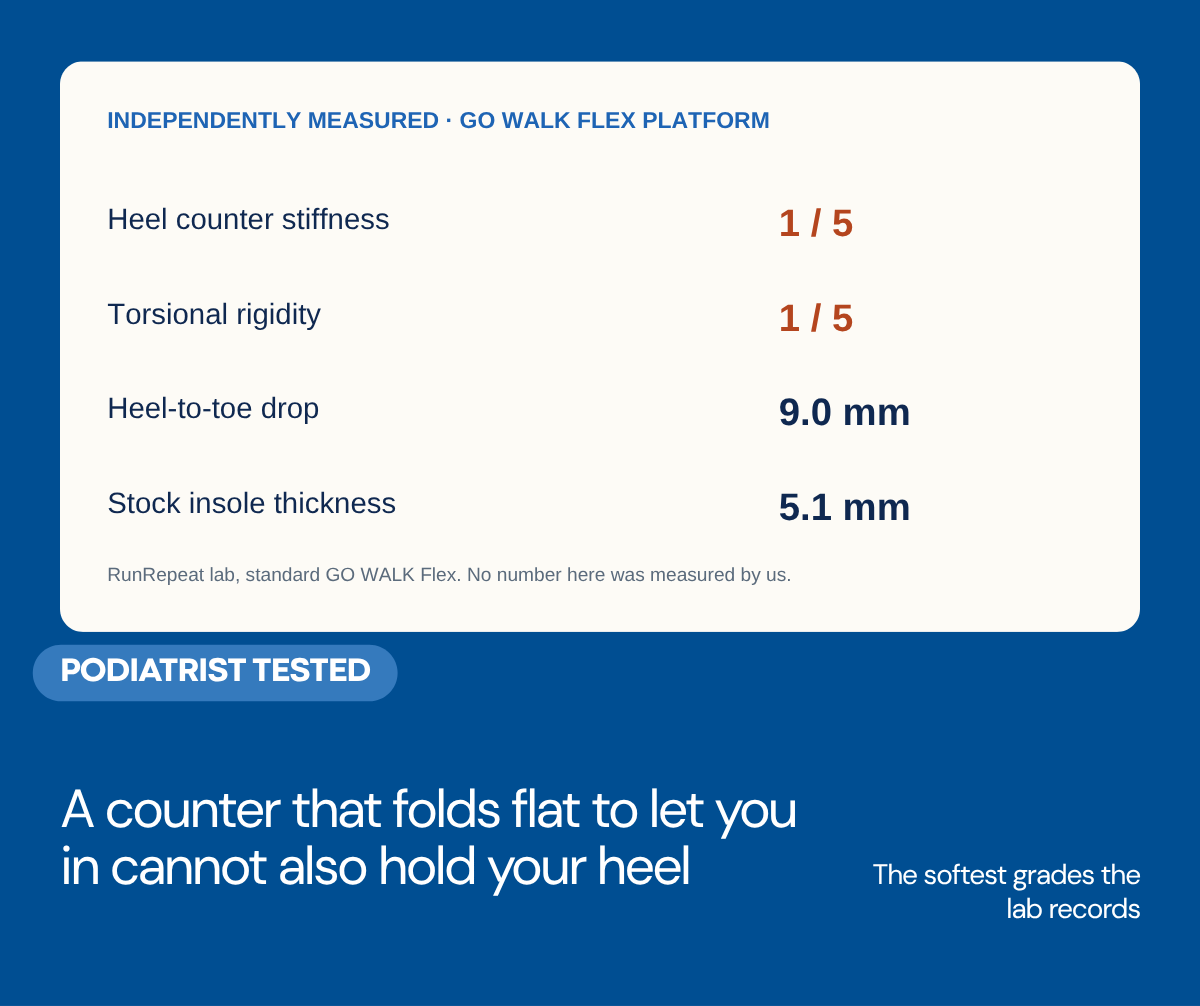
A heel panel engineered to stay open cannot also be a rigid heel counter. Those are opposite goals. Kizik answers the same problem with different hardware — a thermoplastic heel that collapses and springs back — and our Kizik review puts the same question to that mechanism. A conventional heel counter is a stiff cup whose job is to resist the rearfoot rolling inward; you test it by squeezing it between finger and thumb and seeing how much it gives. The Slip-ins panel is designed to hold its shape against a foot pressing down into it — which is a different property, and a softer one by necessity.
That does not mean the counter is weak. It means nobody has published how stiff it is. Skechers gives no figure, no test and no standard for the panel, and heel-counter stiffness is one of the measurements our own bench exists to take. Until somebody squeezes one, “does this shoe control a pronating heel” is an open question and anyone answering it confidently is guessing.
The second thing worth reading carefully is “podiatrist-certified.” Skechers applies it to Arch Fit®, describing arch support “developed using 20 years of data and 120,000 unweighted foot scans.” That is a real and large dataset, and it is worth noting what the word unweighted means: those are scans of a foot that is not standing on it. Arch behaviour is a loading question — the arch that matters is the one under bodyweight. A shape derived from unloaded scans describes the foot’s resting geometry, not what it does when you stand up.
And “podiatrist-certified” is not a defined term. It is not the APMA Seal of Acceptance, which has a published application process; Skechers does not claim the APMA Seal on the Slip-ins technology page at all. It does not say which podiatrists, against what criteria, or what certification consisted of. Treat it as a marketing phrase until somebody publishes the protocol.
What the spec sheet suggests — and what only a test can answer
“2-inch heel height” is Skechers’ own phrase and it is not a stack height. Two inches is about 51 mm, which would be extraordinary for a walking shoe if it meant heel stack in the sense the running industry uses. It almost certainly describes the overall platform at the back of the shoe including the outsole and the visible midsole wall. Without a matching forefoot figure it yields no drop, and drop is one of the few published numbers that reliably changes how load splits between your heel and the ball of your foot. Our calipers will settle it.
No weight is published for any Slip-ins model we read. On a shoe aimed partly at people with reduced strength and balance, weight is not a trivia figure — it is one of the things that decides whether someone actually keeps the shoe on.
No widths are listed on the model page. Skechers does make wide fittings across much of its range, but they are not stated where the shoe is sold, which means a wide-footed buyer cannot check before ordering.
The insole is named but its removability is not stated. That is the figure that decides whether your orthotic goes in, and it is unpublished on a shoe whose likeliest buyer is someone who already owns orthotics.
Who the Skechers Hands Free Slip-ins is probably for
Likely a fit if
- Bending to your feet is difficult, painful or unsafe — after joint replacement, with back pain, with hand arthritis, in late pregnancy, or with balance impairment.
- The alternative you are realistically choosing is a backless slipper worn all day.
- Your mechanics are broadly neutral and you are not relying on the shoe to control a collapsing arch.
- You want a washable everyday shoe at a $90 to $120 price point.
Be careful if
- You overpronate significantly, or have posterior tibial tendon dysfunction — those need a heel counter whose stiffness is known.
- You depend on an orthotic. Removability is unpublished, so check in person before you buy.
- You need a documented width. None is listed at the point of sale.
- You want to compare it on numbers with any other shoe. There are almost none to compare.
Where to buy
Disclosure: the links below are paid links. If you buy through them Amazon pays us a commission at no cost to you. Commissions never influence a score, a ranking or the seal, and this page carries no score because these shoes have not been tested — see our independence policy.
Skechers list prices read on September 9, 2026: the Slip-ins Max Cushioning Glide-Step at $110. Prices and models change constantly across this range, so check the listing. Also sold directly by Skechers.
Questions people ask about Skechers Slip-ins
Are Skechers Slip-ins bad for your feet?
Not as a category, and the blanket claim is not supported by anything published. The fair concern is specific: a heel panel built to stay open as you step in is doing a different job from a stiff heel counter, and Skechers publishes no stiffness figure for it. If you need rearfoot control — significant overpronation, a failing posterior tibial tendon — that unknown matters. If you do not, the objection largely evaporates.
Do Skechers Slip-ins have arch support?
Only the Arch Fit® line carries an arch-support claim, which Skechers calls “podiatrist-certified” and says was developed from 120,000 unweighted foot scans. Unweighted means the foot was not standing on it, and the arch that matters clinically is the loaded one. The other Slip-ins lines — GO WALK, Max Cushioning, Cozy Fit — make no arch claim at all.
Are Slip-ins good after knee or hip surgery?
This is the use case they are genuinely good for, and it is worth saying plainly: if you cannot safely bend to your feet, a closed shoe you can step into beats the backless slipper most people default to. Ask your surgeon or therapist about your own precautions and about anything they have told you regarding heel control, and take the shoe to your next appointment so somebody can look at it on your foot.
Can you put orthotics in Skechers Slip-ins?
Skechers names the insole but does not state whether it lifts out, so nobody can answer this from published information. In practice many Skechers insoles are removable; the way to know is to take the shoe out of the box and lift. If you wear a custom device, take it to the shop and try it in the shoe before you buy. We will publish an Orthotic Volume Rating for a Slip-ins model once one reaches our bench.
What happens next
A Slip-ins model is in the queue for bench testing under Standard v1.0, and on this one the heel-counter squeeze is the headline measurement rather than a footnote: we will publish how much the molded panel gives, next to the same figure for a conventional stability shoe, so the comparison is visible rather than argued about. Weight, heel and forefoot stack with calipers, a real drop figure, internal toe-box width and depth, and an Orthotic Volume Rating follow. If you own a pair and something on this page contradicts what is on your feet, tell us — corrections are logged.
Page type: spec analysis. Acquisition: not yet purchased. Last verified: September 9, 2026. Sources: Skechers’ Hands Free Slip-ins technology page for the molded heel panel, the Heel Pillow, the lines carrying the system and the Arch Fit claim; Skechers’ Slip-ins Max Cushioning Glide-Step product page for price, upper, cushioning, outsole, insole, heel height and washability. Author: Tom Biernacki, DPM, FACFAS — board-certified foot and ankle surgeon, about.
Where this shoe fits
Guides on this site that weigh the Skechers Hands Free Slip-ins against the problem you are actually trying to solve:
- Best shoes for seniors — base width, heel counter and closure, judged for balance rather than cushioning.
- Best shoes for pregnancy — a lower arch, a longer foot, and the weeks you cannot reach your own feet.
- Skechers shoes for women — what the range actually offers a foot, model family by model family.
- Best shoes for arthritis in the feet — why a rocker sole takes load off a stiff, painful joint.
Browse every shoe on file or read how we test.
Compare it with the rest: every Skechers review · everything for walking. Every list shows the published drop, stack, weight, widths and price side by side. Across the range: are Skechers good for your feet?
This page is a spec analysis, not a test report: the figures are the manufacturer’s or a named third party’s, each printed beside its source, and nothing here carries a score or the Seal until the shoe has been worn and measured on our bench. Quote any figure you like — keep the source attached to it, and link the page rather than the number. How to cite or link to an analysis.