
We earn a commission if you buy through links on this page, including Amazon links paid by brand partners through Levanta, at no cost to you. As an Amazon Associate I earn from qualifying purchases. How we make money
On this page
- What Brooks says the Adrenaline GTS 25 is
- Brooks Adrenaline GTS 25 specifications: heel-to-toe drop, stack height and weight
- What the spec sheet suggests — and what only a test can answer
- What changed from the Adrenaline GTS 24
- Questions people ask about the Adrenaline GTS 25
- Who the Brooks Adrenaline GTS 25 is probably for
Brooks Adrenaline GTS 25: A Podiatrist’s Spec Analysis
Spec analysis — not yet tested
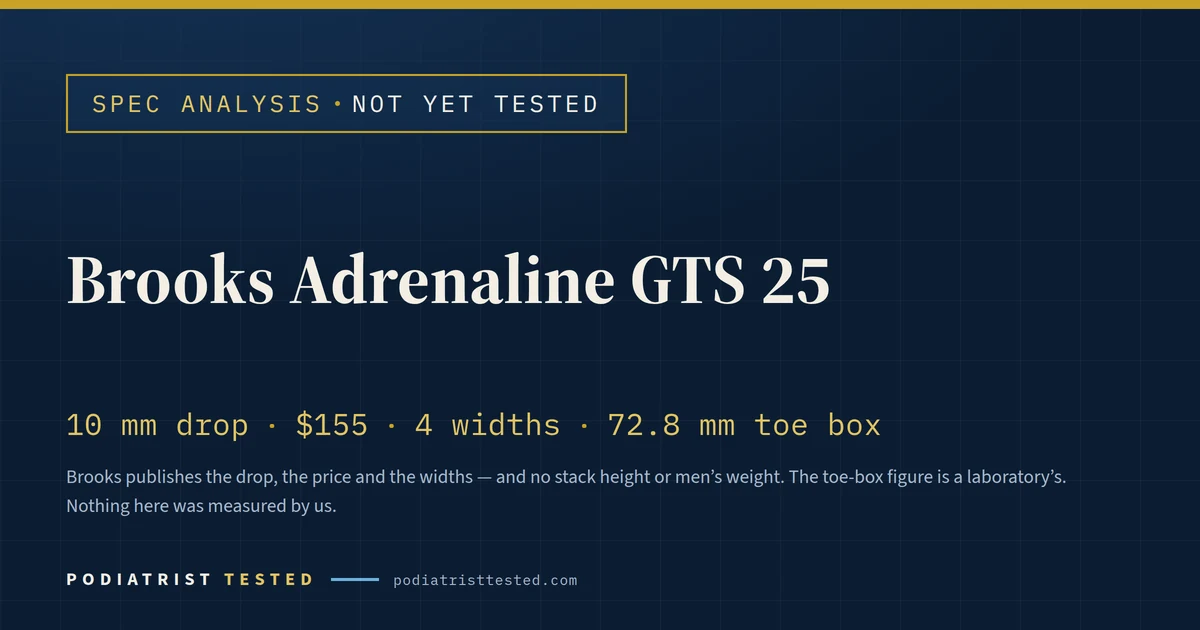
What this page is. A podiatrist’s reading of the published specifications for the Brooks Adrenaline GTS 25 — Brooks’ own figures and an independent lab’s measurements, side by side. Nothing here has been measured, worn or scored by us. There is no score and no seal on purpose: under our standard, a number only appears once a pair has been on the bench and on the road. When we test this shoe, this page is replaced by the full review and the change is logged.
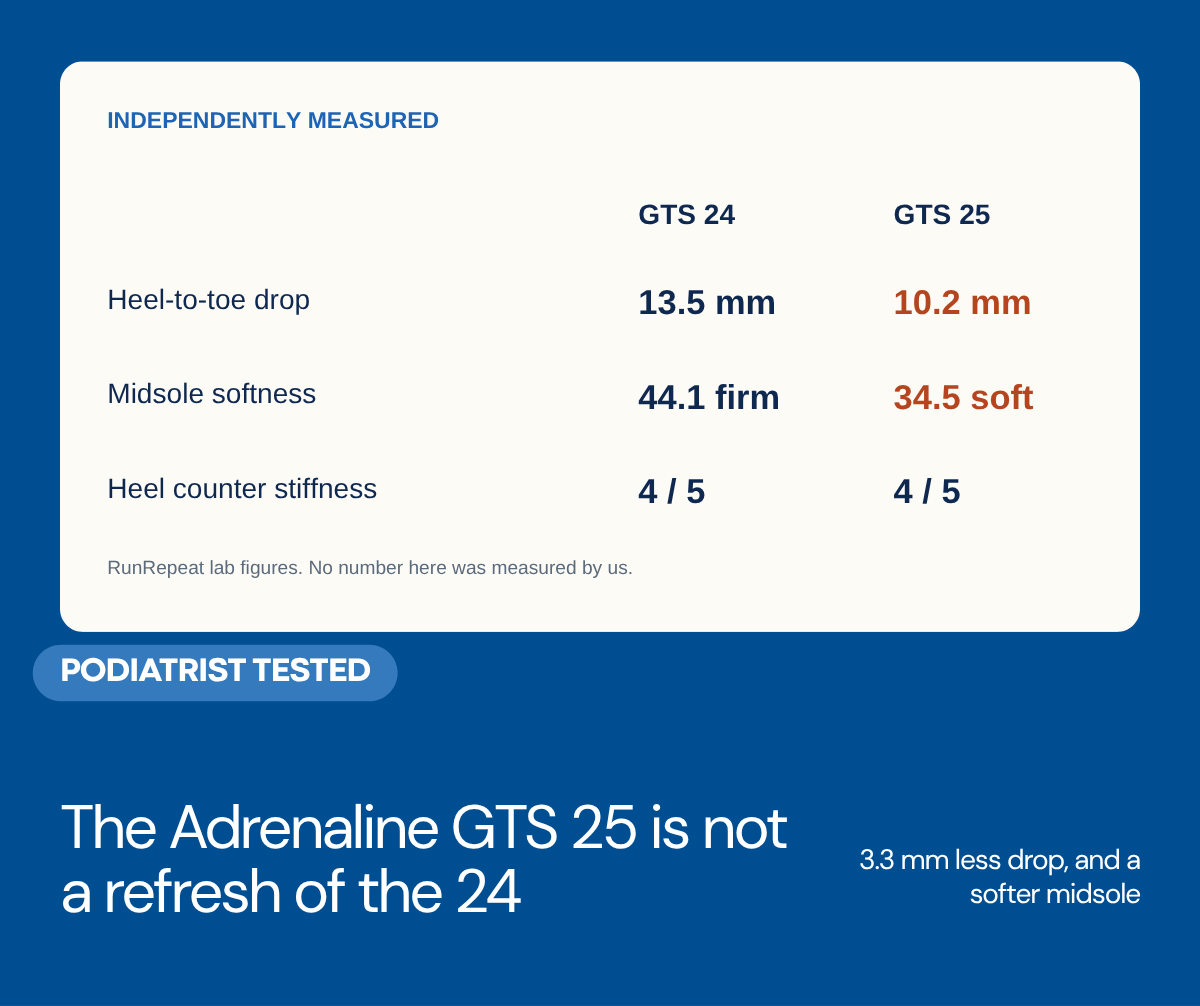
The Adrenaline is the shoe most often handed to someone who has just been told they overpronate. The 25 is not a refresh of the 24: in an independent lab the heel-to-toe drop fell by 3.3 mm and the midsole went from firm to balanced. If you wore the 24 and liked it, read this before you re-order the same size in the same model.
What Brooks says the Adrenaline GTS 25 is
Brooks positions the Adrenaline GTS 25 as its everyday support trainer. The support does not come from a posted arch — the older way of building a stability shoe, and the one most people still picture. It comes from GuideRails: firmer bumpers running along either side of the heel that sit passive until the rearfoot moves further than it should, then limit it. Underfoot is DNA LOFT v3, Brooks’ nitrogen-infused foam. It lists at $145 and, unusually and importantly, in narrow, normal, wide and extra-wide.
Brooks Adrenaline GTS 25 specifications: heel-to-toe drop, stack height and weight
Every figure below is attributed to whoever published it. Where Brooks and the lab disagree, both numbers appear. No number on this page was measured by us.
| Specification | Value | Source |
|---|---|---|
| Stated drop | 10 mm | Brooks |
| Lab-measured drop | 10.2 mm | RunRepeat lab |
| Stated heel stack | Not published by Brooks | Brooks publishes no stack height |
| Lab-measured heel stack | 36.1 mm | RunRepeat lab |
| Stated forefoot stack | Not published by Brooks | Brooks publishes no stack height |
| Lab-measured forefoot stack | 25.9 mm | RunRepeat lab |
| Stated weight | Men’s: 10.6 oz, size not stated. Women’s: 9.5 oz / 269.3 g, size not stated | Brooks (men’s US page, women’s UK page) |
| Lab-measured weight | 295 g (10.4 oz) | RunRepeat lab |
| Toe-box height | 26.6 mm | RunRepeat lab |
| Midsole softness | 34.5 Asker C | RunRepeat lab |
| Heel counter stiffness | 4 / 5 | RunRepeat lab |
| Longitudinal stiffness | 14.3 N | RunRepeat lab |
| Torsional rigidity | 14.3 Nm | RunRepeat lab |
| Insole thickness | 4.9 mm | RunRepeat lab |
| Removable insole | Yes | Brooks |
| Widths | Narrow, Normal, Wide, X-Wide | Brooks |
| MSRP | $155 | Brooks |
Brooks publishes an honest sheet. Every stated figure here lands within about a millimetre of the lab’s measurement, which is not universal — we have looked at shoes where stated and measured drop differ by several millimetres. You can plan around these numbers.
What the spec sheet suggests — and what only a test can answer
The drop change is the story, and nobody is marketing it. The lab measured 13.5 mm on the GTS 24 and 10.2 mm on the 25. Drop decides how load is shared between the back and the front of the foot: the lower it goes, the more dorsiflexion the ankle has to find and the more work the calf and Achilles do. If you were put into the Adrenaline 24 because a tall drop settled an irritable Achilles or a sore heel, the 25 is not the same prescription. That is not a criticism of the shoe. It is a reason to treat it as a new one.
The midsole got substantially softer. 44.1 Asker C on the 24, 34.5 on the 25 — firm to balanced on the same durometer. In a neutral trainer that reads as comfort. In a stability trainer it is a trade, because part of what a firm midsole does is resist collapse on its own. The 25 asks the GuideRails and the heel counter to do proportionally more of the work.
The counter is still genuinely stiff. 4 out of 5, unchanged. That matters more than most spec-sheet lines: a stiff heel counter is the part of a shoe that actually holds the rearfoot, and it is the single feature we would not give up on a foot that pronates heavily. Whatever else changed, this did not.
The insole is thin. 4.9 mm. It lifts out, which is the necessary first condition for a custom orthotic — but pulling out a 5 mm insole frees about 5 mm of volume, and a bulky custom device may still sit high. For comparison, the stock insole in a Skechers Arch Fit is about twice that thickness. Whether a specific orthotic seats without heel slip is exactly what a specification cannot tell you, and exactly what our Orthotic Volume Rating measures. This shoe does not have one yet.
The width is the decision, not the model. Four widths is rare and is the most useful thing on this spec sheet. For a bunion, a hammertoe or a neuroma, the width you choose will do more for you than the difference between this shoe and its competitors.
What changed from the Adrenaline GTS 24
| Lab-measured figure | GTS 24 | GTS 25 |
|---|---|---|
| Heel-to-toe drop | 13.5 mm | 10.2 mm |
| Heel stack | 39.0 mm | 36.1 mm |
| Forefoot stack | 25.5 mm | 25.9 mm |
| Midsole softness | 44.1 Asker C (firm) | 34.5 Asker C (balanced) |
| Toe-box height | 25.4 mm | 26.6 mm |
| Weight | 291 g | 295 g |
| Insole thickness | 5.0 mm | 4.9 mm |
| Heel counter stiffness | 4 / 5 | 4 / 5 |
| MSRP | $140 | $145 |
Both columns are RunRepeat lab measurements, so they are directly comparable. Toe-box width at the big toe, the landmark both lab reviews now report, barely moved: 73.7 mm on the 24 and 72.8 mm on the 25.
Read together, the 25 is a lower, softer, slightly taller-toed shoe than the 24, with the same stiff heel counter and the same four widths. Whether that is an upgrade depends entirely on why you were in the 24.
Where to buy
Amazon listings are colourway-specific; these point at one common colourway of each. If you need a narrow, wide or extra-wide, check that the listing you land on actually offers it — the width is the part of this purchase most worth getting right. Price checked 9 September 2026 at a $145 list.
Questions people ask about the Adrenaline GTS 25
What is the drop on the Brooks Adrenaline GTS 25?
Brooks states 10 mm. An independent lab measured 10.2 mm, so the stated figure is reliable. The GTS 24 measured 13.5 mm, so this generation is meaningfully lower.
Is the Adrenaline GTS 25 good for plantar fasciitis?
The features that tend to help heel pain are present: a stiff heel counter, a cushioned heel and a removable insole so a device can go in. But a lower drop puts marginally more demand on the plantar fascia and Achilles than the 24 did, and we have not tested this shoe. If heel pain is the reason you are buying, buy somewhere with a returns policy and give it two weeks.
GTS 25 or GTS 24 — is it worth upgrading?
If you liked the 24 for its cushioning and support, the 25 gives you the same counter in a softer, lower shoe. If you liked the 24 specifically because it was firm and high-drop — which is often why an Achilles or a heel settles in it — the 25 changes both of those things, and the 24 is worth buying while stock lasts.
Does the Adrenaline GTS 25 work with custom orthotics?
The insole lifts out, which is the first requirement. At 4.9 mm it is thin, so a bulky device may sit higher than you would like. Whether yours seats without heel slip depends on internal volume, which no specification reports.
Is the Adrenaline a motion control shoe?
No. Motion control describes the older, heavily posted category. The Adrenaline is a support trainer that limits movement at the end of its range with GuideRails rather than resisting it throughout. For most feet that is the more comfortable approach; for a severely collapsing foot it may not be enough on its own.
What happens next
Everything that makes this site different is missing from this page, and deliberately so. We have not had this pair under our own caliper. We cannot give you our own toe-box width or depth, we cannot tell you whether a custom orthotic seats without heel slip, and we cannot score comfort from a spec sheet. Those numbers come off a bench, on a pair we own. When they do, this page becomes a scored review and is relabelled.
Related on this site: Brooks Adrenaline GTS 24 · Brooks Ghost 17 · Best shoes for overpronation · Every shoe on file.
A note on where these figures come from. We checked Brooks’ own product pages directly on 9 September 2026. Brooks publishes no stack heights for this shoe on any locale. The US page does publish a men’s weight of 10.6 oz, inside a specification panel that appears only once expanded; re-checked 12 September 2026. Its listed price is $155. This table has been corrected accordingly: two stack figures and a weight previously credited to Brooks have been marked as unpublished, and the MSRP has been fixed. The lab-measured rows remain and are correctly credited to the lab that measured them.
Brooks describes the change from the GTS 24 as deltas only—and you cannot turn them into a stack height. Brooks says it added “3mm to forefoot, 1mm to heel”, giving a “new 10mm offset”. To convert those into absolute stack figures you would need the GTS 24’s absolute stack to add them to, and Brooks never published one. There is no base. Any absolute stack number circulating for this shoe is a measurement or an inference, not a Brooks specification. The offset change is still the interesting part clinically: Brooks reached 10 mm by building the forefoot up rather than cutting the heel down, so this is a taller shoe than the GTS 24 rather than a flatter one—a distinction a spec table showing only “drop: 10 mm” would hide.
The APMA seal. The Adrenaline GTS 25 is listed in the American Podiatric Medical Association’s own seal database with the Seal of Acceptance, as are the GTS 23 and GTS 24. Brooks makes no APMA claim on its product page. APMA states it is not a testing laboratory and evaluates products companies submit to it—so the seal records a reviewed submission, not a clinical trial, and it is not evidence the shoe treats anything.
Where this shoe fits
Guides on this site that weigh the Brooks Adrenaline GTS 25 against the problem you are actually trying to solve:
- Best shoes for overpronation — what stability geometry does, and who it pushes the wrong way.
- Best shoes for flat feet — a flexible flatfoot and a rigid one need opposite things.
- Best shoes for wide feet — why sizing up is the wrong fix for a wide foot.
- Best shoes for plantar fasciitis — what a shoe actually has to do for heel pain.
- Best shoes for plantar fibroma — read this one before assuming it behaves like the GTS 24.
- Best shoes for stress fractures — what a shoe has to do at each stage of healing, and the fractures that do not get a shoe at all.
- Best shoes for tarsal tunnel syndrome — the stability brief for a nerve compressed at the ankle, and what a shoe cannot do.
Browse every shoe on file or read how we test.
Compare it with the rest: every Brooks review · the shoes for overpronation · everything for running · the extra-wide fittings · the narrow fittings · the wide fittings. Every list shows the published drop, stack, weight, widths and price side by side.
Who the Brooks Adrenaline GTS 25 is probably for
Read from the published specification, not from wear. Treat these as hypotheses the test will confirm or overturn.
- You need a wide or an extra-wide in a support shoe — Brooks lists narrow, normal, wide and X-wide, a fuller width run than most stability trainers offer.
- You wear an orthotic — the insole is removable and measured 4.9 mm, so a device displaces very little volume.
- You want guidance without a firm ride — the midsole measured 34.5 Asker C, soft where the GTS 24 read 44.1.
- You are replacing a GTS 24 and expect the same shoe — the measured drop fell from 13.5 mm to 10.2 mm and the heel stack from 39.0 mm to 36.1 mm. A different prescription, not a refresh.
- A tight Achilles or an irritable fascia had settled on the GTS 24 — 3.3 mm less heel lift asks more of the calf at push-off.
- You need a stack height from Brooks — Brooks publishes none. Every stack figure here is RunRepeat’s measurement.
- You are buying the softer midsole expecting more stability — softer foam and guidance pull in opposite directions, and only wear settles which one wins.
This page is a spec analysis, not a test report: the figures are the manufacturer’s or a named third party’s, each printed beside its source, and nothing here carries a score or the Seal until the shoe has been worn and measured on our bench. Quote any figure you like — keep the source attached to it, and link the page rather than the number. How to cite or link to an analysis.
Coming from the GTS 24? Brooks Adrenaline GTS 24 vs GTS 25 — what changed on Brooks’ spec sheet, what changed on the lab’s, and who should stay in the 24.