
Skechers GO WALK Arch Fit 2.0 — Spec Analysis (Not Yet Tested)
Spec analysis — not yet tested
What this page is. A podiatrist’s reading of the manufacturer’s published specifications for the Skechers Slip-ins GO WALK Arch Fit 2.0. Nothing on this page has been measured, worn or scored by us yet. There is no score and no seal here on purpose: under our standard, a number only appears once a pair has been on the bench and on the road. When this shoe is tested, this page is replaced by the full review and the change is logged.
No shoe generates more “is this actually podiatrist-approved?” questions than Arch Fit, and the honest answer is more interesting than either the marketing or the backlash. Skechers makes two specific, checkable claims: that the Arch Fit insole was developed from 120,000 foot scans, and that certain Arch Fit 2.0 styles have been granted the APMA Seal of Acceptance. Both are true. Neither means what most people reading them assumes it means. This page separates the claim from the evidence, using Skechers’ own published wording.
On this page
- What Skechers says the Slip-ins GO WALK Arch Fit 2.0 is
- Skechers GO WALK Arch Fit 2.0 specifications
- What the spec sheet suggests — and what only a test can answer
- Who the Skechers GO WALK Arch Fit 2.0 is probably for
- Skechers GO WALK Arch Fit 2.0: what changed from the previous version
- Questions people ask about the Slip-ins GO WALK Arch Fit 2.0
What Skechers says the Slip-ins GO WALK Arch Fit 2.0 is
Skechers sells the GO WALK Arch Fit 2.0 as a cushioned walking shoe built around a removable Arch Fit insole. Its own product copy describes “Arch Fit technology developed from 120,000 foot scans” and labels the result “podiatrist-certified comfort”. The Slip-ins versions add a Heel Pillow and a bungee lacing system so the shoe can be entered without hands, an engineered knit or mesh upper, a dual-density traction outsole, machine-washable construction and 100% vegan materials.
On skechers.com, the Slip-ins GO WALK Arch Fit 2.0 line also carries a further claim: certain styles have been “granted the APMA Seal of Acceptance”. That is a real award from the American Podiatric Medical Association, and it is worth understanding precisely, because it is doing a lot of persuasive work on this product page.
Skechers GO WALK Arch Fit 2.0 specifications
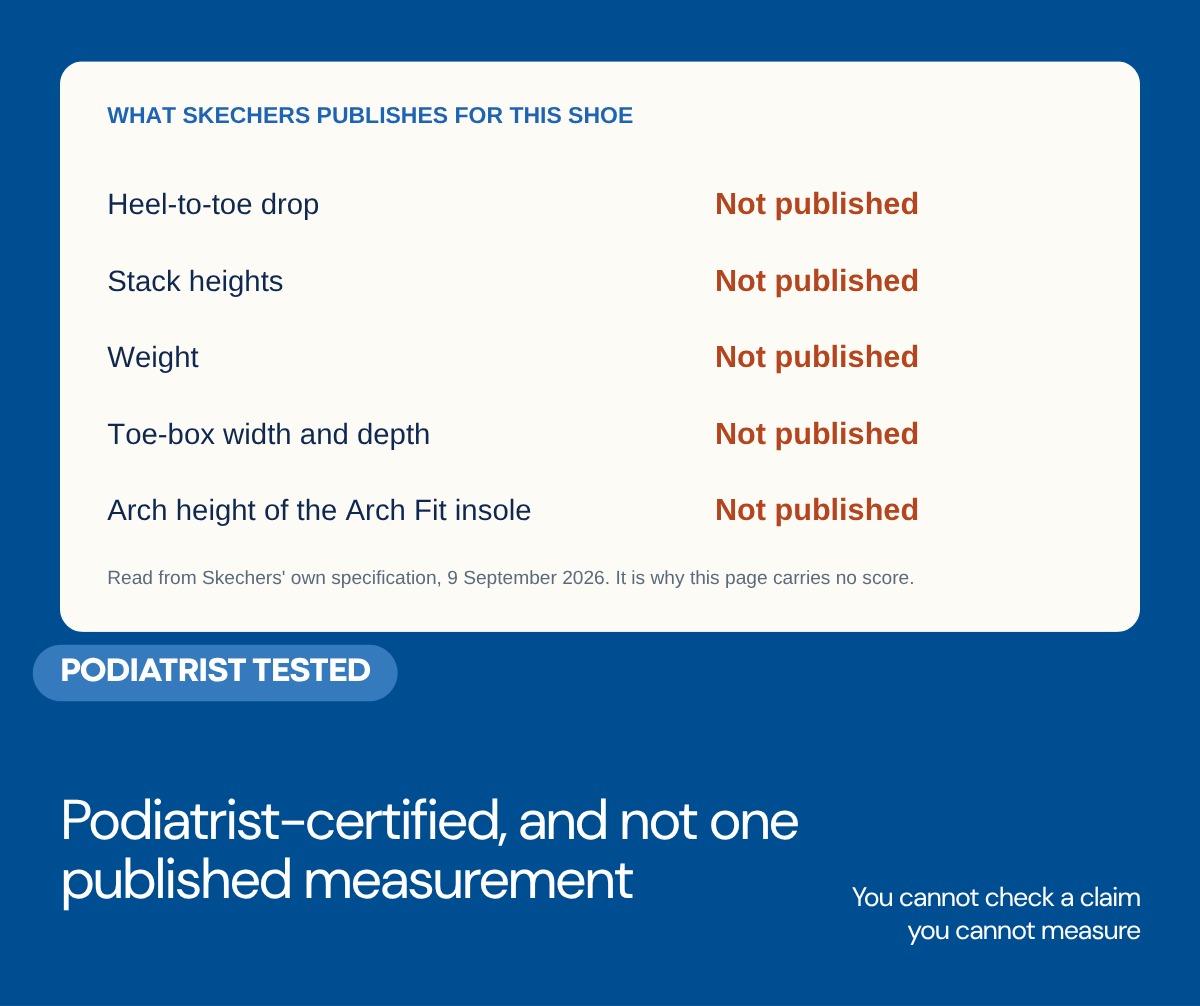
Source column tells you where each figure comes from. “Skechers” means the brand’s own US product page. A retailer name means the brand does not publish that figure and a retailer does. “Not published” means nobody reliable does — those are the figures our bench measures first.
| Specification | Figure | Source |
|---|---|---|
| Category | Cushioned walking shoe | Skechers |
| Insole | Removable Arch Fit insole, “developed from 120,000 foot scans” | Skechers |
| Marketing claim | “Podiatrist-certified comfort” | Skechers |
| Third-party seal | APMA Seal of Acceptance, granted to certain Slip-ins GO WALK Arch Fit 2.0 styles | Skechers |
| Entry system | Slip-ins: Heel Pillow plus bungee lacing, hands-free entry | Skechers |
| Upper | Engineered heathered knit or engineered mesh with synthetic overlays, by style | Skechers |
| Outsole | Dual-density traction outsole | Skechers |
| Care / materials | Machine washable; 100% vegan materials | Skechers |
| List price | Varies by style; skechers.com listed Slip-ins GO WALK Arch Fit 2.0 styles at $55.24–$64.99 on 9 September 2026 | Skechers |
| Heel-to-toe drop | Not published | — |
| Weight | Not published | — |
| Stack heights | Not published | — |
| Internal toe-box width and depth | Not published | — |
| Arch height of the Arch Fit insole | Not published as a measurement | — |
| Reference style for this page | Slip-ins GO WALK Arch Fit 2.0 — Grand Select 2, style 216601 | Skechers / Amazon listing |
Figures checked September 9, 2026. Sources: skechers.com product listings and Skechers’ own product copy as published on its US retail listings, both read 9 September 2026. Prices and seal status are style-specific — check the individual style, because the APMA Seal is granted per product, not per brand.
What the spec sheet suggests — and what only a test can answer
“Podiatrist-certified” is not a regulated phrase, and it is not the same as tested. It describes the involvement of podiatric expertise in designing the insole. That is a genuine and reasonable thing for a company to do, and 120,000 foot scans is a real dataset that most footwear brands do not have. What the phrase does not describe is any independent measurement of this shoe, any comparison against another shoe, or any clinical outcome. It tells you about the design process, not about the product’s performance on your foot. Read plainly, it is a provenance claim, and provenance claims should be judged as such rather than treated as evidence or dismissed as spin.
The APMA Seal of Acceptance is real, and it answers a narrower question than most buyers think. The APMA seal is granted per product, on application, with a processing fee, on the basis of a documentary dossier reviewed by a panel. It is a statement that a product is found to allow for normal foot function and promote quality foot health. It is not comparative — it does not say this shoe is better than any other shoe with or without the seal — and it is not a physical test of the individual pair you buy. We have written a full comparison of our seal and the APMA Seal of Acceptance, because the difference matters and neither seal is served by muddling them. Nothing here is a criticism of the APMA: a documentary review answers a legitimate question honestly. It is just a different question from “what does this shoe measure”.
A single arch shape cannot be right for everyone, and that is fine. The Arch Fit insole has one profile per size. Feet do not. For a foot with a low, flexible arch and no acute pathology, a moderate contoured insole in a cushioned shoe is a perfectly sensible thing and often all that is needed. For a rigid high-arched foot, a post-surgical foot, a foot with a plantar plate tear, or anyone who has been fitted with a custom device, the shoe’s real virtue is that the Arch Fit insole is removable — which frees the volume to put your own device in. That is the specification a clinician actually cares about here, and Skechers deserves credit for making it removable.
Where the caution genuinely lies is the Slip-ins mechanism. Hands-free entry is a real accessibility win for anyone who cannot reach their feet — after a hip replacement, with a stiff back, with a large abdomen, with rheumatoid hands. That is a meaningful benefit and it is under-praised. The trade-off is that a shoe engineered to be entered without hands has a heel collar built to yield, and heel-counter grip is what stops the foot sliding forward and rotating inside the shoe. For an unstable ankle, a neuropathic foot that cannot feel a rubbing heel, or someone with a history of falls, that trade-off deserves a measurement rather than an opinion. Heel-counter stiffness is on our bench protocol precisely because claims like this one cannot be settled by reading.
Who the Skechers GO WALK Arch Fit 2.0 is probably for
Read from the published specification, not from wear. Treat these as hypotheses the test will confirm or overturn.
- You cannot easily reach your feet — hands-free entry is a genuine accessibility gain, not a gimmick.
- You want to use your own orthotic in a cheap, light, washable shoe — the Arch Fit insole comes out.
- A low, flexible arch with no acute pathology — a moderate contoured insole is often all that is needed.
- Budget matters — these list well under half the price of the motion-control shoes in this category.
- You have an unstable ankle or a history of falls — a collar built to yield for hands-free entry is the opposite of a firm heel counter, and nobody has measured this one.
- You have a neuropathic foot — a foot that cannot feel a rubbing heel should not be in an unmeasured heel counter.
- You are reading the APMA Seal as proof it suits your foot — the seal is a per-product documentary review, and it is not comparative.
- You need published depth or stack figures — Skechers publishes none of them for this model.
Skechers GO WALK Arch Fit 2.0: what changed from the previous version
Skechers does not publish a changelog between Arch Fit and Arch Fit 2.0, and the Arch Fit 2.0 name spans a large number of individual styles that differ in upper, closure and outsole. Two of the differences that matter clinically — heel-counter stiffness and whether a given style is a Slip-in — vary within the 2.0 range rather than between 1.0 and 2.0, so “Arch Fit 2.0” on its own does not tell you what you are buying.
The APMA Seal is likewise style-specific: skechers.com states it for particular Slip-ins GO WALK Arch Fit 2.0 styles, not for the Arch Fit platform as a whole. If the seal is part of why you are buying, check the individual style page rather than the brand.
Related walking reviews on this site: Vionic Walk Max, KURU Atom 2 and HOKA Transport 2.
Skechers also builds a plated, maximal running shoe: our spec analysis of the Skechers Aero Burst compares what Skechers publishes with what an independent lab measured, and the two do not agree about the forefoot.
Where to buy
Disclosure: the links below are paid links. If you buy through them Amazon pays us a commission at no cost to you. Commissions never influence a score, a ranking or the seal, and this page carries no score because the shoe has not been tested — see our independence policy.
Amazon listings are colourway-specific; the button opens one common colourway and you can switch colour and width there. List price $55.24–$64.99 (by style) on September 9, 2026; prices move, check the listing.
Questions people ask about the Slip-ins GO WALK Arch Fit 2.0
Are Skechers Arch Fit podiatrists approved?
Certain Slip-ins GO WALK Arch Fit 2.0 styles have been granted the APMA Seal of Acceptance, and Skechers describes the Arch Fit insole as “podiatrist-certified”. Both statements are accurate. What they mean is narrower than they sound: the APMA seal is granted per product, on application with a fee, after a panel reviews a documentary dossier — it says a product allows normal foot function, not that it beats any other shoe, and it is not a physical test of the pair you buy. “Podiatrist-certified” describes podiatric input into the insole design. Neither is a measurement. We explain the distinction in full in our seal comparison.
Do podiatrists like Skechers shoes?
Most of us are far less tribal about brands than the internet suggests. What a clinician actually looks at is whether the insole comes out, how stiff the heel counter is, how much the shoe twists, and whether it comes in the width the patient needs. Arch Fit does well on the first of those — the insole is removable, which makes the shoe a usable carrier for a custom orthotic at a low price. The heel counter on the Slip-ins versions is the part that deserves a measurement rather than an opinion, because a collar designed to yield for hands-free entry is doing the opposite of what a firm counter does.
Are Arch Fit Skechers good for your feet?
For a low, flexible arch with no acute pathology, a moderate contoured insole in a cushioned, washable, inexpensive shoe is a reasonable thing and often enough. For a rigid high arch, a post-surgical foot, or anyone already wearing a custom device, the value of Arch Fit is that you can take its insole out and use the space. What no one can tell you from the published specification is how much volume that frees, because Skechers publishes no internal depth — which is the figure our bench measures first.
What shoes do podiatrists wish people would stop wearing?
Broadly: shoes that twist easily along their length, shoes with a heel collar so soft the foot rotates inside it, shoes worn long past the point where the midsole has packed out, and shoes bought a size too small because the label matters more than the fit. Notice that none of those is a brand — they are properties, and they can be measured. Nobody needs to be told to throw out a whole label; they need to know whether the specific pair on their feet still resists torsion.
Do podiatrists recommend Skechers?
Often, and for reasons that have little to do with the marketing. The GO WALK Arch Fit 2.0 insole lifts out, so a custom or over-the-counter orthotic can replace it — that alone is why this shoe gets suggested in clinic more than its price would suggest. The hands-free Slip-ins entry is genuinely useful for anyone who cannot reach their own foot: after a forefoot procedure, late in pregnancy, with an arthritic spine, or with a body habitus that makes bending hard. What Skechers does not give you is a number. It calls the comfort “podiatrist-certified” and holds an APMA Seal of Acceptance on certain Slip-ins styles, but publishes no heel-to-toe drop, no weight, no stack heights, no internal toe-box width, and no arch height for the Arch Fit insole — the one figure that would tell you whether that arch suits your foot. A seal is a review of a dossier, not a caliper. Podiatrist Tested has not measured this pair either, so it carries no score and no seal of ours.
What happens next
This page currently compares attributed published specifications. No original measurements or wear-test records are documented. Any future first-hand report would require retained photographs, measurement methods and wear notes. Our scoring and award programme remains an unvalidated proposal; no score or Seal follows automatically from a test. The Orthotic Volume Rating is also a proposed notation, not a recorded measurement for this shoe. Corrections to source information can be reported through the published contact route.
Related: this page reads the Arch Fit 2.0’s own specification. For the brand-level questions we also cover what “podiatrist-certified” actually means and whether Skechers are good for your feet.
Page type: spec analysis. Acquisition: not yet purchased. Last verified: September 9, 2026. Author: Tom Biernacki, DPM, FACFAS — board-certified foot and ankle surgeon, about.
Where this shoe fits
Guides on this site that weigh the Skechers GO WALK Arch Fit 2.0 against the problem you are actually trying to solve:
- Skechers Arch Fit, examined — what the moulded footbed is and is not doing.
- Best walking shoes — why a cushioned running shoe usually beats a walking-specific one.
- Best shoes for arch support — why midfoot rigidity holds an arch up and a foam bump does not.
- Best shoes for seniors — base width, heel counter and closure, judged for balance rather than cushioning.
- Best shoes for Parkinson’s disease — stability, easy closures, and the three things that prevent more falls than any shoe.
Browse every shoe on file or read how we test.
Compare it with the rest: every Skechers review · the shoes for plantar fasciitis · the shoes for wide feet · everything for standing all day · everything for walking · the extra-wide fittings · the wide fittings. Every list shows the published drop, stack, weight, widths and price side by side.
This page is a spec analysis, not a test report: the figures are the manufacturer’s or a named third party’s, each printed beside its source, and nothing here carries a score or the Seal until the shoe has been worn and measured on our bench. Quote any figure you like — keep the source attached to it, and link the page rather than the number. How to cite or link to an analysis.