
Wide Feet vs Narrow Feet: How to Tell, and What the Letters Actually Mean
On this page
- The short answer
- What the letters mean, side by side
- What one width letter is actually worth
- The number one brand publishes and the other refuses to
- A wide shoe is not always a wider shoe
- How to tell which you are, at home
- What is considered a narrow foot?
- Narrow feet are the harder shopping problem
- Questions people ask
- Sources
- Related charts and guides
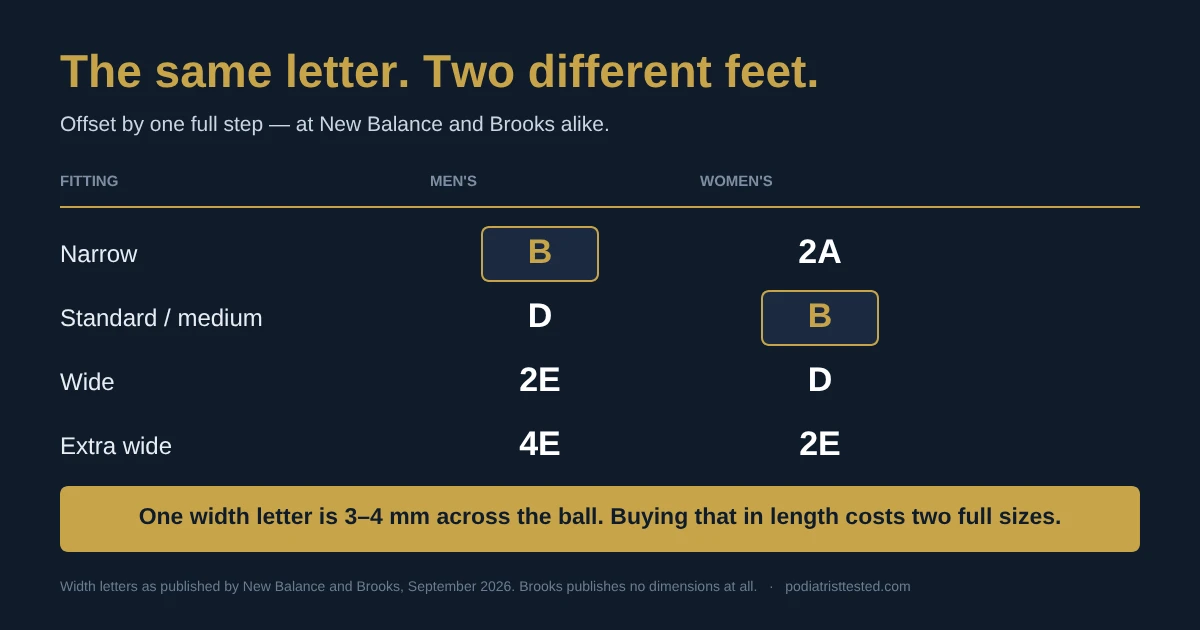
Here is the part that catches almost everybody: “wide” and “narrow” are not descriptions of your foot. They are letters printed on a shoe. And the letter B means narrow if you are shopping men’s and standard if you are shopping women’s — same letter, same brand, same shoe wall. New Balance and Brooks both publish that table, and they agree on it. What they do not agree on is whether a width is worth a number at all: New Balance prints a width in centimetres for every size, and Brooks states in writing that it will not. And New Balance publishes the size of one width step twice, in two places, in figures that differ by more than threefold.
Every figure below is a manufacturer’s own published number or a named retailer’s, labelled where it sits. No caliper of ours touched anything on this page. What our testing tiers mean →
The short answer
A width letter describes how broad a shoe is across the ball of the foot, not your foot’s shape, and it is only meaningful next to a length. A men’s 10 D and a men’s 11 D are not the same width. New Balance publishes a men’s size 10 in D at 10.6 cm across the ball and the same size in B at 10.2 cm — four millimetres apart, which is the whole difference between “standard” and “narrow” at that length.
The letters are offset by gender, and that is the single most common mix-up in a shoe shop. On the men’s scale, B is narrow and D is standard. On the women’s scale, 2A is narrow and B is standard. So a woman in a standard B and a man in a narrow B are wearing two different shoes with the same letter on the box. Both New Balance and Brooks publish this mapping, and it is the same at both brands.
What the letters mean, side by side
Two of the largest width-offering brands in the United States publish the same four-step ladder. Here it is as each brand states it.
| Fitting | Men’s letter | Women’s letter | Published by |
|---|---|---|---|
| Narrow | B | 2A | New Balance; Brooks |
| Standard / medium | D | B | New Balance; Brooks |
| Wide | 2E | D | New Balance; Brooks |
| Extra wide | 4E | 2E | New Balance; Brooks |
| Beyond extra wide | 6E | — | New Balance, selected models only |
Source: New Balance size & width guide and Brooks size guide, both read 17 September 2026. Brooks states the same four steps in words — narrow, medium, wide, extra-wide — with the letters alongside.
The wider scale that sits behind these letters runs from AAAA at the narrow end to EEEE at the wide end. That is the Brannock Device scale, the measuring plate that has sat on shoe-shop floors since Charles Brannock patented his first prototype in 1925 and an improved version in 1927. Almost no brand sells the full range; they pick four or five rungs off it and rename them.
What one width letter is actually worth
This is the figure that turns an adjective into a decision, and New Balance is the only brand in our library that publishes it. Here is a men’s size 10, straight off New Balance’s own width chart.
| Fitting, men’s size 10 | Published width | Step from the one before |
|---|---|---|
| B — narrow | 10.2 cm (4″) | — |
| D — standard | 10.6 cm (4 1/8″) | 4 mm |
| 2E — wide | 10.9 cm (4 1/2″) | 3 mm |
| 4E — extra wide | 11.3 cm (4 1/2″) | 4 mm |
Source: New Balance size & width guide, men’s width table, read 17 September 2026. The centimetre column is the precise one; New Balance rounds its inch column hard, which is why 2E and 4E both read 4 1/2″. New Balance notes the figures are general and vary by style.
So one width letter is three to four millimetres across the ball of the foot. Not a lot in the abstract. Quite a lot when it is the millimetres over a bunion.
approximately a 1/2″ difference between widths (2A, B, D, 2E and 4E), occurring
across the ball of the foot.Half an inch is 12.7 mm. The size chart says three to four. Both figures are New Balance’s, both say “across the ball,” and they differ by more than threefold. The only reading that reconciles them is that one is a girth — a circumference taken right around the ball — and the other a flat width across it. New Balance does not label either. If you are comparing a tracing of your own foot, compare it against the size chart, because a tracing is a flat width.
“Can I just buy a half size up instead of a wide?”
By New Balance’s own chart, this is a bad trade, and you can see exactly how bad. Hold the width letter at B and walk up the lengths: a men’s 8 is 9.8 cm across, a 10 is 10.2 cm, a 12 is 10.6 cm. That is two millimetres of extra width per full size.
Now compare that with the ladder above. One width letter is three to four millimetres. To buy the width of a single letter by going longer, you would need roughly two full sizes — and New Balance publishes the length cost of that too, at about 1/6″ per half size, so two full sizes is around 17 mm of extra shoe sitting in front of your toes.
Seventeen millimetres of length to gain four of width is not a compromise; it is a different shoe. Your foot’s flex point stops lining up with the shoe’s, the heel pistons, and the toes slide forward on every step. If the problem is width, buy width.
The number one brand publishes and the other refuses to
The table above is not an industry standard. It is one brand’s chart, and it exists because New Balance chose to publish one — every size, every fitting, in centimetres and inches, men’s and women’s. You can put a tape measure across your own tracing and compare it directly.
Brooks does not, and it is unusually direct about why. Asked for its footwear dimensions, Brooks answers: We do not offer exact measurements for the dimensions of our footwear, as it is difficult to communicate that information in a way that is helpful.
A wide shoe is not always a wider shoe
This is the finding that surprises people most, and again it comes straight from the manufacturer. Brooks states: Narrow, medium, and wide shoes within the same model are built on the same size footbed. The difference comes in the amount of upper material used, and therefore volume, present in the shoe.
In plain terms: at Brooks, moving from a medium to a wide in the same model gives you more room above your foot, not a broader platform under it (the extra-wide is the stated exception). If the thing pressing on you is a bunion at the first metatarsal head, or a bunionette on the fifth, a roomier upper genuinely helps — that is where the pressure is. If instead your forefoot is overhanging the edge of the midsole, extra upper volume does nothing for it, because the sole under you is the same width it was.
We have measured this from the other direction. Our toe box width chart puts calipers across 31 shoes at the big toe and finds a spread of 67.3 mm to 83.6 mm — and four fifths of the catalogue crammed into a 6 mm band. A wide fitting and a wide toe box are two different things, bought with two different letters, and the shoe wall does not distinguish them.
How to tell which you are, at home
You do not need equipment. You need paper, a pencil held upright, and the discipline to do it at the right time of day.
- Do it in the late afternoon or evening. New Balance’s own guidance is to try shoes on
in the late afternoon when your feet are at their largest due to normal swelling.
A morning measurement will under-read you, and you will buy the shoe that hurts by three o’clock. - Stand on the paper in the socks you will actually wear. Full weight on both feet. Sitting down changes the answer — the foot spreads under load, which is the state it will be in inside the shoe.
- Trace both feet, keeping the pencil vertical against the skin rather than angled under the arch.
- Measure the widest part of each tracing — that is across the ball, at the two bumps of the first and fifth metatarsal heads, not across the middle of the foot and not across the toes.
- Measure the length too, heel to longest toe, and use the larger foot. Width has no meaning without it: 10.6 cm is a standard D at a men’s 10 and a narrow fitting at a men’s 13.
- Compare against a brand that publishes numbers. New Balance’s chart is the one we use, because it is the one with figures in it.
New Balance adds one more piece of advice worth repeating: Have your feet re-measured every year. Feet typically get bigger with age and women’s feet often become a half size or more larger after pregnancy.
Adult feet are not fixed. Width in particular drifts as the transverse arch settles.
What is considered a narrow foot?
There is no clinical threshold in millimetres, and any site that gives you one has invented it. What exists is the ladder above, and your position on it relative to the length you wear. If your measured ball width lands a full letter below the standard fitting for your length — below B on the men’s scale, below 2A on the women’s — you are into genuinely narrow territory, and the practical problem stops being comfort and becomes heel retention.
A foot that swims in a standard shoe lets the heel lift on every step. The shoe’s counter loses the calcaneus, the forefoot slides forward into the toe box, and you get the blister pattern and the Achilles irritation that people usually blame on the sock. Lacing tricks and a thicker insole buy you some of it back. A narrow fitting buys you all of it, if you can find one.
Narrow feet are the harder shopping problem
We keep a file on every shoe we assess, and the asymmetry in it is stark. Of the 43 shoe reviews published on this site, 39 are sold in at least one wide fitting. Only 14 are sold in a narrow one. If you are wide, nearly the whole market is open to you. If you are narrow, three quarters of it is closed.
It is worse than the count suggests, because the brands do not use one language. Here is how the brands in our library actually describe their widths, taken from each shoe’s own published specification.
| Brand | How it names its widths | Letter codes published? |
|---|---|---|
| New Balance | B, D, 2E, 4E — and 6E on selected Made in USA models | Yes, with a centimetre figure per size |
| ASICS | Men’s D, 2E, 4E · Women’s 2A, B, D | Yes |
| KURU | D, 2E, 4E | Yes |
| Brooks | Mostly words — Narrow, Normal, Wide, X-Wide — with letters on some models | Mixed; no dimensions, by policy |
| Saucony | D and 2E on some models, “Regular, Wide, Extra Wide” on others | Mixed |
| Altra | Regular, Wide — with 2E given in brackets | Partial |
| HOKA | Regular, Wide, X-Wide | No letter codes published |
| On | D and 2E, carried on retailer listings | Via retailer, not the brand page |
| Skechers | Not stated on the model pages we checked | No |
Compiled from the published specification recorded in each review on this site, 17 September 2026. Where a figure came from a retailer rather than the brand, the individual review says so.
Three of those nine brands give you a letter you can compare across a shoe wall. One gives you a number. The rest give you an adjective. That is the actual state of width information in 2026, and it is why the honest answer to “am I a 2E?” is “in which brand?”
Questions people ask
What is the difference between a wide foot and a narrow foot?
Girth across the ball of the foot at a given length, nothing else. It is not arch height, not foot volume, and not toe shape, although all three can make a shoe feel tight. On New Balance’s published width chart, one width letter is three to four millimetres of flat width across the ball at a given length.
How do I know if I have a narrow foot?
Trace your weight-bearing foot in the late afternoon, measure the widest point across the ball, measure the length, and compare both against a brand that publishes width dimensions. If your width sits a full letter below the standard fitting for your length, you are narrow. The everyday tell is a heel that lifts out of the shoe when you walk, and a shoe that feels fine at the toes but loose at the midfoot however hard you pull the laces.
How do I tell if my feet are wide?
Same method, opposite direction. The reliable signs are a measured ball width a letter or more above standard for your length, an upper that creases hard over the first and fifth metatarsal heads, and a forefoot that visibly overhangs the edge of the midsole when you stand. Pain alone is not a diagnosis of width — a too-short shoe, a bunion and a neuroma all hurt in the forefoot without the foot being wide.
Are narrow feet the same as regular width feet?
No, and the letters make it confusing because they are offset by gender. Regular for a man is D; narrow for a man is B. Regular for a woman is B; narrow for a woman is 2A. The letter B is therefore a regular fitting on one wall of the shop and a narrow fitting on the other.
Does a wide shoe have a wider sole?
Not always. Brooks states that narrow, medium and wide versions of the same model are built on the same footbed, and that the difference is the volume of upper material — with the extra-wide as the stated exception. Other brands build a genuinely wider last. If your forefoot overhangs the midsole, ask which kind you are buying.
Can I wear a wide shoe if my feet are not wide?
You can, and plenty of people do it to accommodate an orthotic or a swollen foot. The cost is midfoot hold: a wide shoe on a standard foot lets the foot slide laterally in the shoe during push-off, and the shoe’s own stability features stop lining up with the joints they were drawn for. If the reason is an orthotic rather than the foot, a removable footbed is usually the better lever than a width letter — that is why we record it on every review.
Do my two feet need the same width?
They frequently do not, and you fit the larger one. Padding, lacing and a thicker sock manage the smaller foot; nothing manages a foot that is too wide for its shoe.
Sources
- New Balance, Size & Width Guide — width letters by gender, the men’s and women’s width tables in centimetres and inches (men’s 10: B 10.2, D 10.6, 2E 10.9, 4E 11.3 cm), and the late-afternoon and annual re-measurement guidance. Read 17 September 2026.
- New Balance customer support, What are the measurements between New Balance shoe sizes and widths — the 1/2″ between-widths figure, 3/8″ between 4E and 6E, and 1/6″ per half size of length. Read 17 September 2026; quoted here alongside the size chart because the two do not reconcile.
- Brooks Running support, How do I know which width to choose — width letters by gender, the same-footbed statement, and the refusal to publish dimensions. Read 17 September 2026.
- Brooks Running, Size Chart & Measurement Guide — the narrow/medium/wide/extra-wide mapping. Read 17 September 2026.
- The Brannock Device Company, via the device’s published documentation — the AAAA to EEEE scale, the 1925 and 1927 patents, and the distinction between heel-to-toe length and arch length.
- Published widths recorded in the 43 shoe reviews on this site, each attributed in its own review to the brand or the named retailer that published it.
Related charts and guides
- Toe box width chart: 31 shoes measured in millimetres — because a wide fitting and a wide toe box are not the same purchase.
- Shoe spec database: 43 shoes, every published number — and who published it.
- Every shoe on file sold in a wide fitting — 39 of them.
- Every shoe on file sold in a narrow fitting — only 14.
- Extra wide, 4E to 6E — where the range actually runs out.
- Brooks vs New Balance — the two brands on this page, compared across six shoes.
Reviews for Narrow
Individual shoe pages state their evidence tier, published measurements and who should skip them.
New Balance Made in USA 990v6
Spec AnalysisNew Balance publishes no weight, drop or stack height for the 990v6, but it does publish B through 6E widths — and that range is why it still matters. Not tested by…
Brooks Adrenaline GTS 25
Spec AnalysisOn an independent lab’s calipers the drop fell 3.3 mm from the GTS 24 and the midsole went from firm to soft — a different prescription, not a refresh. Not tested by…
Brooks Ghost 18
Spec AnalysisBrooks publishes a 10 mm drop; a lab measured 12.2 mm. Four widths. Not tested by us.
Measured, worn, scored — never sponsored
No brand has ever paid for a review, a score, a ranking or the seal. Where we earn a commission the link says so, and the score does not change.