
Brooks vs On Cloud: One Brand Publishes Its Numbers
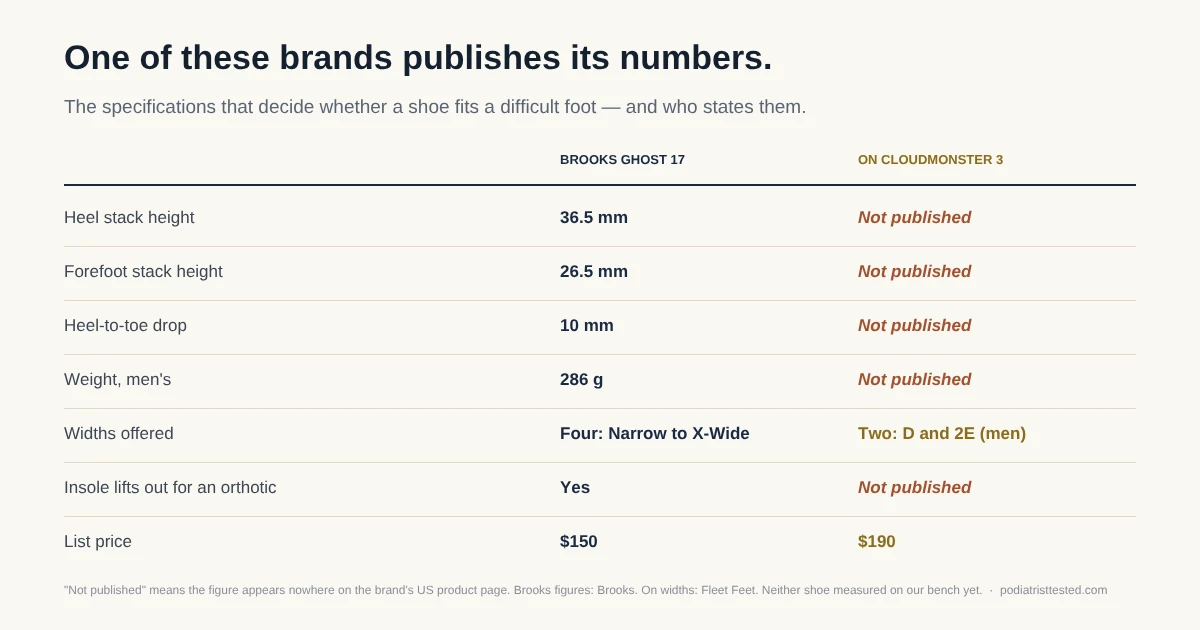
The honest difference between these two brands is not the ride. It is that Brooks publishes its numbers and On does not. Brooks states drop, heel stack, forefoot stack, weight, four widths and a removable insole for every model here. On publishes none of those for the Cloudmonster 3, and for the Cloudrunner 2 not even a weight — the figures below had to be sourced from a reviewer and a retailer. Brooks is also $10 to $50 cheaper.
We earn a commission if you buy through links on this page, including Amazon links paid by brand partners through Levanta, at no cost to you. As an Amazon Associate I earn from qualifying purchases. How we make money
On this page
None of these shoes has been under our caliper, so none is scored and none carries our seal. Every figure below is the brand’s or a named third party’s, labelled. What our testing tiers mean →
The short answer
Model versions: the Brooks Adrenaline GTS 24 and Brooks Ghost 17 named on this page have since been superseded. The current models are the Brooks Adrenaline GTS 25 and Brooks Ghost 18. Nothing here has been swapped to the newer versions — this page describes the models it was built on, and each newer model has its own review.
If you have a foot problem, buy Brooks. Not because the shoes are better — we have not tested either brand and will not pretend to know — but because the two things that decide whether a shoe works on a difficult foot are width and whether an orthotic fits, and Brooks answers both in writing while On does not. Brooks lists Narrow, Medium, Wide and X-Wide across the models below and confirms the insole lifts out. On lists D and 2E for men on the Cloudmonster and D only for women, and does not publish insole removability at all.
If you are buying on feel, the question is different and we cannot answer it for you yet. On’s CloudTec elements and Speedboard produce a ride that has no Brooks equivalent, and people who love it are not wrong. What we can tell you is that you will be paying $160 to $190 for a shoe whose stack height its own maker will not state.
Every published figure, side by side
Two neutral daily trainers and two support shoes, one pair from each brand. “Not published” in the On column means the brand does not state it anywhere on its US product page.
| Specification | Brooks Ghost 17 | On Cloudmonster 3 | Source |
|---|---|---|---|
| Category | Neutral daily trainer | Maximum cushion, neutral | Both brands |
| Stated heel stack | 36.5 mm | Not published | Brooks; On states none |
| Stated forefoot stack | 26.5 mm | Not published | Brooks; On states none |
| Third-party stack | 36.2 / 25.8 mm | 35 / 29 mm | RunRepeat lab; Doctors of Running |
| Stated drop | 10 mm | Not published | Brooks; On states none |
| Third-party drop | 10.4 mm measured | 6 mm | RunRepeat lab; Doctors of Running |
| Stated weight, men’s | 286 g / 10.1 oz | Not published | Brooks; On states none |
| Third-party weight | 289 g measured | 295 g at size 9 | RunRepeat lab; Doctors of Running |
| Widths | Narrow, Medium, Wide, X-Wide | Men D and 2E; women D only | Brooks; Fleet Feet for On |
| Removable insole | Yes | Not published | Brooks; nobody for On |
| Toe box at the big toe | 69.6 mm | Not measured by anyone | RunRepeat lab |
| MSRP | $150 | $190 | Both brands |
| Specification | Brooks Adrenaline GTS 24 | On Cloudrunner 2 | Source |
|---|---|---|---|
| Category | Stability daily trainer | Stability / “more support” | Brooks; REI listing for On |
| Support hardware | GuideRails, medial post, reinforced heel counter | Not specified | Brooks; On describes none |
| Stated heel stack | 39 mm | Not published | Brooks; On states none |
| Stated forefoot stack | 27 mm | Not published | Brooks; On states none |
| Stated drop | 12 mm | 10 mm | Brooks; REI for On |
| Lab-measured drop | 13.5 mm | Not measured by anyone | RunRepeat lab |
| Weight | 283 g stated, 291 g measured | Pair weight 1 lb 3.5 oz, size not stated | Brooks and RunRepeat; REI for On |
| Widths | Narrow, Medium, Wide, X-Wide | Not published | Brooks; On states none |
| Removable insole | Yes | Not published | Brooks; nobody for On |
| Toe box at the big toe | 73.7 mm | Not measured by anyone | RunRepeat lab |
| MSRP | $140 | $160 | Brooks; on.com for On |
Where the numbers are shaky — on both sides
Brooks is not perfect either. The Adrenaline GTS 24 is listed at a 12 mm drop and RunRepeat’s calipers found 13.5 mm, because the measured forefoot came in 1.5 mm under the stated figure. That is the largest discrepancy in this comparison and it is worth knowing if you are choosing a stability shoe for Achilles pain, where drop is one of the few published numbers that reliably matters. The Ghost 17, by contrast, measured within 0.7 mm of Brooks’ figures on every dimension — among the most honest spec sheets we have read.
On’s figures come from other people entirely. The Cloudmonster 3’s 35/29 mm stack and 6 mm drop are Doctors of Running’s, from one pair in one size. The Cloudrunner 2’s 10 mm drop is REI’s, and its only weight is a pair weight with no size attached, which is not a figure you can compare with anything. Nobody has published an internal toe-box measurement for either On shoe. Those are not small omissions on a $160 to $190 shoe.
Which brand a foot doctor hands you
Brooks makes more sense when
- You need width. Four widths from Narrow to X-Wide, published, on both models here.
- You wear an orthotic. Brooks confirms the insole lifts out; On does not say.
- You want to be able to check the shoe against the numbers, and to compare it with anything else.
- Price matters: $140 to $150 against $160 to $190 for the On equivalents.
On makes more sense when
- You want a flatter shoe. The Cloudmonster’s 6 mm drop is well below the Ghost’s 10 mm and the Adrenaline’s 12 mm.
- You have tried the CloudTec ride and prefer it. Nothing in the Brooks range feels like it, and that is a real reason.
- You are a standard width with no orthotic, where On’s missing figures cost you nothing.
- You want more forefoot foam: 29 mm on the Cloudmonster against 25.8 mm measured on the Ghost.
Where to buy
Amazon affiliate links. We earn a commission at no extra cost to you; commissions never influence a ranking, a score or the seal. Price and availability change, so check the listing. Our independence policy.
Brooks — Ghost 17 from $150, Adrenaline GTS 24 from $140. Four widths, removable insole.
Brooks Ghost 17, men’s Brooks Ghost 17, women’s Adrenaline GTS 24 on AmazonOn — Cloudmonster 3 from $190, Cloudrunner 2 from $160. Flatter drop, fewer widths.
On Cloudmonster 3, men’s On Cloudmonster 3, women’s On Cloudrunner 2, men’s On Cloudrunner 2, women’sThese buttons open an Amazon search rather than one colourway, because all four models are sold in dozens of colour and width combinations and a single listing would send most readers to the wrong one. Prices are the brands’ list prices read on September 9, 2026.
Our full analysis of each
The most accurate spec sheet in our library: every stated figure within 0.7 mm of the lab.
GuideRails, four widths, and the 1.5 mm forefoot discrepancy that moves the real drop to 13.5 mm.
Every figure On declines to publish, and who filled each of them in.
A stability shoe with no published stack, no published widths and no support hardware named.
On makes far more than the Cloudmonster, and the rest of the line does not share its numbers. Our brand-level assessment works through the range in On Cloud shoes for men.
Common questions
Are On Cloud shoes good for plantar fasciitis?
We have not tested them, so we will not rank them for it. What is worth knowing before you spend $190: plantar fasciitis decisions turn on heel height, drop, width and whether an orthotic fits, and On publishes none of those four for the Cloudmonster 3. The Brooks equivalents publish all four. That does not make On a bad shoe — it makes it a shoe you cannot evaluate for a specific foot problem before you buy it. Our plantar fasciitis guide covers what we have looked at.
Which brand is wider?
Brooks, and not marginally. Both Brooks models here come in Narrow, Medium, Wide and X-Wide. The On Cloudmonster 3 is listed by Fleet Feet in D and 2E for men and D only for women, and On publishes no widths at all for the Cloudrunner 2. If you have a bunion, a hammertoe or a genuinely wide forefoot, that is usually the end of the discussion.
Is On worth the extra money?
On the published figures alone, no — you are paying $40 more for the Cloudmonster than the Ghost and getting fewer widths, no stated stack and no confirmation that an orthotic fits. But ride is not on a spec sheet, and plenty of people try both and come back to On. The fair statement is that the premium buys a feel, not a specification.
What about Brooks vs Hoka, or Brooks vs New Balance?
Different questions with different answers, and we treat them separately. Hoka’s published data sits between these two brands — it states weights and drops but usually not stack heights. New Balance publishes drop and widths but is inconsistent on stack. Brooks remains the most completely documented of the four in our library so far.
Sources: Brooks’ US product pages for the Ghost 17 and Adrenaline GTS 24 (stack, drop, weight, widths, insole, price); RunRepeat’s lab measurements for both Brooks models; On’s US product pages for the Cloudmonster 3 and Cloudrunner 2 (category, midsole, upper, price); Doctors of Running for Cloudmonster 3 stack, drop and weights; Fleet Feet for Cloudmonster outsole and widths; REI for Cloudrunner 2 category, drop and pair weight. Last verified 9 September 2026.
Recently reviewed
Individual shoe pages state their evidence tier, published measurements and who should skip them.
Saucony Endorphin Speed 5
Spec AnalysisLight plated neutral trainer. Saucony publishes both stack heights and they match its 8 mm drop — not yet tested.
HOKA Mach 6
Spec AnalysisLower, firmer neutral HOKA. HOKA publishes a 5 mm drop and neither stack height — not yet tested.
ASICS Novablast 5
Spec AnalysisBouncy high-stack neutral. ASICS publishes an 8 mm drop and neither stack height — not yet tested.
Our funding and evidence policy
We earn affiliate commissions from qualifying purchases. Our policy is to assess published evidence and fit needs rather than rank products by commission rate. Current reviews are specification analyses; see our method for their limits.