
Best Brooks Shoes for Plantar Fasciitis: Eight Models on the Measured Numbers
The Adrenaline GTS lost 3.3 mm of drop and went firm to soft between the 24 and the 25. Eight Brooks compared on lab-measured drop, heel counter and midsole.
We earn a commission if you buy through links on this page, including Amazon links paid by brand partners through Levanta, at no cost to you. As an Amazon Associate I earn from qualifying purchases. How we make money
On this page
- The short answer
- Why Brooks keeps coming up for heel pain
- The Brooks models, compared on the numbers that matter
- The Adrenaline GTS changed, and not in your favour
- The printed drop is not the real drop
- Model by model: who each one is for
- Match the Brooks to your arch first
- Brooks for women with plantar fasciitis
- The Brooks this page leaves out, and why
- If your heel pain is not plantar fasciitis
- When Brooks is the wrong brand for your heel
- The 30-second test before you buy any of them
- Shoes are one part of the treatment
- What the evidence supports, and where it stops
- Where to buy
- Frequently asked questions
- Related guides and reviews
Most pages that answer this question tell you the Adrenaline GTS is the Brooks for plantar fasciitis. Here is what the numbers say: the Adrenaline got measurably less suited to heel pain between the 24 and the 25. On an independent lab’s instruments the drop fell from 13.5 mm to 10.2 mm and the midsole went from 44.1 Asker C — firm — to 34.5, soft. Those are the two figures that matter most to a sore fascia, and both moved the wrong way. Brooks publishes no stack height for any of these eight shoes, so every height below came from a lab or a named retailer.
None of these eight has been under our own caliper, so none is scored and none carries our seal. Every figure is Brooks’, an independent lab’s, or a named retailer’s, labelled where it sits. What our testing tiers mean →
The short answer
If you want the most heel lift and the firmest midfoot, it is the Adrenaline GTS 24 — 13.5 mm of lab-measured drop and a 44.1 Asker C midsole, the highest drop and the firmest midsole of the Brooks running shoes on file (only the Addiction Walker 2, a walking shoe, measures firmer). It is also the cheapest of the trainers at $140 and it is being cleared out, because the 25 replaced it.
If you want the most heel control, it is the Ghost 18 — heel-counter stiffness 5 of 5 on the lab’s scale, one of two shoes here that score full marks, with the Ghost 17 it replaced. It is a neutral trainer, which surprises people, and it is stiffer at the heel than the motion-control walking shoe in this list.
If you wear a prescribed orthotic, it is the Beast GTS 26 or the Ghost Max 4 — the two Brooks state in writing are built to take one, in men’s D/2E/4E and women’s B/D/2E, and the Beast GTS 26 carries the APMA Seal of Acceptance by name.
Why Brooks keeps coming up for heel pain
Two reasons, one good and one accidental.
The good one: Brooks builds high-drop shoes and confirms in writing that the insole lifts out. Drop — the height difference between heel and forefoot — sits between 8 and 13.5 mm across this range, which is high for 2026, when much of the market has drifted to 4–6 mm. A higher heel takes some of the tensile demand off the calf and, through the calcaneus, off the plantar fascia. And a removable footbed is the difference between a shoe your orthotic fits into and a shoe it does not.
The accidental one: the Adrenaline GTS has been the default recommendation in running shops for fifteen years, so it inherits the question whether or not it is still the right answer. As the lab figures below show, the shoe under that name has changed.
The Brooks models, compared on the numbers that matter
Four columns decide a plantar fasciitis purchase: how much heel lift, how stiff the heel counter, how firm the midsole, and whether the insole comes out. Here are all eight.
| Shoe | Heel-to-toe drop | Heel counter | Midsole firmness | Insole out | Price |
|---|---|---|---|---|---|
| Adrenaline GTS 24 | 13.5 mm lab Brooks states 12 | 4 / 5 | 44.1 AC — firmest trainer here | Yes | $140 |
| Addiction Walker 2 | 12.2 mm lab Brooks publishes none | 3 / 5 | 48.7 AC | Not stated | $140 |
| Beast GTS 26 | 12 mm Brooks | Not measured | Not measured | Stated to accept orthotics | $170 |
| Ghost 18 | 10 mm Brooks | 5 / 5 — joint stiffest here | 40.5 AC | Yes | $149.95 |
| Ghost 17 | 10.4 mm lab Brooks states 10 | 5 / 5 — joint stiffest here | 36.2 AC | Yes | $150 |
| Adrenaline GTS 25 | 10.2 mm lab Brooks states 10 | 4 / 5 | 34.5 AC — soft | Yes | $155 |
| Ghost Max 4 | 9.0 mm lab Running Warehouse lists 6; Brooks publishes none | 3 / 5 | 39.7 AC | Stated to accept orthotics | $165 |
| Glycerin 23 | 8.2 mm lab Brooks states 8 | 4 / 5 | 29.2 AC — softest here | Yes, 4.4 mm | $175 |
Sorted by drop, highest first. Lab figures are RunRepeat’s instrumented measurements, as recorded in each shoe’s review on this site or read from RunRepeat on 28 September 2026; Asker C is a durometer scale where a higher number is firmer. Brooks publishes no stack height for any of these eight, so every height quoted anywhere on this page came from a lab or a named retailer. Blank cells mean nobody we trust has published that figure — we do not estimate.
The Adrenaline GTS changed, and not in your favour
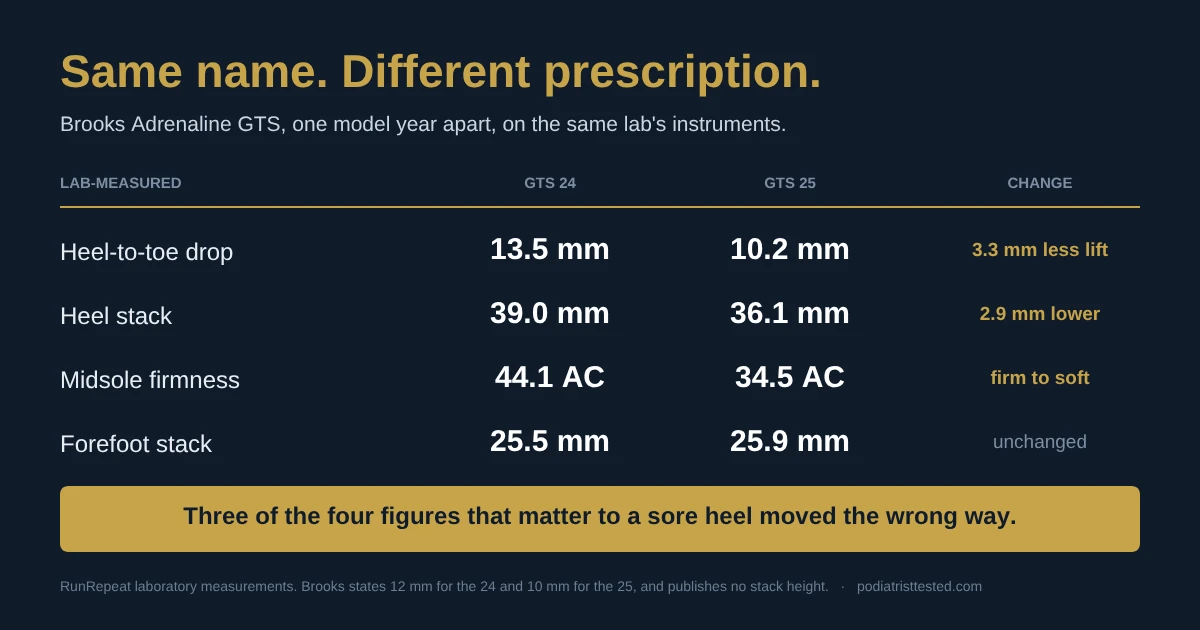
This is the finding that should change what you buy, so it gets its own table. Same shoe, same name, one model year apart, both measured on the same lab’s instruments.
| Lab-measured figure | Adrenaline GTS 24 | Adrenaline GTS 25 | What it means for a sore heel |
|---|---|---|---|
| Heel-to-toe drop | 13.5 mm | 10.2 mm | 3.3 mm less heel lift |
| Heel stack | 39.0 mm | 36.1 mm | Nearly 3 mm lower under the heel |
| Midsole firmness | 44.1 Asker C | 34.5 Asker C | Firm became soft — a softer midsole lets the arch sink further |
| Forefoot stack | 25.5 mm | 25.9 mm | Essentially unchanged |
| Toe-box height | Not published | 26.6 mm | Only the 25 has a measured figure; the lab published none for the 24 |
Both sets of figures: RunRepeat laboratory, as recorded in our GTS 24 and GTS 25 reviews. Brooks states 12 mm for the 24 and 10 mm for the 25, and publishes no stack height for either.
Read that as a prescription change rather than a refresh. The 25 is a softer, flatter shoe wearing the badge of a firmer, higher one. If what you wanted from an Adrenaline was heel lift and a midfoot that holds, the 24 is the shoe you wanted, and it is thirty-five dollars cheaper and disappearing from shelves.
The printed drop is not the real drop
Every shoe here where both numbers exist shows the same pattern: the lab measures more drop than Brooks prints.
- Adrenaline GTS 24 — Brooks states 12 mm, the lab measured 13.5 mm. A 1.5 mm gap.
- Ghost 17 — Brooks states 10 mm, the lab measured 10.4 mm.
- Adrenaline GTS 25 — Brooks states 10 mm, the lab measured 10.2 mm.
- Glycerin 23 — Brooks states 8 mm, the lab measured 8.2 mm.
- Addiction Walker 2 — Brooks publishes no drop at all; the lab measured 12.2 mm.
The gaps are small and they run one way, which is what you would expect from measuring a compressed insole in place rather than a bare last. It matters for one decision only: if you have been told to stay above 8 mm of drop, a shoe printed at 8 is genuinely at 8 or a little over, not a little under. That is a better record than most of this industry manages.
Model by model: who each one is for
Adrenaline GTS 24 — the most heel lift
The highest-drop and firmest Brooks trainer on this site, in four widths, with a removable insole and GuideRails. If a clinician told you to get into a higher-drop supportive shoe, this is the one that measures the part. Buy it while it is still stocked.
Ghost 18 — the most heel control
Full marks for heel-counter stiffness, which is the figure that decides how much your calcaneus moves inside the shoe. Neutral, four widths, insole lifts out. The second-narrowest toe box of the Brooks trainers here, after the Ghost 17’s 69.6 mm, so not the pick if you have a bunion.
Beast GTS 26 — for the orthotic wearer
Brooks states in writing that it is designed to accommodate orthotic inserts, and the Beast GTS 26 and Ariel GTS 26 are both named on APMA’s Brooks listing. High drop, high volume, motion control. Heavy at 12.5 oz, which is the price of the platform.
Addiction Walker 2 — for walking, not running
The firmest midsole in the Brooks range on file, and a torsional rigidity of 5 out of 5 — it barely twists, which is exactly what a collapsing midfoot needs. Leather, four widths, 14.5 oz. Note the heel counter is only 3 of 5, softer than the Ghost 18, which is not what the motion-control label leads you to expect.
Ghost Max 4 — for a stiff, painful forefoot
The second-lowest drop here on the lab’s instruments, 9.0 mm (a retailer lists 6), so not a first choice for fascia pain on drop alone. But the rocker and the maximal stack suit hallux rigidus and metatarsalgia, and Brooks states the roomy fit accommodates orthotics. Pick it for a forefoot problem, not a heel one.
Glycerin 23 — the softest, and the caveat
The softest Brooks midsole on file at 29.2 Asker C and the widest toe box of the Brooks trainers. Lovely under a bruised heel pad. But softest also means the arch sinks furthest, and the lowest drop of the trainers, so it is the least obvious Brooks for a fascia that is already under tension.
Match the Brooks to your arch first
Plantar fasciitis is one diagnosis arriving through at least three different feet, and the Brooks that settles one can aggravate another. Work out which foot you have before you choose between the models above.
A flat or flexible foot that rolls in
When the arch drops under load, the fascia is stretched between the heel and the toes with every step, which is one reason a collapsing midfoot and heel pain so often travel together. This foot wants the GuideRails models — the Adrenaline GTS, the Beast GTS and its women’s version, the Ariel GTS — and, for walking, the Addiction Walker 2, the most torsionally rigid shoe on file at 5 of 5. Of the running shoes, the Adrenaline GTS 24 has the firmest midsole on file at 44.1 Asker C, so the arch has the least foam to sink into. If you also wear an orthotic, the Beast GTS 26 has the volume for it.
One warning. If the foot is flat and stiff rather than flat and flexible, or if one arch has dropped in the last year while the other has not, that is not a shoe question yet. A one-sided, recent collapse is the classic presentation of a failing posterior tibial tendon, and it needs an examination first — see the guide to posterior tibial tendon dysfunction, and the flat feet guide for other brands.
A high, rigid arch
A high-arched foot does the opposite. It tends to roll outward, absorbs shock poorly and puts its load through the heel and the ball of the foot, with a tight fascia strung between the two. Motion control is the wrong medicine here: support built up under the inner arch pushes a foot that already tips outward further onto its outer edge. This foot wants a neutral, cushioned Brooks with a firm heel counter — the Ghost 18 as the default, because its heel counter is the stiffest on file at 5 of 5; the Glycerin 23 if the heel pad itself is bruised; and the Ghost Max 4 if the ball of the foot hurts as much as the heel. The supination guide covers the other brands.
A neutral foot
If your arch neither collapses nor stands rigidly high, the choice comes down to heel lift against heel control. Take the Adrenaline GTS 24 for the most lift (13.5 mm, lab-measured), or the Ghost 18 if holding the heel still matters more to you than the last few millimetres of drop.
How to tell which foot you have
A wet footprint shows how much of your arch touches the floor while you stand still. That is a fair guide to arch height, but it says nothing about how the foot moves when you walk. Better evidence is already in your cupboard. Some wear on the outside of the heel is normal for almost everyone, because that is where most people land. What tells you more is the upper: stand an old pair on a table and look from behind. A heel counter that leans inward points to a foot that rolls in; one that leans outward, with wear running the length of the outer edge, points to a foot that rolls out. If your two feet disagree with each other, or one has changed, a podiatrist’s gait examination is worth more than any shoe on this page.
Brooks for women with plantar fasciitis
Plantar fasciitis is most common between about 40 and 60, and nothing about the condition itself is different in women. The shoes are another matter. Every model above is made in a women’s version — the Beast GTS is sold to women as the Ariel GTS — but four things differ enough to change the purchase.
- The width letters mean different things. On a women’s Brooks, B is standard, D is wide and 2E is extra wide. On a men’s, D is standard, 2E is wide and 4E is extra wide. If someone told you that you need a D, find out which scale they meant. Where Brooks publishes women’s widths for the models on file, they stop at 2E.
- Crossing over to the men’s range. Women’s sizes run 1.5 larger than men’s, so a women’s 9.5 is a men’s 8. Women who need more width than a women’s 2E sometimes buy the men’s version for its 4E. It works when the heel holds, but a men’s last is usually broader at the back, and a heel that slips is the one thing a sore fascia does not need. Walk in them before you keep them.
- Coming down from heels. Women who wear heels most days have been shown to have shorter calf-muscle fibres and a stiffer Achilles tendon, and a calf that will not stretch is one of the best-established risk factors for plantar fasciitis. Dropping straight from a heeled shoe into a 6 mm trainer puts that short calf on full stretch with every step. The Adrenaline GTS 24, at a lab-measured 13.5 mm, is the gentlest landing in the range. Step down over weeks, not overnight.
- Pregnancy. Weight gain and looser ligaments can lower the arch during pregnancy, and research has found that the lower arch and longer foot can persist after delivery. If your heel pain started during or after a pregnancy, re-measure both feet before buying your old size. The pregnancy guide covers the months before.
For other brands, see the women’s plantar fasciitis guide; for walking rather than running, the women’s Brooks walking shoe guide.
The Brooks this page leaves out, and why
Eight shoes is not the whole range. The others are missing for one of two reasons: nobody we trust has published the figures that matter for a heel, or the shoe was designed for something a sore heel does not need.
- Anthem. Brooks’ entry-price road shoe. There is no review of it on this site and no lab figure on file for its heel, so we cannot place it against the eight above. If price is what draws you to it, the Adrenaline GTS 24 is being cleared at $140 and has the measured numbers a sore heel wants.
- Revel and Launch. Lighter, lower-priced neutral trainers, built for versatility and speed rather than protection. No figures on file. For an irritated fascia, saving weight is rarely the point.
- Hyperion. Brooks’ lightweight range for tempo running and racing. If you race, race in it, and do your daily miles in something from the table.
- Glycerin GTS. The Glycerin with GuideRails added. Not reviewed here, so no figures, but the reasoning in the Glycerin 23 entry above applies: soft foam lets the arch sink, and GuideRails exist to limit how far the rest of the leg follows it. If you love the Glycerin’s softness and your foot rolls in, it is the version to try.
- Older Ghost Max, Ghost and Glycerin versions. As the Adrenaline showed, one model year can change a shoe’s drop and its firmness. A discounted older version may be a better or worse prescription than the current one; check its own figures rather than assuming it matches.
If your heel pain is not plantar fasciitis
Classic plantar fasciitis hurts under the heel, toward the inside, and is worst on the first steps in the morning or after sitting, easing as you walk and returning after a long day. Several other conditions hurt in nearly the same place and want different shoes:
- Pain at the back of the heel, where the Achilles attaches. Insertional Achilles tendinopathy or a Haglund’s bump. Heel lift still helps, but a stiff heel counter that presses on the bump does not — look for a soft or notched collar. See Haglund’s deformity and Achilles tendonitis.
- A deep, bruised ache in the centre of the heel pad, worse barefoot and on hard floors. Fat pad atrophy or fat pad syndrome. Here cushioning, not support, is the point, which is the one situation where the Glycerin 23 moves to the top of this list. See heel fat pad atrophy.
- Burning, tingling or numbness along the inside of the heel or into the sole. A nerve rather than the fascia — Baxter’s nerve entrapment or tarsal tunnel syndrome. See Baxter’s nerve entrapment and tarsal tunnel syndrome.
- Pain when you squeeze both sides of the heel, or pain that built up after a jump in mileage. Treat it as a calcaneal stress fracture until a clinician says otherwise. Stop running and get it examined; early stress fractures often do not show on a first X-ray, and no shoe on this page treats one. See stress fractures.
- A child of roughly 8 to 14 with heel pain after sport. Usually Sever’s disease, an irritation of the heel’s growth plate, not plantar fasciitis. See Sever’s disease.
When Brooks is the wrong brand for your heel
- You need a width beyond 4E. Brooks stops at extra wide. New Balance publishes a 6E on selected models — see Brooks vs New Balance and the extra-wide list.
- You want to compare stack heights before you buy. Brooks publishes none, and states in writing that it does not give exact dimensions for its footwear. If that matters to you, buy from a brand that prints them.
- Your pain is under the ball, not the heel. Drop is the wrong lever; you want a rocker. Start at shoes for ball-of-foot pain.
- You need a narrow fitting and a firm heel. Brooks offers narrow, but only 14 of the 43 shoes on this site come in one at all — see the narrow list and how to tell which you are.
The 30-second test before you buy any of them
- Squeeze the heel counter between finger and thumb. It should barely give. The Ghost 18 is the benchmark here at 5 of 5.
- Twist the shoe like wringing out a cloth. A shoe for a collapsing midfoot should resist; the Addiction Walker 2 is the benchmark at 5 of 5.
- Bend it. It should hinge across the ball, where your toes hinge — not in the middle of the arch.
- Pull the insole out. If it does not lift cleanly, your orthotic is not going in, and no amount of foam compensates.
Shoes are one part of the treatment
Plantar fasciitis responds best to a combination: load management, calf and fascia stretching, a supportive shoe worn from the first step out of bed, and in stubborn cases a custom or well-chosen prefabricated orthotic. Footwear alone rarely settles it, and no shoe on this page is a substitute for the stretching. What footwear does is stop the fascia being re-provoked between sessions, which is why the insole-out question matters more than any foam.
What the evidence supports, and where it stops
The mechanical reasoning behind a higher drop is sound — raising the heel shortens the effective length of the gastrocnemius-soleus-Achilles-fascia chain, and tension in that chain is what irritates the fascia at its calcaneal insertion. What the literature does not support is a specific drop number as a treatment threshold, or any claim that one model of shoe resolves plantar fasciitis. Trials consistently find the strongest effects for stretching protocols and orthoses, with footwear as a supporting variable. Treat the figures on this page as a way to choose sensibly between shoes, not as a dose.
Where to buy
Disclosure: the links below are paid links. If you buy through them Amazon pays us a commission at no cost to you. Commissions never influence a score, a ranking or the seal, and nothing on this page is scored because none of these shoes has been tested by us — see our independence policy.
Frequently asked questions
Which Brooks shoe is best for plantar fasciitis?
On measured figures, the Adrenaline GTS 24 for heel lift and midfoot firmness, the Ghost 18 for heel control, and the Beast GTS 26 if you wear an orthotic. There is no single answer, because those three shoes solve three different mechanical problems and plantar fasciitis arrives with different ones in different feet.
Are Brooks good for plantar fasciitis?
As a range, they are a reasonable place to look, for two concrete reasons: the drops run high for the current market, 8 to 13.5 mm across this list, and Brooks confirms the insole is removable on the trainers, so an orthotic goes in. The main thing Brooks does badly is publish dimensions — it states plainly that it does not give exact measurements for its footwear, so you cannot compare stack heights before buying.
Is the Ghost or the Adrenaline better for plantar fasciitis?
The Ghost 18 has the stiffer heel counter, 5 of 5 against the Adrenaline GTS 25’s 4 of 5. The Adrenaline GTS 24 has the higher drop, 13.5 mm against the Ghost 18’s stated 10. Between the two current shoes the Ghost 18 controls the heel better; between all four, the GTS 24 gives the most heel lift. GuideRails on the Adrenaline matter if you also overpronate.
Is the Glycerin good for plantar fasciitis?
It is the softest and one of the widest in the toe box, which feels wonderful on a bruised heel pad, but it has the lowest drop of the Brooks trainers at a lab-measured 8.2 mm and the softest midsole at 29.2 Asker C. Soft foam lets the arch sink further, which is the opposite of what a tensioned fascia wants. Choose it for comfort under a fat-pad problem, not for fascia tension.
Do I need the wide version?
Only if you are actually wide, and width is a measurement, not a feeling — our guide to wide feet versus narrow feet shows how to check. One caution specific to Brooks: the brand states that narrow, medium and wide versions of the same model are built on the same footbed, and that the difference is the volume of upper material, with extra-wide as the exception. So a Brooks wide gives you more room over the foot, not a broader platform under it.
How long should a pair last with plantar fasciitis?
Brooks publishes no lifespan figure, so anyone quoting you a mileage for these shoes is estimating. What is measurable is the midsole durometer, and foam softens with use — which means a shoe that started at 44.1 Asker C has more room to soften before it stops supporting you than one that started at 29.2. If your morning heel pain returns after months of being settled, the shoes are the first thing to check.
Are Brooks Anthem good for plantar fasciitis?
We cannot tell you on the numbers. There is no review of the Anthem on this site and no lab figure on file for its heel. It is Brooks’ entry-price trainer. If price is what draws you to it, the Adrenaline GTS 24 is being cleared at $140 and measures well for a sore heel: 13.5 mm of lab-measured drop and the firmest midsole of the Brooks running shoes on file.
Which Brooks is best for flat feet and plantar fasciitis?
For running, the Adrenaline GTS 24 while you can still find it: GuideRails, the most heel lift on file at a lab-measured 13.5 mm, and the firmest midsole of the running shoes at 44.1 Asker C. For walking, the Addiction Walker 2, the most torsionally rigid shoe on file. With an orthotic, the Beast GTS 26, or the Ariel GTS 26 for women. A flat foot that is also stiff, or that has flattened recently on one side only, needs an examination before a shoe.
Which Brooks is best for high arches and plantar fasciitis?
The Ghost 18. A high arch needs cushioning and a firm heel counter rather than motion control, and the Ghost 18 has the stiffest heel counter on file, 5 of 5, on a neutral platform. If the ball of your foot hurts too, the Ghost Max 4’s rocker spreads that load; if the heel pad itself is bruised, the Glycerin 23 is the softest.
Can I put a custom orthotic in Brooks shoes?
In most of them, yes. The insole lifts out of the Ghost, the Adrenaline and the Glycerin, and Brooks states in writing that the Beast GTS 26 and the Ghost Max 4 are built to accommodate orthotics; it does not say either way for the Addiction Walker 2. Take the orthotic with you when you try shoes on, take the factory insole out first, and check that your heel still sits down in the counter rather than riding up and out of it. For a thick, full-length device, the extra volume of the Beast is the safest place to start.
Are women’s Brooks different from men’s for plantar fasciitis?
The design is the same; the fit is not. Women’s versions are built on a women’s last and use their own width scale — B standard, D wide, 2E extra wide, where the men’s run D, 2E and 4E — and women’s sizes run 1.5 larger than men’s. The Beast GTS is sold to women as the Ariel GTS.
How do I break in new Brooks when my heel already hurts?
Wear them around the house for a few days first, and keep the old pair for the second half of a long day, so a new midsole does not meet an irritated fascia for ten hours at once. Put them on before your first steps out of bed, not after — those first steps are when the fascia is tightest. If a new pair has made your morning pain worse after a week or two, it is the wrong shoe for your foot, whatever its numbers say.
Related guides and reviews
- Best shoes for plantar fasciitis — the full guide, all brands.
- Best HOKA shoes for plantar fasciitis and best Saucony — the same analysis, other brands.
- Best insoles for plantar fasciitis — because the insole matters more than the shoe.
- Adrenaline GTS 24 · GTS 25 · Ghost 18 · Ghost 17 · Glycerin 23 · Beast GTS 26 · Ghost Max 4 · Addiction Walker 2
- Brooks vs New Balance — when the width range decides it.
- Shoe spec database — every published number on this site, and who published it.
Reviews for Plantar Fasciitis
Individual shoe pages state their evidence tier, published measurements and who should skip them.
Dansko XP 2.0
Spec AnalysisOccupational clog with a removable dual-density footbed and slip-resistant outsole — not yet tested.
Orthofeet Coral
Spec AnalysisExtra depth, published quarter-inch removable insole, widths A to 4E depending on colour, 15.7 mm drop — not yet tested.
Skechers GO WALK Arch Fit 2.0
Spec AnalysisRemovable Arch Fit insole, hands-free entry, APMA Seal on some styles — not yet tested.
Our funding and evidence policy
We earn affiliate commissions from qualifying purchases. Our policy is to assess published evidence and fit needs rather than rank products by commission rate. Current reviews are specification analyses; see our method for their limits.