
HOKA Gaviota 6 vs Arahi 8: Same Support Frame, $30 Apart
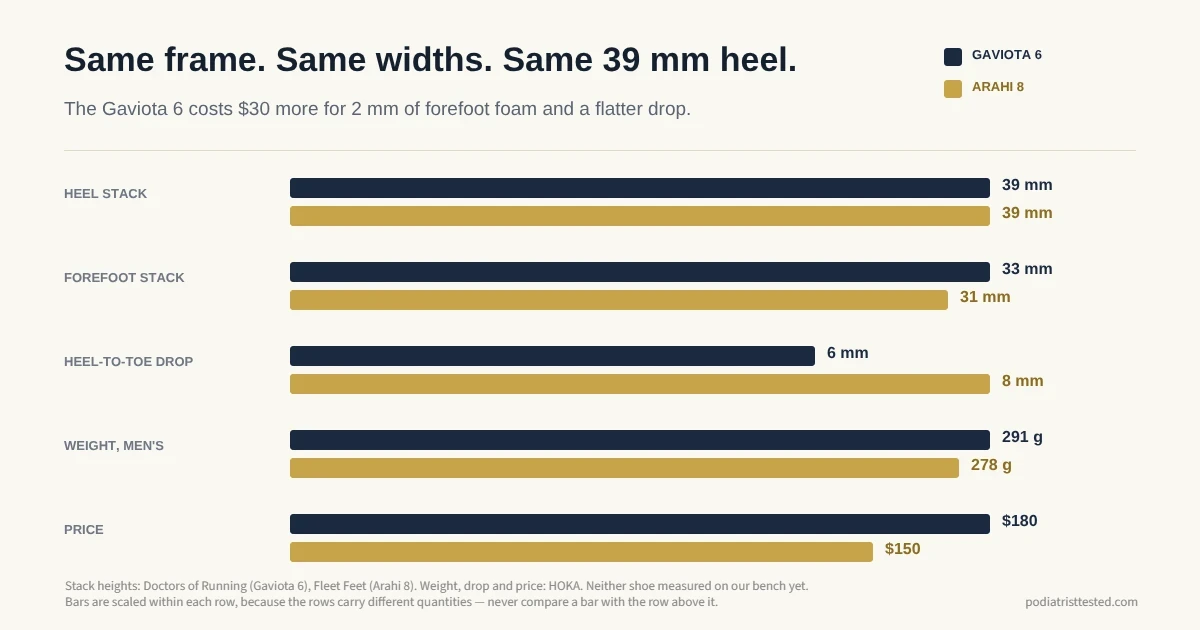
These are HOKA’s two stability shoes and they share more than they differ: the same Enhanced H-Frame, the same three widths, and a heel that measures 39 mm on both. The Gaviota 6 costs $30 more and buys you 2 mm more forefoot and a softer, more level ride. The Arahi 8 is 13 g lighter in men’s, 26 g lighter in women’s, and is the one HOKA actually lists as APMA-accepted.
We earn a commission if you buy through links on this page, including Amazon links paid by brand partners through Levanta, at no cost to you. As an Amazon Associate I earn from qualifying purchases. How we make money
On this page
Neither shoe has been under our caliper, so neither is scored and neither carries our seal. Every figure below is HOKA’s, a named third party’s or an independent lab’s, labelled. What our testing tiers mean →
The short answer
Take the Arahi 8 unless you need a wider base or a roomier toe box. It is lighter, $30 cheaper, and carries the APMA Seal of Acceptance that HOKA does not claim for the Gaviota, and in the lab it absorbed more impact at the heel. It is the sensible default for someone who overpronates and wants a stability shoe for daily walking or running.
Take the Gaviota 6 if you are heavier, your heel rolls in hard, your forefoot is broad, or you have found the Arahi too firm. In the lab it had the widest heel base of the 35 shoes we review (105.6 against 96.3 mm), a firmer heel counter (4 of 5 against 3), softer foam and a roomier toe box, on a flatter drop (7.3 against 11.3 mm). It is barely thicker under the ball of the foot (0.6 mm), but for forefoot pain its lower drop, softer foam and extra room still make it the better of the two.
Specifications, side by side
| Specification | Gaviota 6 | Arahi 8 | What it means |
|---|---|---|---|
| Category brand | Maximum-cushion stability | Everyday stability | Same job, different amount of shoe |
| Support system brand | Enhanced H-Frame, MetaRocker | Enhanced H-Frame | The same frame on different bases: a lab measured the Gaviota’s base 9.3 mm wider at the heel |
| List price brand | $180 | $150 | $30, for a wider base and a roomier toe box |
| Weight, men’s brand | 291 g / 10.25 oz | 278 g / 9.8 oz | 13 g on HOKA’s figures; a lab weighed 283 against 259 g |
| Weight, women’s brand | 244 g / 8.62 oz | 218 g / 7.7 oz | 26 g — a much bigger gap than the men’s |
| Heel stack 3rd party | 39 mm | 39 mm (men’s) | Not identical: a lab measured 36.0 against 39.4 mm |
| Forefoot stack 3rd party | 33 mm | 31 mm (men’s) | The 2 mm gap shrinks to 0.6 in the lab: 28.7 against 28.1 mm |
| Drop brand | 6 mm | 8 mm | The Gaviota is flatter; a lab measured 7.3 against 11.3 mm |
| Midsole brand | Compression-moulded EVA | Dual-density CMEVA | In the lab the Gaviota’s foam was the softer, 32.6 against 35.8 on the Asker C scale |
| Upper brand | Engineered mesh, ghillie lacing | Double jacquard mesh, largely recycled | Ghillie lacing lets you tune pressure over a bunion |
| Widths brand | Regular, Wide, X-Wide | Regular, Wide, X-Wide | Identical, both genders |
| APMA Seal brand | Not claimed | Yes | HOKA’s APMA page lists the Arahi, not the Gaviota |
Where the numbers are soft
HOKA does not publish stack heights for either shoe. The Gaviota’s 39/33 mm comes from Doctors of Running; the Arahi’s 39/31 mm comes from Fleet Feet. Two different measurers, two different shoes — so the 2 mm forefoot gap was suggestive, not settled, and a lab that measured both the same way has since shrunk it to 0.6 mm: 28.7 against 28.1 mm under the ball, with the Gaviota 3.4 mm lower at the heel. HOKA’s drop figures (6 and 8 mm) did not hold up either: the lab measured 7.3 and 11.3 mm.
Both brands quote weight without stating the size, which is the usual way a weight figure becomes unfalsifiable. Doctors of Running weighed the Gaviota at 10.0 oz in a size 9. We will publish our own measured stack, drop, internal toe-box width and depth, and an Orthotic Volume Rating for both when they go under our caliper; until then, the lab’s figures below are the best measured numbers there are.
What a lab found when it cut both in half
The figures above come from HOKA and two different third parties, measured on different pairs. RunRepeat’s lab bought one retail pair of each, cut them in half and measured both the same way, and three of the published figures do not survive it: the heels are not the same height, the Gaviota has barely any extra foam under the ball of the foot, and the drops are 4 mm apart, not 2.

| Measurement | Gaviota 6 | Arahi 8 | What it means |
|---|---|---|---|
| Heel stack | 36.0 mm | 39.4 mm | Not the same heel: the Arahi stands 3.4 mm taller |
| Forefoot stack | 28.7 mm | 28.1 mm | Within 0.6 mm under the ball of the foot |
| Heel-to-toe drop | 7.3 mm | 11.3 mm | 4 mm apart, not 2; both steeper than HOKA states |
| Heel shock absorption | 122 SA | 138 SA | The Arahi absorbed about 13% more at the heel (median 137) |
| Midsole softness, Asker C | 32.6 | 35.8 | Lower is softer: the Gaviota’s foam is the softer |
| Force to twist the midfoot | 17.7 Nm | 19.5 Nm | Both well above the median of 24 shoes, 14.5; the gap between them is small |
| Heel counter, 1 to 5 | 4 | 3 | The Gaviota holds the heel more firmly |
| Base width, heel / forefoot | 105.6 / 120.0 mm | 96.3 / 117.6 mm | The Gaviota’s heel base is the widest of the 35 shoes we review |
| Toe box, big toe / widest point | 76.7 / 97.2 mm | 73.6 / 95.3 mm | The Gaviota is roomier: fourth widest of 34 at the big toe, joint fourth at the widest point |
| Toe box height | 28.2 mm | 27.6 mm | A little more depth in the Gaviota |
| Weight, one shoe | 283 g | 259 g | 24 g apart; the Arahi is the seventh lightest of the 35 |
| Insole | 4.8 mm, removable | 4.5 mm, removable | Both lift out, the first condition for an orthotic |
The Gaviota is not an Arahi with more foam. It is a lower, wider, softer shoe with a firmer heel counter: its base is 9.3 mm wider at the heel than the Arahi’s, the widest of the 35 shoes we review that the lab has measured, and its toe box is among the roomiest. The Arahi is taller at the heel, steeper, lighter and absorbed more impact there; the two were about equally hard to twist.
What that means in clinic. A heel that rolls in hard, a heavier body or a broad forefoot is better served by the Gaviota’s base, heel counter and toe box. Heel pain, a sore Achilles or a tight calf is better served by the Arahi’s steeper drop and extra heel cushioning. For a flat foot that collapses through the midfoot, both are among the harder shoes to twist, so fit decides it; the lab’s twist test of 22 shoes shows where they sit. One caution: HOKA’s Arahi 9, which replaces the 8, measured 11.8 Nm in the same test, so the 8’s resistance to twisting has not carried over (Arahi 8 vs 9).
RunRepeat lab, one retail pair of each, read 28 September 2026. SA is the lab’s heel shock-absorption unit; the twist figure is the torque to turn the shoe 10 degrees each way through the midfoot (its March 2026 method); base width is measured across the bottom of the midsole. Neither shoe has been on our own bench.
Which one a foot doctor hands you
Both shoes on this page are stability shoes, so the question here is how much shoe you want under a foot that already needs support. If what you are really deciding is support against sheer cushioning, that is a different comparison — HOKA Bondi vs Arahi.
The Arahi 8 makes sense when
- You overpronate and want the lighter, steeper of HOKA’s two stability shoes.
- You want the lighter shoe: 26 g lighter in women’s on HOKA’s figures, and 24 g lighter on the lab’s scale.
- The APMA Seal matters to you, or to whoever recommended the shoe.
- You are price-sensitive: it is the same support frame for $30 less.
- Your heel or Achilles is the problem: the lab measured the steeper drop (11.3 against 7.3 mm) and more impact absorbed at the heel.
The Gaviota 6 makes sense when
- You are heavier, or on concrete all day, and want the most planted base: 105.6 mm at the heel in the lab, the widest of the 35 shoes we review, against the Arahi’s 96.3.
- Your pain is under the ball of the foot rather than the arch or heel.
- You want the flatter drop: 7.3 mm in the lab, against 11.3.
- You need the ghillie lacing to take pressure off a bunion or a dorsal bump; the lab also measured its toe box 3.1 mm wider at the big toe.
Where to buy
Amazon affiliate links. We earn a commission at no extra cost to you; commissions never influence a ranking, a score or the seal. Price and availability change, so check the listing. Our independence policy.
HOKA Arahi 8 — MSRP $150. Lighter, cheaper, APMA-accepted.
HOKA Gaviota 6 — MSRP $180. Wider base, roomier toe box, flatter drop, ghillie lacing.
Our full analysis of each
Everyday stability. Every published figure with its source, including what HOKA leaves out.
Maximum-cushion stability. Includes the APMA listing check in full.
Common questions
Is the Gaviota more supportive than the Arahi?
Not simply. Both use HOKA’s Enhanced H-Frame, but a lab found they support differently: the Gaviota stands on a much wider heel base (105.6 against 96.3 mm, the widest of the 35 shoes we review) with a firmer heel counter (4 of 5 against 3), and the two were about equally hard to twist (19.5 and 17.7 Nm, both well above the 14.5 median). A heel that rolls in hard does better on the Gaviota’s base. If you need real correction, the answer is still an orthotic inside either shoe, not the more expensive model.
Which is better for plantar fasciitis?
Neither has been tested by us for it, so we will not rank them, but on the lab’s numbers we lean to the Arahi for heel pain: it absorbed more impact at the heel (138 against 122 SA) and measured the steeper drop (11.3 against 7.3 mm), which takes more strain off the fascia. Both come in three widths. See our plantar fasciitis guide for the shoes we have looked at for it.
Do orthotics fit in either?
Probably: HOKA does not say so, but the lab found both insoles removable, 4.8 mm thick in the Gaviota and 4.5 mm in the Arahi, and the Gaviota’s toe box is a little taller (28.2 against 27.6 mm), so it has slightly more room for a device. Both come in Wide and X-Wide, which is usually the bigger constraint. We will publish an Orthotic Volume Rating for both once they are measured.
Is the Gaviota worth $30 more?
On the lab’s numbers the $30 buys a much wider heel base, a firmer heel counter, softer foam and a roomier toe box, at the cost of 24 g, some heel cushioning and the APMA listing. It is not more foam: the lab measured it 3.4 mm lower at the heel and within 0.6 mm at the forefoot. For most people the Arahi is still the better buy; the Gaviota earns its price for a heavier walker, a heel that rolls in hard, a broad forefoot or forefoot pain.
Sources: HOKA product pages for both models (category, support system, weights, drop, midsole, outsole, upper, widths, price) and HOKA’s APMA page; Doctors of Running for Gaviota 6 stack heights and the size-9 weight; Fleet Feet for Arahi 8 stack heights; RunRepeat’s lab for every measured figure (one retail pair of each, read 28 September 2026). Last verified 28 September 2026.
Recently reviewed
Individual shoe pages state their evidence tier, published measurements and who should skip them.
Saucony Endorphin Speed 5
Spec AnalysisLight plated neutral trainer. Saucony publishes both stack heights and they match its 8 mm drop — not yet tested.
HOKA Mach 6
Spec AnalysisLower, firmer neutral HOKA. HOKA publishes a 5 mm drop and neither stack height — not yet tested.
ASICS Novablast 5
Spec AnalysisBouncy high-stack neutral. ASICS publishes an 8 mm drop and neither stack height — not yet tested.
Our funding and evidence policy
We earn affiliate commissions from qualifying purchases. Our policy is to assess published evidence and fit needs rather than rank products by commission rate. Current reviews are specification analyses; see our method for their limits.