
Best Shoes for Sesamoiditis 2026: Podiatrist-Approved Picks
Not yet bench-tested. This guide was written by Tom Biernacki, DPM, FACFAS from clinical experience and moved to Podiatrist Tested from the practice’s patient library. The products named here have not been measured or worn under the Podiatrist Tested standard, so no scores and no Seal appear on this page. Tested reviews replace these recommendations as they are published.
Any stack heights, drops, weights, heel-cup depths or other dimensions quoted on this page are manufacturer-published figures reproduced from the original guide, not Podiatrist Tested measurements.
Podiatrist Tested is reader-supported. Links to Amazon are affiliate links; commissions never influence a recommendation or a score. Read the independence policy.
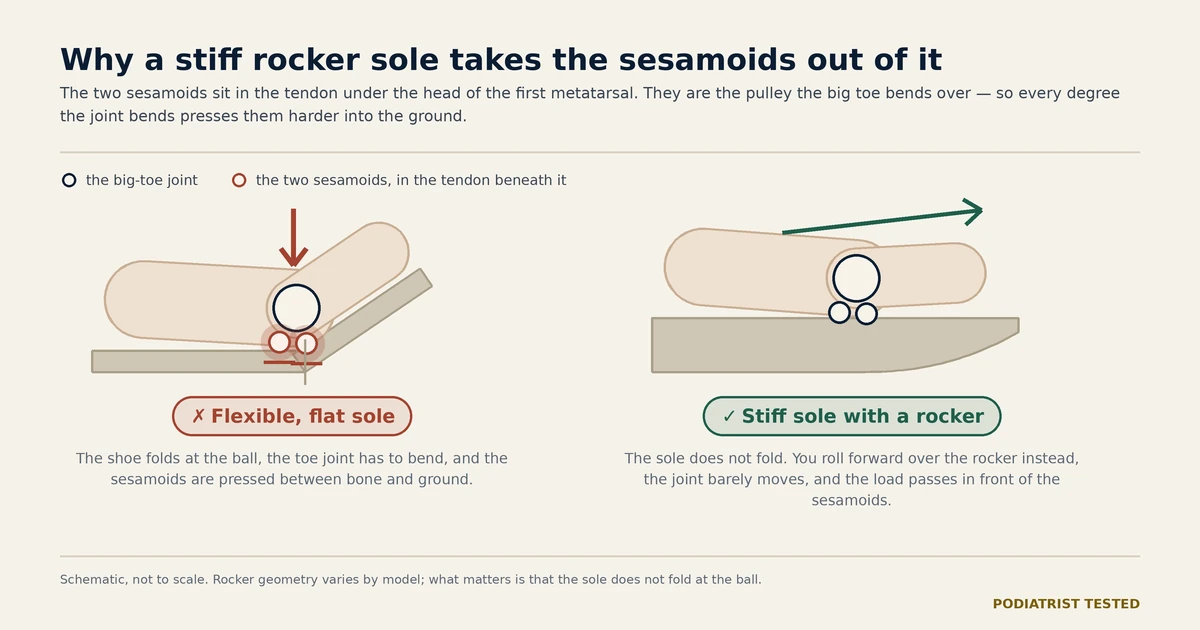
Quick answer: The best shoes for sesamoiditis have a stiff, rocker-bottom sole that offloads the inflamed sesamoid bones under the big toe, plus cushioning and a roomy toe box — Hoka and dedicated rocker-sole models work well, often with a sesamoid pad or cushioned insole. Avoid flexible, flat, or high-heeled shoes that load the ball of the foot.
The sesamoid bones are two small ossicles embedded within the flexor hallucis brevis tendon beneath the first metatarsal head. They function as a pulley system for the hallux and absorb significant compressive and shear forces during the propulsive phase of gait. When repetitively overloaded — particularly in dancers, runners, and patients wearing high heels — they develop inflammation (sesamoiditis) or frank fracture (sesamoid stress fracture). Getting the footwear right is the single most impactful intervention in sesamoiditis management.
What Is Sesamoiditis and What Causes It
Sesamoiditis refers to inflammation of the sesamoid bones and surrounding soft tissue — including the flexor hallucis brevis, sesamoid ligaments, and plantar plate. It is classified as a stress response or overuse injury, most commonly developing from a combination of repetitive loading, inadequate cushioning, and high forefoot pressure activities. The tibial sesamoid (medial) is affected 3× more frequently than the fibular sesamoid (lateral) due to its greater load-bearing role under the first metatarsal head.
Contributing factors include high-arch (cavus) foot posture that concentrates pressure under the first metatarsal head, hallux valgus (bunion) that alters sesamoid tracking, prolonged hard-surface activity in inadequate footwear, sudden increase in training volume (runners), and dancing en pointe or in high heels.

Shoe Criteria for Sesamoiditis
- Stiff rocker sole: The most critical feature. A rigid sole that pivots over a rocker point behind the first metatarsal head eliminates great toe dorsiflexion during push-off — the movement that maximally compresses the sesamoids. Without a rocker, every step re-loads the injured structures.
- Substantial forefoot cushioning: 20mm+ of EVA or polyurethane foam under the forefoot attenuates the impact forces transmitted to the sesamoids during heel-strike-to-toe-off transition.
- Wide toe box: Prevents hallux compression that would alter sesamoid tracking mechanics and worsen the inflammatory process.
- Removable insole: Required for accommodating a sesamoid offloading pad (a U-shaped or circular cutout under the first metatarsal head) and orthotic insole.
- Low heel-to-toe drop (4-8mm): Avoids the forefoot overloading that occurs with completely flat zero-drop shoes, while not creating the extreme forefoot pressure of high heels.
Top Shoes for Sesamoiditis — Podiatrist Picks
Best Overall: The Hoka Bondi
Hoka Bondi
If a patient walks in with sesamoid pain and wants one shoe to start with, this is the one I name. The Bondi is the rare shoe that satisfies every criterion above at once: a thick, genuinely stiff midsole that will not fold at the ball of the foot, a pronounced forefoot rocker that carries you through toe-off so the great toe never has to dorsiflex hard, a removable insole so a sesamoid pad or orthotic can go underneath your foot rather than on top of the shoe, and wide and extra-wide builds for the people who need them. Very little else in a mainstream shoe stacks all four together.
Two honest caveats. The stack height is tall, so if you have a history of ankle instability or you are older and unsteady on your feet, walk around in them before committing — a few patients tell me they feel like they are on stilts. And the Bondi is a neutral shoe. If you overpronate heavily, cushioning alone will not fully unload the sesamoid; either move to Hoka’s stability build or plan on pairing the shoe with the orthotic modification described in the next section. Model numbers turn over every year or two, so buy whichever Bondi is current rather than hunting down a specific version.
Best Running Shoe for Sesamoiditis
Before the pick, the prerequisite, which is the same answer given in the FAQ below: you should not be running through an actively painful sesamoid. That is how sesamoiditis turns into a sesamoid stress fracture. What follows is for returning to running once the pain has settled, or for the runner whose symptoms are mild and stable.
For daily mileage the Bondi again does the most work, and the lighter Hoka Clifton is the reasonable choice for anyone who finds the Bondi too heavy or too tall underfoot. But here is the recommendation that surprises people: a carbon-plated racing shoe is often kinder to an irritated sesamoid than a traditional cushioned trainer is. The plate makes the forefoot rigid and the geometry rolls you through toe-off instead of asking your great toe to bend — which is exactly the offloading a rocker sole is meant to provide, delivered more aggressively. Plated shoes are expensive, they wear out faster, and their narrow platform makes them a poor choice as your only pair, so treat this as a tool for your longer runs rather than as the whole solution. —
Best Walking and Work Shoe for Sesamoiditis
Most people with sesamoiditis are not runners. They are on their feet at work, and the shoe worn for nine hours matters far more than the one worn for a workout. The same rocker principle applies, but two things become more important. The first is the removable insole, because this is the shoe that will carry your offloading pad all day, every day, and that pad is doing as much of the work as the shoe is. The second is a wide, stable forefoot platform — a walking shoe that is steady side to side lets you keep a normal stride instead of rolling to the outside of the foot to dodge the sore spot, which is how patients end up with peroneal tendon pain stacked on top of the original problem.
For nursing, retail, hospitality, and anything else spent on hard floors, a stiff-soled rocker clog and a maximally cushioned rocker walking shoe both work well. What does not work is the soft, flexible slip-on that feels wonderful the moment you try it on. Comfort in the store and offloading at hour eight are two different measurements, and only the second one is treating you.
How the Four Models Named Above Compare
The summary near the top of this article names the Hoka Bondi, the Brooks Ghost, the New Balance 1080, and the Asics Gel-Kayano. All four are excellent shoes, but they are not equally suited to this particular condition, and it is worth being precise about why.
Where to buy the four models compared here
- Hoka Bondi — Check price on AmazonAmazon affiliate link. We earn a commission at no extra cost to you; commissions never influence a score, a ranking or the seal. Price and availability change, so check the listing.· Read our spec review
- Brooks Ghost — Check price on AmazonAmazon affiliate link. We earn a commission at no extra cost to you; commissions never influence a score, a ranking or the seal. Price and availability change, so check the listing.· Read our spec review
- New Balance 1080 — Check price on AmazonAmazon affiliate link. We earn a commission at no extra cost to you; commissions never influence a score, a ranking or the seal. Price and availability change, so check the listing.
- Asics Gel-Kayano — Check price on AmazonAmazon affiliate link. We earn a commission at no extra cost to you; commissions never influence a score, a ranking or the seal. Price and availability change, so check the listing.· Read our spec review
Prices change; check the current listing. As an Amazon Associate we earn from qualifying purchases.
The Bondi is the truest rocker of the four and the first choice for sesamoid pain. The New Balance 1080 is the sensible alternative — softer underfoot with a milder rocker, and the better pick if the Bondi feels too firm or sits too tall for you. The Brooks Ghost and the Asics Gel-Kayano are outstanding general trainers, but both are built to flex at the ball of the foot, and that flex is the exact motion identified in the criteria above as the one that compresses the sesamoids. That does not disqualify them. It means they are the right choice only if your symptoms are mild, or if you pair them with a full-length rigid insole or a Morton’s extension that restores the stiffness the shoe itself does not have.
One test settles most of this in the store and it takes five seconds. Hold the shoe by the heel and the toe and try to fold it in half. If it bends easily at the ball of the foot, it will let your sesamoids take the load with every step no matter how soft the cushioning feels. If it resists and pivots instead of folding, it is doing its job. Bring your orthotic or your sesamoid pad with you and fit the shoe with it already inside, and shop late in the day when your feet are at their largest.
Orthotic and Padding Protocol for Sesamoiditis
The shoe provides the structural offloading environment, but an orthotic modification is essential for maximum sesamoid pressure relief. This combination of rocker-sole shoe plus sesamoid-accommodating orthotic can reduce first metatarsal head plantar pressure by 40-60% compared to unmodified footwear.
Worst Shoes for Sesamoiditis
These shoe types maximally load the sesamoid complex and should be completely avoided during sesamoiditis recovery.
- High heels (any height): Shift 75% of body weight onto the forefoot, creating extreme sesamoid compression with every step. Even a 1-inch heel significantly increases first metatarsal head plantar pressure.
- Flexible-soled shoes and flats: Any shoe that bends at the ball of the foot forces active great toe dorsiflexion — the exact motion that compresses the sesamoids. The sole must be stiff enough to resist bending.
- Minimalist and zero-drop shoes: Maximize barefoot-like loading of the forefoot with no cushioning attenuation. Contraindicated for all sesamoid conditions.
- Dance shoes and pointe shoes: The primary occupational footwear cause of sesamoiditis in dancers. Temporary reduction in pointe work is typically required for recovery.
Best Shoes for Sesamoiditis for Women
Sesamoiditis walks into my office in women’s shoes far more often than men’s, and the reason has almost nothing to do with anatomy. It is geometry. Two things about the way women’s footwear is built — heel height, and a forefoot that tapers to a point — load the sesamoid bones directly, and both are fixable without giving up shoes you can actually wear in public.
Heel Height Is the Single Biggest Factor
The section above already puts high heels at the top of the list of shoes to avoid. Here is why that is not negotiable with this particular diagnosis. Your sesamoids sit directly underneath the head of the first metatarsal, and a raised heel does two things to them at once: it tips your body weight forward onto the forefoot, and it holds the big toe joint in an extended position while that weight arrives. More load, delivered in exactly the position that presses the sesamoids up into the bone above them. That combination is why patients so often tell me the pain started during a season of weddings, conferences, or long shifts in dress shoes rather than after any injury they can name.
During a flare, the honest answer is that the heels come off. If a specific event genuinely cannot be missed, treat it as damage control rather than permission: pick the lowest, broadest heel you own rather than a stiletto, put a ball-of-foot cushion under the first joint — the padding section above covers the type I hand out — carry a flat pair to change into, sit down whenever you reasonably can, and expect a sore day or two afterward.
One caution about the transition itself. If you have worn a heel most days for years, your calf and Achilles have shortened to match, and going completely flat overnight pulls you forward onto the forefoot rather than off it — the opposite of what you were trying to achieve. Come down in stages over several weeks, and stretch the calf daily while you do it. Patients who step down gradually almost always tolerate the change; the ones who go flat on a Monday are usually blaming the new shoes by Friday.
Low Drop Is Good, Zero-Drop Is Not
This is the part of the guide that confuses people most, so it is worth stating plainly. The criteria section above asks for a low heel-to-toe drop, and the list of shoes to avoid names zero-drop and minimalist shoes as contraindicated. Both are correct, and what reconciles them is whatever sits under the ball of your foot.
Drop is only the height difference between the heel and the forefoot of a shoe. It tells you nothing about how much material is under the forefoot or whether the sole bends. A cushioned trainer with a moderate drop, a thick forefoot, and a stiff rocker gives you the benefit you actually want — you are not pitched onto your toes — while still keeping real material between the sesamoids and the pavement. A minimalist zero-drop shoe reaches its low number by taking material away from the heel and the forefoot both, and it is usually built to flex freely at the ball of the foot, which is the exact motion the criteria section identifies as the one that compresses the sesamoids most.
So judge the forefoot first and the drop number second. How thick is it, and does it bend? Only after those two answers does the drop figure mean anything at all.
Forefoot Width, Not Shoe Size
A wide toe box is one of the five criteria this guide is built on, and it is the one women’s footwear misses most often, because so many women’s lasts begin tapering toward a point well before the toes end. That taper matters more here than it would for most foot problems. The sesamoids ride in two shallow grooves on the underside of the first metatarsal head and are held on track by the tendon they are embedded in. Push the big toe toward the second toe and the bone above them shifts off that track, so the sesamoids stop sitting squarely in their grooves and start taking load on an edge instead.
The practical correction is almost always the opposite of what people do: buy for width, not for length. Going up half a size in a shoe that tapers gets you a longer shoe with the same squeeze across the ball of the foot, plus a heel that now slips. Most of the models named above are built in women’s D and 2E widths, and moving from a standard B to a D is frequently the entire fix.
Two checks that take ten seconds in the store. First, judge width standing up, not sitting down — the forefoot spreads noticeably under body weight, and a shoe that feels fine seated can be tight the moment you stand. Second, pull the removable insole out and stand on it on the floor: if the ball of your foot spills over the edges, the shoe is too narrow, whatever the number on the box says. That same test tells you whether there is room to add an offloading pad later.
Work and Dress Shoes You Can Actually Wear
Very few women can wear a max-cushion trainer to work, and pretending otherwise is how footwear advice gets ignored. The requirements do not change, but they can be met by shoes that still look like work shoes: a rigid sole that does not fold, a rounded or almond toe rather than a point, enough depth to take an insole, and a flat or very low, broad heel rather than a taper. During an active flare, keep it flat; a low block heel is a reasonable compromise once symptoms have settled and you are back to normal activity. A stiff-soled loafer, a supportive ankle boot on a broad heel, or a professional-looking clog with a rocker all clear that bar.
Ballet flats and soft fashion sneakers do not, and it is worth understanding why they fail even though they are flat: with nothing structural under the forefoot, they bend at precisely the point where the sole is supposed to resist bending. Use the five-second fold test described above on anything you are considering, dress shoes included. If it folds in half at the ball of the foot while you are standing in the store, it will let your sesamoids carry the load with every step you take in it — and that is equally true whether the shoe cost forty dollars or four hundred.
Red Flags — When Sesamoiditis Needs Immediate Evaluation
Sesamoiditis is usually a patient, unglamorous soft-tissue problem that responds to offloading. A handful of findings mean it is something else, and they are worth knowing so that you do not spend three months changing shoes for a problem that needed an X-ray in week one.
- Pain that wakes you at night or aches at rest: Inflamed soft tissue hurts when you load it and quiets down when you stop. Pain that persists while you are lying still points toward bone — a stress fracture, bone marrow edema, or avascular necrosis, where the small bone’s blood supply is compromised. All three change the treatment plan, and all three need imaging to find.
- A sudden sharp pain during push-off, followed by difficulty bearing weight: Sesamoiditis comes on gradually. A distinct moment of injury suggests an acute fracture rather than an overuse inflammation, and the two are managed very differently.
- No meaningful improvement after three to four weeks of strict offloading: A mild case should be trending better inside that window even if it is nowhere near finished. Flat progress after a genuine effort in the right shoe with the right pad is the point to stop guessing and get the foot imaged.
- Redness, warmth, and swelling over the ball of the foot, especially with fever or a break in the skin: Infection in the forefoot is uncommon, but it is treated urgently rather than conservatively, and it is not something to wait out.
- Numbness, tingling, or burning running into the great toe: That is a nerve pattern rather than a sesamoid pattern. It suggests either a different diagnosis or a second problem layered on top of this one.
- Increasing stiffness and a grinding sensation in the big toe joint itself: Sesamoid pain sits underneath the joint. Pain and stiffness in the joint line, with the toe losing its upward motion, is more suggestive of hallux rigidus — arthritis of the great toe joint — which is a different condition with a different footwear answer.
- Any pain at the first joint if you have diabetes or peripheral neuropathy: If you cannot reliably feel pressure, you cannot use pain as your guide to whether the offloading is working, and a pad placed slightly off can create a wound instead of preventing one. This group should be evaluated early rather than self-treating.
- Pain still present beyond six months of appropriate conservative care: That is the threshold at which the conversation changes and further options, including surgical ones, become reasonable to discuss.
None of this is a reason to panic. The large majority of sesamoid pain is exactly what it looks like and it gets better with time, the right shoe, and a pad. The point of the list is that a small number of presentations do not, and the cost of recognizing one of them early is far lower than the cost of discovering it in month four.
FAQ — Shoes for Sesamoiditis
How long does sesamoiditis take to heal with proper footwear? Mild sesamoiditis with a true stress response (no fracture) typically resolves in 6-12 weeks with strict activity modification, rocker-sole footwear, and sesamoid-offloading orthotics. Sesamoid stress fractures take 12-20 weeks and may require a period of immobilization in a CAM boot before transitioning to footwear management.
Can I run with sesamoiditis? Running on a sesamoiditis that is actively symptomatic will significantly prolong recovery. Low-impact cross-training (swimming, cycling) should replace running until pain-free weight-bearing is achieved in supportive footwear. Gradual return to running with sesamoid-offloading orthotics can begin once the foot tolerates 30+ minutes of walking without pain.
Is sesamoiditis the same as a sesamoid fracture? No — sesamoiditis is an inflammatory condition without structural fracture. A sesamoid fracture (stress fracture or acute fracture) requires X-ray or MRI confirmation and has a longer recovery timeline. The clinical distinction matters because fractures may require immobilization and, if healing fails, surgical excision. Dr. Biernacki takes weight-bearing X-rays at every sesamoid evaluation to make this critical distinction.
Sesamoiditis needs a stiff, rocker-soled shoe — a different prescription than most conditions. Compare what we recommend for every diagnosis in Dr. Tom’s podiatrist-recommended shoes hub.
Dr. Tom’s Sesamoiditis Shoe + Support Protocol
- PowerStep Pinnacle — Metatarsal dome position offloads the 1st ray. Most effective OTC insole for sesamoid pain with stiff-soled shoes.
- Foot Petals Tip Toes — For women in heels or dress shoes: Tip Toes ball-of-foot cushion specifically offloads 1st MTP joint.
What is sesamoiditis and what causes it?
Sesamoiditis is inflammation of the two pea-sized sesamoid bones embedded in the flexor tendons beneath the first metatarsal head (big toe joint). The sesamoids act as a pulley for the flexor hallucis brevis, absorbing significant load with every push-off. Causes include high-impact activity (running, dancing, jumping), high-arched feet that concentrate load under the first ray, thin-soled footwear, and sudden activity increases. It’s most common in runners and dancers in their 20s–40s.
What does sesamoiditis feel like?
A dull to sharp ache directly under the big toe joint — specifically at the ball of the foot, not at the toe knuckle. Pain worsens with push-off, going up on tiptoe, and wearing heels. Walking downstairs or on uneven ground is often uncomfortable. Unlike Morton’s neuroma, there’s no radiating pain into the toes. Unlike plantar fasciitis, the pain is not worst with first morning steps — it builds with activity and improves with rest.
How long does sesamoiditis take to heal?
Mild cases: 4–8 weeks with proper offloading. Moderate cases: 3–4 months. Severe sesamoiditis with bone edema on MRI: 4–6 months, sometimes longer. Sesamoid fractures (which can occur alongside sesamoiditis) require a walking boot for 6–8 weeks and may need surgical removal if they don’t heal. The most important factor is consistent load reduction during the healing phase — patients who continue high-impact activity through sesamoiditis triple their recovery time.
What is a dancer’s pad and does it help sesamoiditis?
A dancer’s pad (also called a J-pad or sesamoid offloading pad) is a felt or foam pad with a cutout beneath the sesamoid bones. It redirects load to the surrounding metatarsal head while leaving the painful area pressure-free. It’s one of the most effective short-term interventions for sesamoiditis — most patients report significant pain reduction within 1–2 weeks of correct placement. We fabricate these in-office. They’re more effective than standard metatarsal pads for first-ray pathology.
Do I need a walking boot for sesamoiditis?
Moderate-to-severe cases benefit significantly from a short period (2–4 weeks) in a walking boot to completely offload the sesamoids. If pain is present with normal walking or the MRI shows bone edema (stress reaction), a boot is typically recommended. Mild cases can often be managed with a dancer’s pad alone. A boot is not an admission that surgery is coming — it’s an aggressive conservative treatment to reset the inflammation and give the bone a chance to recover. Two to four weeks is a starting estimate rather than a finish line, and what should decide the boot comes off is whether the sesamoid stays quiet when it is pressed and loaded directly. Coming out early is the most common reason a case that should have settled keeps flaring.
What are the best insoles for sesamoiditis?
Insoles with a first-ray cutout or dancers’ modification are most effective — standard arch support doesn’t help sesamoiditis because the problem is under the first metatarsal, not the arch. Custom orthotics with a first-ray cutout are the gold standard; quality OTC options include the Powerstep Pinnacle with added padding modified to offload the first ray.
Can sesamoiditis lead to surgery?
In fewer than 10% of cases. Surgery (sesamoidectomy — removal of the affected sesamoid) is considered after 6–12 months of failed conservative management, or when there’s a displaced fracture that won’t heal. Results are generally good — 80–85% of patients return to full activity. However, removing the tibial (medial) sesamoid can cause hallux valgus (bunion) as a complication, so indications are carefully considered. We exhaust all conservative options before recommending sesamoidectomy.
Can I run with sesamoiditis?
Running through active sesamoiditis risks stress fracture and significantly delays recovery. During the acute phase (pain >3/10 with walking), rest from impact completely. Swimming and cycling are excellent alternatives. As symptoms improve, a gradual return begins — short runs on soft surfaces with a dancer’s pad, increasing distance by no more than 10% weekly. Full return to unrestricted running typically takes 3–6 months. Runners who skip the rest phase reliably end up in a boot for 3 months instead.
Is a sesamoid stress fracture the same as sesamoiditis?
No — but they coexist frequently and present identically. Sesamoiditis is soft tissue inflammation; a stress fracture is an actual crack in the bone from repetitive overload. X-ray often can’t distinguish them from a bipartite sesamoid (a naturally two-part bone present in 10–30% of people). MRI is the definitive diagnostic tool — bone marrow edema on MRI confirms stress reaction or fracture. This distinction matters because stress fractures require more aggressive rest and longer protection.
What shoes should I wear for sesamoiditis?
Stiff-soled shoes that minimize first MTP joint flexion are most protective — a stiff rocker-bottom sole prevents the push-off motion that loads the sesamoids. Hoka Bondi and similar maximally cushioned rocker designs are excellent. Avoid flexible, thin-soled shoes entirely. Heels of any height are contraindicated because they increase forefoot load. For daily use, a stiff-soled casual shoe with an added dancer’s pad provides good protection.
Podiatrist Pairing — Best Insole for This Shoe Category
Sesamoiditis responds to a stiff-sole shoe paired with a metatarsal-pad insole that offloads the sesamoid bones. The combination is more effective than either intervention alone. Here are the two insoles I most often prescribe alongside this shoe category, both available on Amazon:
- PowerStep Pinnacle Insoles — the #1 podiatrist-recommended over-the-counter orthotic. Full-length with built-in arch support and a deep heel cradle. Fits inside most shoes after removing the stock insole.
- Currex RunPro Insoles — gait-engineered insole with shock absorption and dynamic support. Three arch profiles (low / med / high) so it matches your actual foot.
Sure it is sesamoiditis? Pain right under the big-toe joint can be sesamoiditis, but a sudden, pinpoint ache after stepping on something hard may instead be a stone bruise, which is managed a bit differently.
Recently reviewed
Individual shoe pages state their evidence tier, published measurements and who should skip them.
Dansko XP 2.0
Spec AnalysisOccupational clog with a removable dual-density footbed and slip-resistant outsole — not yet tested.
Orthofeet Coral
Spec AnalysisExtra depth, published quarter-inch removable insole, four widths A–2E, 15.7 mm drop — not yet tested.
Skechers GO WALK Arch Fit 2.0
Spec AnalysisRemovable Arch Fit insole, hands-free entry, APMA Seal on some styles — not yet tested.
Measured, worn, scored — never sponsored
No brand has ever paid for a review, a score, a ranking or the seal. Where we earn a commission the link says so, and the score does not change.