
Best Shoes for Plantar Fasciitis for Women: A Foot Surgeon’s Guide (2026)
The mechanics of plantar fasciitis are the same in everyone, and the four shoe features that reduce load on the fascia are covered in the main guide: best shoes for plantar fasciitis. This page is about the things that are specifically different for women — which, in clinic, is most of what actually decides whether the problem resolves.
Written and medically reviewed by Dr. Tom Biernacki, DPM, FACFAS · Last reviewed 24 September 2026
We earn a commission if you buy through links on this page, including Amazon links paid by brand partners through Levanta, at no cost to you. As an Amazon Associate I earn from qualifying purchases. How we make money
On this page
- The short answer
- 1. A women’s shoe is a different shape, not a scaled-down men’s
- 2. Your feet may have permanently changed
- 3. The dress-code problem
- 4. Heels, and what they did to your calf
- What to wear, by situation
- The shoes we would shortlist for women with plantar fasciitis
- Who should get this looked at rather than shopping
- Frequently asked questions
- What we are testing next
- Related guides & reviews
Testing status: the categories named here meet the clinical criteria described below but have not yet completed our measurement protocol, so nothing carries a score or the seal — see How We Test.
The short answer
Four differences matter: the last is a different shape, not a smaller one; feet commonly change permanently after pregnancy; dress codes push women into the worst footwear at exactly the wrong time; and a long history of heels changes what your calf will tolerate. Solve those and the standard advice starts working.
1. A women’s shoe is a different shape, not a scaled-down men’s
Women’s lasts are generally narrower at the heel relative to the forefoot. That single fact produces the most common fitting failure I see: the shoe fits the forefoot and slips at the heel, so the wearer sizes down, and now the forefoot is cramped and the heel still slips because the shoe is the wrong shape rather than the wrong size.
If a shoe fits your forefoot but your heel lifts, lace-lock the top eyelet before you consider a smaller size. And if your forefoot spreads over the edge of the midsole when you stand up, you need a wider fitting, not a longer shoe — which is where brands with a real width matrix earn their place (New Balance for women).
2. Your feet may have permanently changed
Ligamentous laxity in pregnancy lets the arch flatten, and for many women that change does not reverse — the foot ends up longer, wider, or both. Arch height also drops gradually with age.
The clinical consequence is that a large number of women with heel pain are wearing a size that was correct fifteen years ago, in a width that never was. Before changing anything else, be measured standing, both feet, late in the day. It is free and it resolves a surprising share of cases.
3. The dress-code problem
This is the difference that matters most and gets discussed least. The advice “wear a supportive shoe” is easy to give and impossible to follow if your workplace requires something else. A supportive shoe you are not allowed to wear helps nobody.
What actually works:
- Look for a leather walking shoe with a real heel counter rather than a dress flat. There are genuinely supportive shoes that read as smart — the Brooks Addiction Walker is the standard example (Brooks walking shoes).
- Change for the commute. Two hours a day of walking in the right shoe is worth more than eight hours of standing in the wrong one, and it is usually the easiest concession to win.
- Avoid the ballet flat. It is the worst common option: no heel counter, no torsional rigidity, no cushioning, and a sole that folds in half. It is functionally barefoot with a hard interface.
- A slim orthotic can rescue a mediocre shoe — but only if the shoe has the depth. Check the footbed lifts out before you buy.
4. Heels, and what they did to your calf
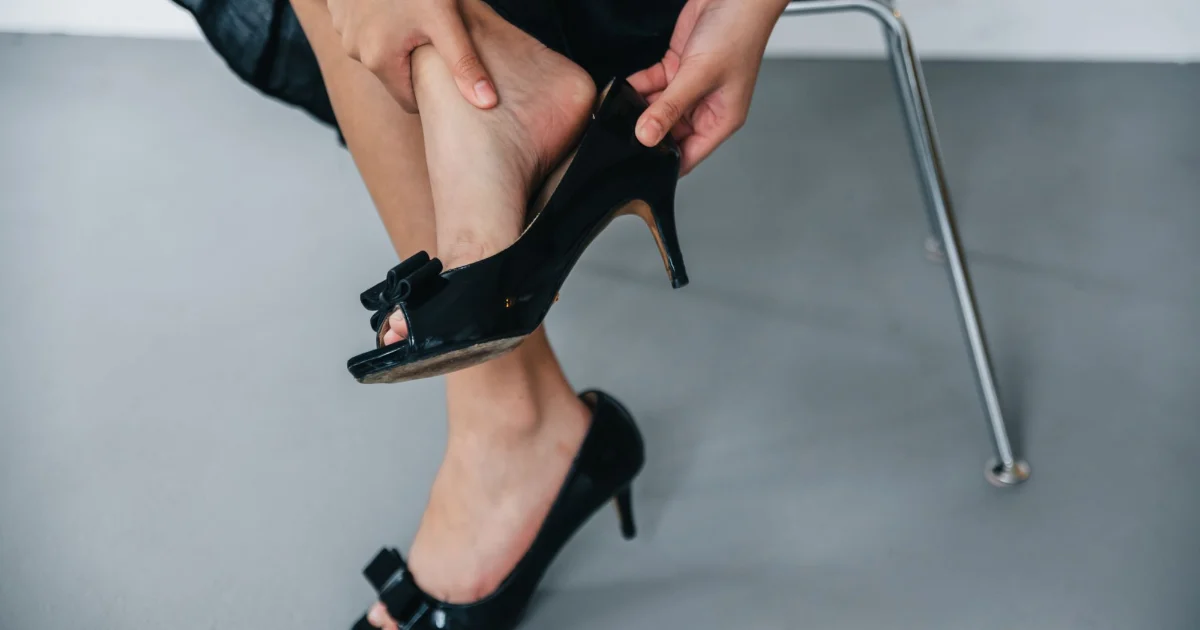
Years in a raised heel leave the calf and Achilles adapted to a shortened position. Then a flat shoe suddenly demands the ankle range that adaptation removed, the midfoot supplies it instead, and the fascia takes the load. This is why some women get worse when they dutifully switch to completely flat shoes.
Two practical points. A modest heel — an inch or so — is often better tolerated in the short term than absolutely flat, and there is nothing wrong with using that while things settle. And calf stretching, both straight-knee and bent-knee, does more for this than any shoe: it is the single highest-value thing on this page and it costs nothing.
It is also why zero-drop shoes are the wrong first move for someone with a long heel history and an angry fascia.
What to wear, by situation
Work and standing
A stability or well-cushioned neutral shoe with a firm heel counter, in the correct width. See work shoes for women and, for healthcare, best shoes for nurses.
If the heel still hurts in a shoe that fits, add a prefabricated insole with a firm shell and a deep heel cup before changing shoes again. The PowerStep Pinnacle is the one we reach for most.
At home
The most under-treated part of the day. Barefoot on tile or hardwood undoes a lot of what the work shoe achieved, and morning heel pain is often generated here. A supportive house shoe or a contoured slide is the fix — this is where built-in-support brands genuinely earn their place (Vionic).
The contoured slide most often suggested for this is the OOFOS OOahh.
Summer
Sandals are the classic August relapse. Look for a contoured footbed with a deep heel cup and a secured heel, not a flat slide with a toe post.
Exercise
Cushioned neutral or stability depending on how your foot behaves, and replace them on age rather than appearance — foam softens long before the upper looks worn.
The shoes we would shortlist for women with plantar fasciitis
Six shoes to start from, all taken from our main plantar fasciitis guide. Each has its own review page, but none has been through our bench yet, so there are no scores here: the heel drops and widths are what each maker publishes. A higher drop is the easier starting point for an acutely sore heel, which is why the list runs from 10 mm down to 6 mm.
Women’s shortlist
- On your feet all day: KURU ATOM 2The highest stated heel drop in our table, 10 mm, with a firm heel cup, built for standing. The heaviest shoe on this list. Women’s widths B, D and 2E.Women’s — check price at KURU
- Stability in a light shoe: ASICS GT-2000 15Geometry-guided stability at an 8 mm stated drop, and the lightest shoe in our table. Women’s widths 2A, B and D.Women’s — check price
- Stability with a rocker: HOKA Arahi 8H-Frame stability at an 8 mm stated drop, with a rocker at push-off. Regular, Wide and X-Wide.Women’s — check price
- The most cushion: ASICS Gel-Nimbus 28Maximum cushion that still keeps an 8 mm stated drop. Women’s widths 2A, B and D.Women’s — check price
- The most support: New Balance 860v15Plated stability at an 8 mm stated drop, and the heaviest running shoe in our table. Women’s widths 2A, B, D and 2E.Women’s — check price
- Neutral, in four widths: New Balance 880v15A tall neutral shoe in 2A, B, D and 2E. Its 6 mm stated drop asks more of the fascia than the shoes above, so it suits a wide foot better than an acutely sore heel.Women’s — check price
Paid links: we earn a commission at no extra cost to you, and it never changes what is listed. Weight and price for every shoe are in the main guide’s table.
Who should get this looked at rather than shopping
- Heel pain that has not improved after six to eight weeks of sensible footwear and daily calf stretching.
- Pain that is worse after rest and at night, rather than worst on the first steps of the morning.
- Numbness, tingling or burning rather than sharp focal heel pain — that suggests a nerve, not the fascia (tarsal tunnel).
- Sudden pain with a pop, bruising, or an inability to weight-bear.
- An arch that has visibly flattened on one side only, with aching behind the inner ankle bone.
Frequently asked questions
What shoes do podiatrists recommend for women with plantar fasciitis?
A shoe with real heel cushioning, a heel counter that does not collapse when squeezed, torsional rigidity through the midfoot, and — the part usually missed — the correct width. Brand matters far less than those four things plus fit.
Can I still wear heels with plantar fasciitis?
A modest heel is often better tolerated than completely flat, particularly if you have worn heels for years. The problem is height, narrow toe boxes and long exposure, not the concept. Change out of them for commuting and standing.
Are ballet flats bad for plantar fasciitis?
They are the worst common option — no support, no counter, no cushioning, and a sole that folds. If the dress code demands something flat, look for a supportive leather walking shoe instead.
Why did my feet change after pregnancy?
Ligament laxity allows the arch to flatten, and for many women the change is permanent. Get re-measured rather than assuming your old size still applies.
Do I need women’s specific shoes?
Usually, because the last shape differs at the heel — but the more important variable is width. A men’s or unisex shoe in the right width sometimes fits a wider foot better than a women’s model in the wrong one.
How long until it gets better?
Most cases settle over weeks to months with consistent footwear, calf stretching and reduced barefoot time. If there is no change at all after six to eight weeks of genuinely doing those things, have it examined.
What we are testing next
Women’s models are measured on the same protocol as men’s, and the figure we expect to be most useful is internal toe-box width at the widest point — because “wide” is a letter, not a measurement, and it is not consistent between models. Scorecards publish at Reviews.
Reviews for Plantar Fasciitis
Individual shoe pages state their evidence tier, published measurements and who should skip them.
Dansko XP 2.0
Spec AnalysisOccupational clog with a removable dual-density footbed and slip-resistant outsole — not yet tested.
Orthofeet Coral
Spec AnalysisExtra depth, published quarter-inch removable insole, widths A to 4E depending on colour, 15.7 mm drop — not yet tested.
Skechers GO WALK Arch Fit 2.0
Spec AnalysisRemovable Arch Fit insole, hands-free entry, APMA Seal on some styles — not yet tested.
Our funding and evidence policy
We earn affiliate commissions from qualifying purchases. Our policy is to assess published evidence and fit needs rather than rank products by commission rate. Current reviews are specification analyses; see our method for their limits.