
Best Brooks Shoes for Plantar Fasciitis: Eight Models on the Measured Numbers
On this page
- The short answer
- Why Brooks keeps coming up for heel pain
- The Brooks models, compared on the numbers that matter
- The Adrenaline GTS changed, and not in your favour
- The printed drop is not the real drop
- Model by model: who each one is for
- When Brooks is the wrong brand for your heel
- The 30-second test before you buy any of them
- Shoes are one part of the treatment
- What the evidence supports, and where it stops
- Where to buy
- Frequently asked questions
- Related guides and reviews
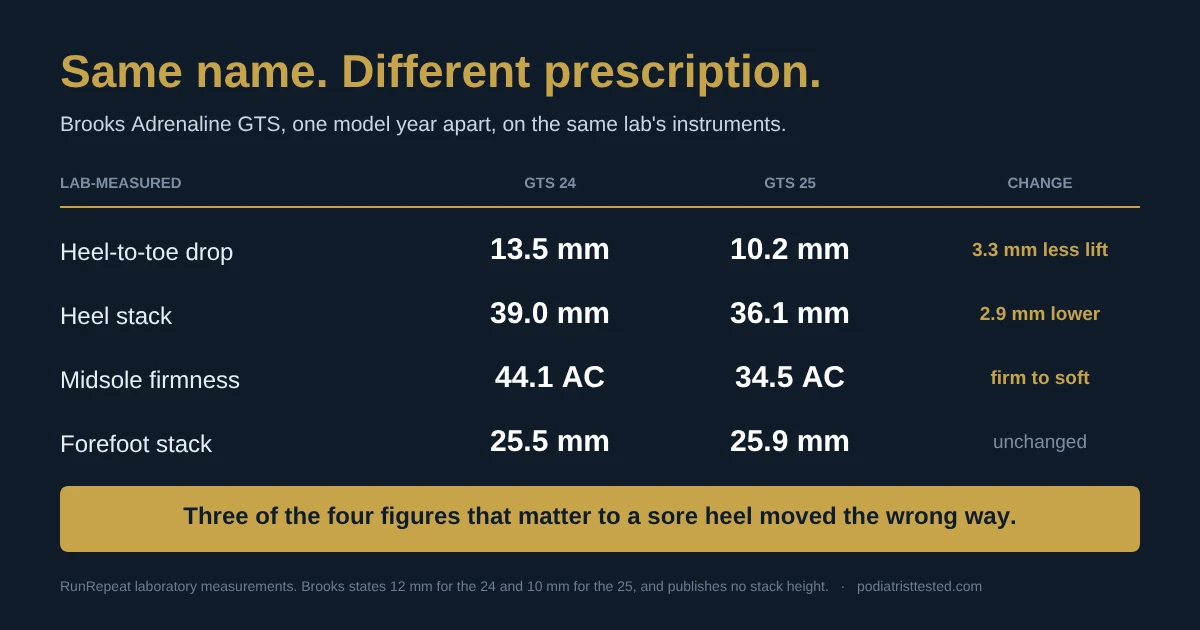
Most pages that answer this question tell you the Adrenaline GTS is the Brooks for plantar fasciitis. Here is what the numbers say: the Adrenaline got measurably less suited to heel pain between the 24 and the 25. On an independent lab’s instruments the drop fell from 13.5 mm to 10.2 mm and the midsole went from 44.1 Asker C — firm — to 34.5, soft. Those are the two figures that matter most to a sore fascia, and both moved the wrong way. Brooks publishes no stack height for any of these eight shoes, so every height below came from a lab or a named retailer.
None of these eight has been under our own caliper, so none is scored and none carries our seal. Every figure is Brooks’, an independent lab’s, or a named retailer’s, labelled where it sits. What our testing tiers mean →
The short answer
If you want the most heel lift and the firmest midfoot, it is the Adrenaline GTS 24 — 13.5 mm of lab-measured drop and a 44.1 Asker C midsole, the highest and the firmest in the whole Brooks range on file. It is also the cheapest of the trainers at $140 and it is being cleared out, because the 25 replaced it.
If you want the most heel control, it is the Ghost 18 — heel-counter stiffness 5 of 5 on the lab’s scale, the only shoe here that scores full marks. It is a neutral trainer, which surprises people, and it is stiffer at the heel than the motion-control walking shoe in this list.
If you wear a prescribed orthotic, it is the Beast GTS 26 or the Ghost Max 4 — the two Brooks state in writing are built to take one, in men’s D/2E/4E and women’s B/D/2E, and the Beast GTS 26 carries the APMA Seal of Acceptance by name.
Why Brooks keeps coming up for heel pain
Two reasons, one good and one accidental.
The good one: Brooks builds high-drop shoes and confirms in writing that the insole lifts out. Drop — the height difference between heel and forefoot — sits between 8 and 13.5 mm across this range, which is high for 2026, when much of the market has drifted to 4–6 mm. A higher heel takes some of the tensile demand off the calf and, through the calcaneus, off the plantar fascia. And a removable footbed is the difference between a shoe your orthotic fits into and a shoe it does not.
The accidental one: the Adrenaline GTS has been the default recommendation in running shops for fifteen years, so it inherits the question whether or not it is still the right answer. As the lab figures below show, the shoe under that name has changed.
The Brooks models, compared on the numbers that matter
Four columns decide a plantar fasciitis purchase: how much heel lift, how stiff the heel counter, how firm the midsole, and whether the insole comes out. Here are all eight.
| Shoe | Heel-to-toe drop | Heel counter | Midsole firmness | Insole out | Price |
|---|---|---|---|---|---|
| Adrenaline GTS 24 | 13.5 mm lab Brooks states 12 | Not measured | 44.1 AC — firmest here | Yes | $140 |
| Addiction Walker 2 | 12.2 mm lab Brooks publishes none | 3 / 5 | 48.7 AC | Not stated | $140 |
| Beast GTS 26 | 12 mm Brooks | Not measured | Not measured | Stated to accept orthotics | $170 |
| Ghost 18 | 10 mm Brooks | 5 / 5 — stiffest here | Not measured | Yes | $149.95 |
| Ghost 17 | 10.4 mm lab Brooks states 10 | Not measured | 36.2 AC | Yes | $150 |
| Adrenaline GTS 25 | 10.2 mm lab Brooks states 10 | 4 / 5 | 34.5 AC — soft | Yes | $155 |
| Glycerin 23 | 8.2 mm lab Brooks states 8 | 4 / 5 | 29.2 AC — softest here | Yes, 4.4 mm | $175 |
| Ghost Max 4 | 6 mm Running Warehouse; Brooks publishes none | Not measured | Not measured | Stated to accept orthotics | $165 |
Sorted by drop, highest first. Lab figures are RunRepeat’s instrumented measurements as recorded in each shoe’s review on this site; Asker C is a durometer scale where a higher number is firmer. Brooks publishes no stack height for any of these eight, so every height quoted anywhere on this page came from a lab or a named retailer. Blank cells mean nobody we trust has published that figure — we do not estimate.
The Adrenaline GTS changed, and not in your favour
This is the finding that should change what you buy, so it gets its own table. Same shoe, same name, one model year apart, both measured on the same lab’s instruments.
| Lab-measured figure | Adrenaline GTS 24 | Adrenaline GTS 25 | What it means for a sore heel |
|---|---|---|---|
| Heel-to-toe drop | 13.5 mm | 10.2 mm | 3.3 mm less heel lift |
| Heel stack | 39.0 mm | 36.1 mm | Nearly 3 mm lower under the heel |
| Midsole firmness | 44.1 Asker C | 34.5 Asker C | Firm became soft — a softer midsole lets the arch sink further |
| Forefoot stack | 25.5 mm | 25.9 mm | Essentially unchanged |
| Toe-box height | 25.4 mm | 26.6 mm | Slightly roomier over the toes |
Both sets of figures: RunRepeat laboratory, as recorded in our GTS 24 and GTS 25 reviews. Brooks states 12 mm for the 24 and 10 mm for the 25, and publishes no stack height for either.
Read that as a prescription change rather than a refresh. The 25 is a softer, flatter shoe wearing the badge of a firmer, higher one. If what you wanted from an Adrenaline was heel lift and a midfoot that holds, the 24 is the shoe you wanted, and it is thirty-five dollars cheaper and disappearing from shelves.
The printed drop is not the real drop
Every shoe here where both numbers exist shows the same pattern: the lab measures more drop than Brooks prints.
- Adrenaline GTS 24 — Brooks states 12 mm, the lab measured 13.5 mm. A 1.5 mm gap.
- Ghost 17 — Brooks states 10 mm, the lab measured 10.4 mm.
- Adrenaline GTS 25 — Brooks states 10 mm, the lab measured 10.2 mm.
- Glycerin 23 — Brooks states 8 mm, the lab measured 8.2 mm.
- Addiction Walker 2 — Brooks publishes no drop at all; the lab measured 12.2 mm.
The gaps are small and they run one way, which is what you would expect from measuring a compressed insole in place rather than a bare last. It matters for one decision only: if you have been told to stay above 8 mm of drop, a shoe printed at 8 is genuinely at 8 or a little over, not a little under. That is a better record than most of this industry manages.
Model by model: who each one is for
Adrenaline GTS 24 — the most heel lift
The highest-drop and firmest mainstream trainer on this site, in four widths, with a removable insole and GuideRails. If a clinician told you to get into a higher-drop supportive shoe, this is the one that measures the part. Buy it while it is still stocked.
Ghost 18 — the most heel control
Full marks for heel-counter stiffness, which is the figure that decides how much your calcaneus moves inside the shoe. Neutral, four widths, insole lifts out. The narrowest toe box of the Brooks trainers here, so not the pick if you have a bunion.
Beast GTS 26 — for the orthotic wearer
Brooks states in writing that it is designed to accommodate orthotic inserts, and the Beast GTS 26 and Ariel GTS 26 are both named on APMA’s Brooks listing. High drop, high volume, motion control. Heavy at 12.5 oz, which is the price of the platform.
Addiction Walker 2 — for walking, not running
The firmest midsole and the most torsionally rigid shoe on file — it barely twists, which is exactly what a collapsing midfoot needs. Leather, four widths, 14.5 oz. Note the heel counter is only 3 of 5, softer than the Ghost 18, which is not what the motion-control label leads you to expect.
Ghost Max 4 — for a stiff, painful forefoot
The lowest drop here, so not a first choice for fascia pain on drop alone. But the rocker and the maximal stack suit hallux rigidus and metatarsalgia, and Brooks states the roomy fit accommodates orthotics. Pick it for a forefoot problem, not a heel one.
Glycerin 23 — the softest, and the caveat
The softest midsole on file at 29.2 Asker C and the widest toe box of the Brooks trainers. Lovely under a bruised heel pad. But softest also means the arch sinks furthest, and the lowest drop of the trainers, so it is the least obvious Brooks for a fascia that is already under tension.
When Brooks is the wrong brand for your heel
- You need a width beyond 4E. Brooks stops at extra wide. New Balance publishes a 6E on selected models — see Brooks vs New Balance and the extra-wide list.
- You want to compare stack heights before you buy. Brooks publishes none, and states in writing that it does not give exact dimensions for its footwear. If that matters to you, buy from a brand that prints them.
- Your pain is under the ball, not the heel. Drop is the wrong lever; you want a rocker. Start at shoes for ball-of-foot pain.
- You need a narrow fitting and a firm heel. Brooks offers narrow, but only 14 of the 43 shoes on this site come in one at all — see the narrow list and how to tell which you are.
The 30-second test before you buy any of them
- Squeeze the heel counter between finger and thumb. It should barely give. The Ghost 18 is the benchmark here at 5 of 5.
- Twist the shoe like wringing out a cloth. A shoe for a collapsing midfoot should resist; the Addiction Walker 2 is the benchmark at 5 of 5.
- Bend it. It should hinge across the ball, where your toes hinge — not in the middle of the arch.
- Pull the insole out. If it does not lift cleanly, your orthotic is not going in, and no amount of foam compensates.
Shoes are one part of the treatment
Plantar fasciitis responds best to a combination: load management, calf and fascia stretching, a supportive shoe worn from the first step out of bed, and in stubborn cases a custom or well-chosen prefabricated orthotic. Footwear alone rarely settles it, and no shoe on this page is a substitute for the stretching. What footwear does is stop the fascia being re-provoked between sessions, which is why the insole-out question matters more than any foam.
What the evidence supports, and where it stops
The mechanical reasoning behind a higher drop is sound — raising the heel shortens the effective length of the gastrocnemius-soleus-Achilles-fascia chain, and tension in that chain is what irritates the fascia at its calcaneal insertion. What the literature does not support is a specific drop number as a treatment threshold, or any claim that one model of shoe resolves plantar fasciitis. Trials consistently find the strongest effects for stretching protocols and orthoses, with footwear as a supporting variable. Treat the figures on this page as a way to choose sensibly between shoes, not as a dose.
Where to buy
Disclosure: the links below are paid links. If you buy through them Amazon pays us a commission at no cost to you. Commissions never influence a score, a ranking or the seal, and nothing on this page is scored because none of these shoes has been tested by us — see our independence policy.
Frequently asked questions
Which Brooks shoe is best for plantar fasciitis?
On measured figures, the Adrenaline GTS 24 for heel lift and midfoot firmness, the Ghost 18 for heel control, and the Beast GTS 26 if you wear an orthotic. There is no single answer, because those three shoes solve three different mechanical problems and plantar fasciitis arrives with different ones in different feet.
Are Brooks good for plantar fasciitis?
As a range, they are a reasonable place to look, for two concrete reasons: the drops run high for the current market, 8 to 13.5 mm across this list, and Brooks confirms the insole is removable on the trainers, so an orthotic goes in. The main thing Brooks does badly is publish dimensions — it states plainly that it does not give exact measurements for its footwear, so you cannot compare stack heights before buying.
Is the Ghost or the Adrenaline better for plantar fasciitis?
The Ghost 18 has the stiffer heel counter, 5 of 5 against the Adrenaline GTS 25’s 4 of 5. The Adrenaline GTS 24 has the higher drop, 13.5 mm against the Ghost 18’s stated 10. Between the two current shoes the Ghost 18 controls the heel better; between all four, the GTS 24 gives the most heel lift. GuideRails on the Adrenaline matter if you also overpronate.
Is the Glycerin good for plantar fasciitis?
It is the softest and one of the widest in the toe box, which feels wonderful on a bruised heel pad, but it has the lowest drop of the Brooks trainers at a lab-measured 8.2 mm and the softest midsole at 29.2 Asker C. Soft foam lets the arch sink further, which is the opposite of what a tensioned fascia wants. Choose it for comfort under a fat-pad problem, not for fascia tension.
Do I need the wide version?
Only if you are actually wide, and width is a measurement, not a feeling — our guide to wide feet versus narrow feet shows how to check. One caution specific to Brooks: the brand states that narrow, medium and wide versions of the same model are built on the same footbed, and that the difference is the volume of upper material, with extra-wide as the exception. So a Brooks wide gives you more room over the foot, not a broader platform under it.
How long should a pair last with plantar fasciitis?
Brooks publishes no lifespan figure, so anyone quoting you a mileage for these shoes is estimating. What is measurable is the midsole durometer, and foam softens with use — which means a shoe that started at 44.1 Asker C has more room to soften before it stops supporting you than one that started at 29.2. If your morning heel pain returns after months of being settled, the shoes are the first thing to check.
Related guides and reviews
- Best shoes for plantar fasciitis — the full guide, all brands.
- Best HOKA shoes for plantar fasciitis and best Saucony — the same analysis, other brands.
- Best insoles for plantar fasciitis — because the insole matters more than the shoe.
- Adrenaline GTS 24 · GTS 25 · Ghost 18 · Ghost 17 · Glycerin 23 · Beast GTS 26 · Ghost Max 4 · Addiction Walker 2
- Brooks vs New Balance — when the width range decides it.
- Shoe spec database — every published number on this site, and who published it.
Reviews for Plantar Fasciitis
Individual shoe pages state their evidence tier, published measurements and who should skip them.
Dansko XP 2.0
Spec AnalysisOccupational clog with a removable dual-density footbed and slip-resistant outsole — not yet tested.
Orthofeet Coral
Spec AnalysisExtra depth, published quarter-inch removable insole, four widths A–2E, 15.7 mm drop — not yet tested.
Skechers GO WALK Arch Fit 2.0
Spec AnalysisRemovable Arch Fit insole, hands-free entry, APMA Seal on some styles — not yet tested.
Measured, worn, scored — never sponsored
No brand has ever paid for a review, a score, a ranking or the seal. Where we earn a commission the link says so, and the score does not change.